
LIBS vs XRF: comparing handheld scrap analyzers
A side-by-side breakdown of LIBS and XRF handheld analyzers — accuracy, cost, speed, and best use cases for scrap metal recycling
What is XRF technology?
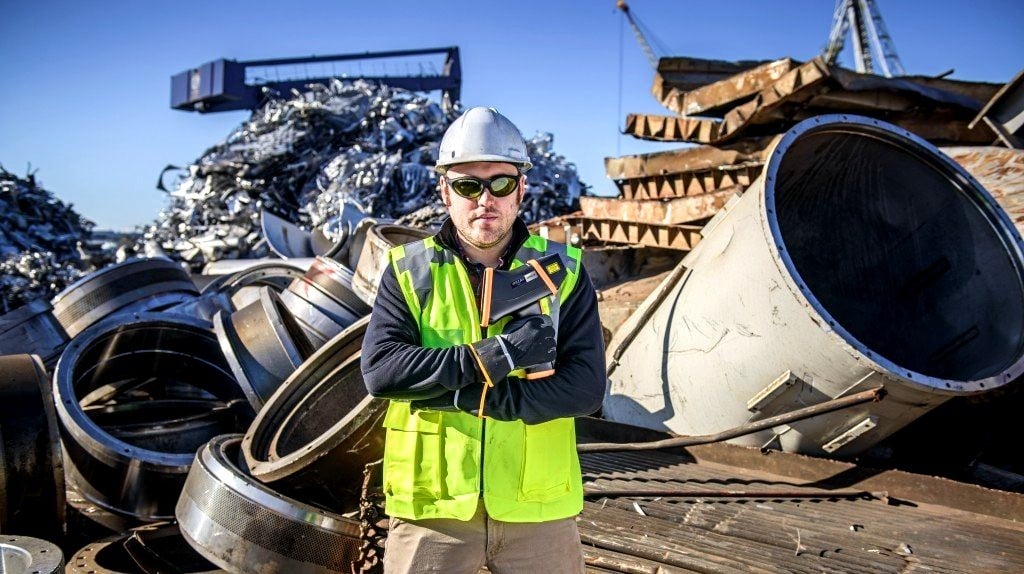
X-ray fluorescence (XRF) is a non-destructive analytical technique used to determine the elemental composition of materials.
For scrap metal recyclers who require precise identification of metals and alloys, XRF-based handheld analyzers have been the industry standard for material verification for decades.
Benefits of handheld XRF analyzers
Handheld XRF analyzers are widely regarded as the best option for stainless steel, heavy metals, plastics sorting, and e-waste applications. Key benefits include:
- Highest accuracy for heavy metals — the preferred method for stainless steel, nickel, and precious metals, where elemental precision directly affects scrap trading value
- Broadest material range — effectively measures ferrous metals, aluminum, copper, stainless steel, nickel, and gold karats in a single device
- Built for high-volume yards — fast enough for 100% material checking, reducing sorter fatigue and increasing throughput
What is LIBS technology?
Laser-induced breakdown spectroscopy (LIBS) is an analytical technique that uses a short-pulse, low-energy laser to perform surface analysis through laser ablation, with no radiation concerns.
LIBS adoption has grown significantly in metal recycling, particularly for aluminum and other non-ferrous metals.
Benefits of handheld LIBS analyzers
- Enhanced light element detection — outperforms XRF on aluminum alloys, magnesium, and titanium grades where light element differentiation is critical
- Faster turnaround — returns results in as few as 10 seconds, better suited for rapid sorting workflows
- No radiation — eliminates X-ray safety compliance requirements, ideal for confined spaces or sites with access restrictions
- Near non-destructive sampling — ablates only a minimal surface area, leaving material essentially intact
What is the difference between XRF and LIBS?
The core distinction: XRF uses X-ray radiation to identify metal and alloy content; LIBS uses a low-energy laser and optical technology for radiation-free analysis.
For light element sorting — particularly aluminum alloys, magnesium, and titanium grades — LIBS is the stronger performer. When precision, accuracy, and price-point verification matter (positive material identification, quality control, scrap trading of nickel and molybdenum), XRF remains the method of choice.
XRF vs. LIBS: which handheld analyzer should scrap recyclers choose?
The answer depends on your application:
- XRF if your operation focuses on stainless steel, heavy metals, precious metals, PMI, or requires the highest elemental accuracy for trading purposes.
- LIBS if your primary material stream is aluminum, non-ferrous light metals, or if radiation-free operation is a priority.
Both technologies now offer smart connectivity to data analysis platforms, and modern handheld devices are designed to be lightweight, rugged, and ergonomic for demanding yard environments.
Bruker: A tale of two technologies
Bruker, a leading U.S.-based manufacturer of both XRF and LIBS handheld analyzers, describes XRF technology on their company website as a completely non-destructive process whereby electrons are displaced from their atomic orbital positions, releasing a burst of energy that is characteristic of a specific element. This release of energy is then registered by a silicon detector in the XRF handheld instrument, which in turn categorizes the energies by element.
With LIBS analyzers, Bruker's site describes the concept as follows: "With LIBS, a laser pulse strikes the surface of the sample and ablates an amount of material and generates a plasma plume (partially ionized gas). The energy of the laser is low, but is focused to a microscopic point on the sample to generate the plasma. In this plasma, emitted light is transmitted through optical fibres and the polychromatic radiation is dispersed in one or more spectrometers and detected by CCD chips." (CCD is an acronym for "charge coupled device", an image sensor technology that converts light into electrical charges, as used in most digital cameras.)
Bruker: S1 TITAN (XRF)
The S1 TITAN Handheld XRF Spectrometer is among the lightest tube-based handheld XRF analyzers on the market today, according to its manufacturer Bruker, at 1.5 kg, including battery. Fast analysis speed and exceptional accuracy are two key attributes that help define the S1 TITAN. Other innovative features include an integrated touch-screen colour display, 50 kV X-ray tube, SMART Grade timing, SharpBeam optimized X-ray geometry, Silicon Drift Detector (SDD), and an extremely tough housing that is sealed against humid and dusty environments.
The S1 TITAN series is available in five configurations: models 800, 600, 500, 300 and 200. All models use Bruker's SharpBeam technology. The S1 TITAN 800 and 600 use a large area CUBE SDD detector to provide incredibly fast analysis times, while the S1 TITAN 500 is configured with a fast, accurate, and affordable standard SDD detector. The S1 TITAN 200 and 300 are configured with an economical Si-PIN detector. In addition, the S1 TITAN can be configured with calibrations that are optimized for a variety of sample materials, including a wide range of alloys, a variety of mining and environmental samples, as well as restricted materials.
Bruker: EOS 500 - Handheld (LIBS)
Bruker's new EOS 500 is a handheld Laser Induced Breakdown Spectroscopy (HH-LIBS) system. The EOS 500 is based on laser excitation of a metal sample followed by quantitative analysis of the light generated in the plume. This technology provides quick (3 to 5 seconds) analysis of alloys including aluminum, titanium and magnesium.
The EOS is especially well suited to scrap sorting of these alloys because of its quick and user-friendly operation. In addition to common elements detectable with XRF analyzers, the EOS is capable of measuring very light elements such as Li, Be and B, as well as laser-fast analysis of Mg, Al and Si.
TSI's ChemLite LIBS analyzer provides high accuracy and speed for light metals
Todd Hardwick is the global marketing manager for TSI Incorporated, a company focused on the manufacture of LIBS handheld analyzers."XRF cannot compete with LIBS when it comes to speed, ease of operation and cost of ownership," says Hardwick. "Our ChemLite LIBS analyzers precisely identify metals in one to two seconds, much faster than with XRF." Hardwick says that because there are no radiation concerns and their units use an eye-safe Class 1M pulsed laser, ChemLite "gun" owners avoid regulatory hassles - such as radiation licensing and the paperwork that comes with it.
"LIBS requires no special training or storage and ChemLite LIBS guns do not need argon gas to operate," he continues. "When you add up the extra time, fees, training and supplies that XRF requires, the cost of ownership is often lower for LIBS."
Hardwick does add though that LIBS is not a viable option for plastics recycling or e-waste applications according to their experience, whereas XRF technology is a viable tool for use in these applications.
TSI: ChemLite Plus (LIBS)
ChemLite Plus is TSI's newest handheld LIBS metals analyzer. Units are designed to be accurate and fast, with 1 to 2 second readings and eye-safe, Class 1M lasers. Because there's no radiation, there are no regulation requirements, and compared to XRF units, ChemLite is easy and safe for any operator. Additionally, ChemLite analyzers have the largest laser spot size available, and a built-in cleaning mode.
ChemLite guns identify Al, Mg, Ti, Fe, Ni, and Cu alloys, and are able to separate close Al alloys that XRF cannot. TSI LIBS analyzers can also detect tramp elements, like Li and Be, down to 1 ppm and can measure Be copper alloys.
Olympus LIBS analyzer aims to enhance existing XRF technology
According to Ted Shields, portable products manager, analytical instruments division, Olympus Scientific Solutions Americas, LIBS is best viewed as a complimentary machine to more traditional handheld XRF, and each type of machine does certain things well.
"The most intriguing thing about LIBS is the ability to measure elements that you cannot measure with XRF," says Shields. "Carbon, beryllium and lithium are all possible, and recent advances are making carbon in L-grades achievable for some LIBS analyzers."
He says however that LIBS analyzers struggle with some elements that XRF excels at. Notably, he says, these include refractory metals, such as Cr, Zr, Mo, Ta and other common and commercially important alloying elements. "LIBS has a much smaller spot size than XRF," continues Shields. "This is good in the sense that the burn mark left behind is small. But it makes it much harder to get the same answer when you test twice in a row. This is because the sample varies across the small scale of the LIBS spot."
Olympus: VANTA (XRF)
The Vanta analyzer is Olympus' most advanced handheld X-ray fluorescence (XRF) device and provides rapid, accurate element analysis and alloy identification to laboratory-quality results in the field. Units are military-standard drop tested, IP64 or IP65 rated, and designed with a large, gesture-capable touch screen, wireless communication, access to the Olympus Scientific Cloud, and direct PDF creation. They are also designed to be easy to use with minimal training, and to provide high throughput.
The latest Vanta VMR model analyzers' come with a graphene detector window making them even more sensitive for magnesium, aluminum and silicon. Units provide very fast grade identification and are combined with Axon technology for high x-ray count. Other key features include: SmartSort and Grade Match Messaging; IMX processor; a metal detector shutter; intuitive navigation and configurable software.
Hitachi High-Technologies' calibration options suit various recycling applications
Hitachi High-Technologies: X-MET8000 (XRF)
Hitachi High-Tech's latest handheld XRF analyzer, the X-MET8000, is typically used in metal recycling and scrap yards when accurate on-site alloy identification and chemistry are required.
"The optimized combination of a high performance X-ray tube and large area silicon-drift detector (SDD) delivers the results required in even the most demanding metals applications," says McKernan. "The X-MET8000 is used for analysis of light elements (Mg to S) and most commercial alloys, including aluminum, titanium, bronze and high temperature alloys. The low limits of detection provide accurate grading and determination of impurities and penalty elements."
McKernan adds that unlike Hitachi-High Tech's LIBS model (Vulcan), its X-MET8000 HH-XRF analyzer is available with calibration options that suit various recycling applications. The X-MET8000's plastic FP calibration, for example, is optimized for the determination of a wide range of elements (Cl, Cd, Hg, Pb and many others). "In instances where separation of chlorinated from non-chlorinated plastics is required, The X-MET8000 can be used to ensure that materials such as PVC are not incinerated, preventing damage to the incinerator's masonry as well as the release of harmful dioxins into the atmosphere," explains McKernan.
Hitachi High-Technologies: Vulcan (LIBS)
For Hitachi High-Tech's latest LIBS analyzer (the Vulcan) speed is the biggest asset to scrap metal recyclers as this maximizes their operational efficiency during metal sorting. According to Sean McKernan of Non-Destructive Testing (NDT) Products, an Ontario-based distributor for Hitachi High-Technologies analyzers; "by employing point and shoot operation, Hitachi High-Tech's Vulcan LIBS technology, creates a simple, fast routine for recyclers which eliminates user related errors and ensures consistency of results.
SciAps offers both LIBS and X-ray technologies
SciAps: Z-200 (LIBS)
The Z-200 LIBS model uses a laser pulse of 5-6 mJ/pulse, with a 50 Hz repetition rate. According to SciAps, it is the world's only handheld LIBS capable of carbon analysis, and the only handheld analyzer with integrated argon purge, allowing for operation in both air-based analysis for quick screening, or argon-purge for highly sensitive, precise measurements. The Z model is ideal for analysis of aluminum scrap, particularly where low concentrations of Li, Be and/or B are important, for upgrading stainless into low-carbon or straight grades, and for sorting carbon steels.
SciAps: X-250 (LIBS)
Complementing the LIBS model, SciAps' latest XRF model is the X-250, which provides quick analysis of stainless, high temperature- and red metals. The X-250 also excels in the analysis of aluminum alloys, in four seconds, including Al alloys that historically get mixed by other X-ray guns. Additionally, the X-250 offers leading performance on other light elements including S, P, Al and Si.
This is an updated article; an earlier version was published in the March 2018 edition of Recycling Product News, Volume 26, Number 2.
Company info

5465 East Cheryl Parkway
Madison, WI
US, 53711-5373
Website:
bruker.com
Phone number:
608-276-3000




2 Technology Park Dr., 2nd Floor
Westford, MA
US, 01886
Website:
hha.hitachi-hightech.com/en