
AI identifies, air ejects, and MRFs run with less manual QC
Cal-Waste’s upgrades show how operators can add automation without rebuilding from scratch
Existing material recovery facilities (MRFs) are modernizing and increasingly turning to automation, and new MRFs are being designed around it from the start. In both cases, the first targets are the manual positions at each end of the process: pre-sort and quality control (QC).
Automating pre-sort
Pre-sort is the most demanding and least predictable manual work in the plant. Sorters face the full inbound stream, including bulky items, film, hoses, and unsafe objects like sharps.
CP Group developed the CP Auger Screen to eliminate the traditional pre-sort. Its cantilevered steel augers fractionate material before manual sorting and release film and hoses off the end instead of wrapping.
As a primary screen, it diverts 60 percent or more of inbound material away from manual sorting while reducing the number of human sorters at the front end of the plant. It also improves efficiency in downstream sorting units, whether it's a mechanical screen, an AI unit, or an NIR machine.
Auger screens are a cornerstone of plant sorting performance. Sized, more uniform fractions reach downstream units at a lower burden depth, with fewer overlapping objects. The QC automation that follows depends on that presentation.
Automating QC with Vivid Air and Recycleye
On the container line, QC sorters clean up after the primary separation equipment. They pull contamination out of the PET, HDPE, and aluminum streams before baling, and on the last-chance line, they recover any missed containers.
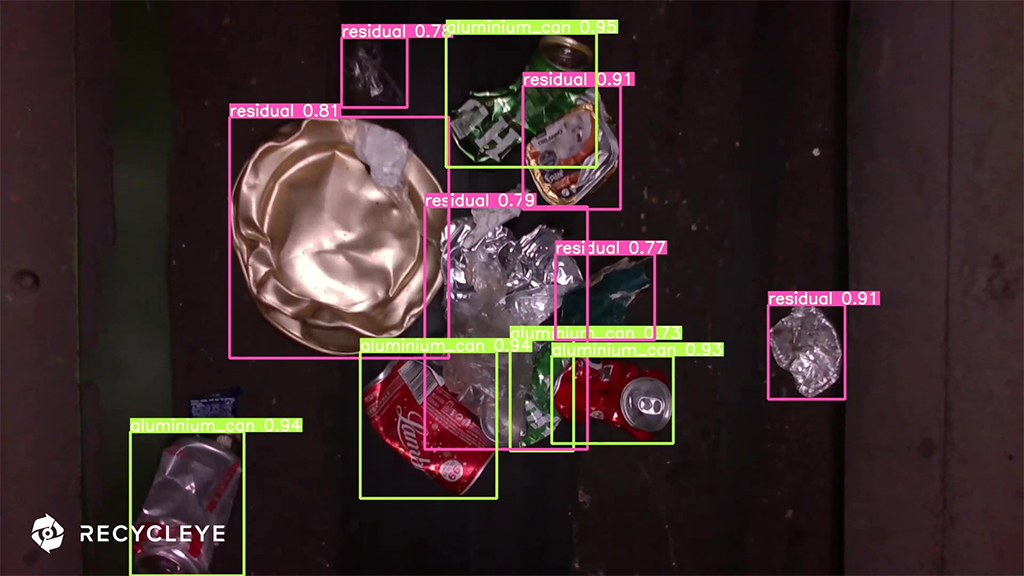
NIR sorting decisions depend on polymer. Many QC decisions depend on an object's form instead, and at many plants they have stayed manual. These are the sorting decisions AI vision is built to make.
But vision has to be paired with a way to remove what it finds. A robotic arm picks one object per cycle. Cycle rate and suction-cup seal cap its recovery, and material that arrives in surges can get missed. Air ejection doesn't have the one-object-per-cycle limit and allows higher throughput. A valve bank spans the belt and can eject several items side by side at once at high belt speeds.
Conventional NIR sorters have long used air, but NIR identifies polymers, not objects. It cannot separate a PET bottle from a PET thermoform, or non-ferrous items that shouldn't be with the UBC.
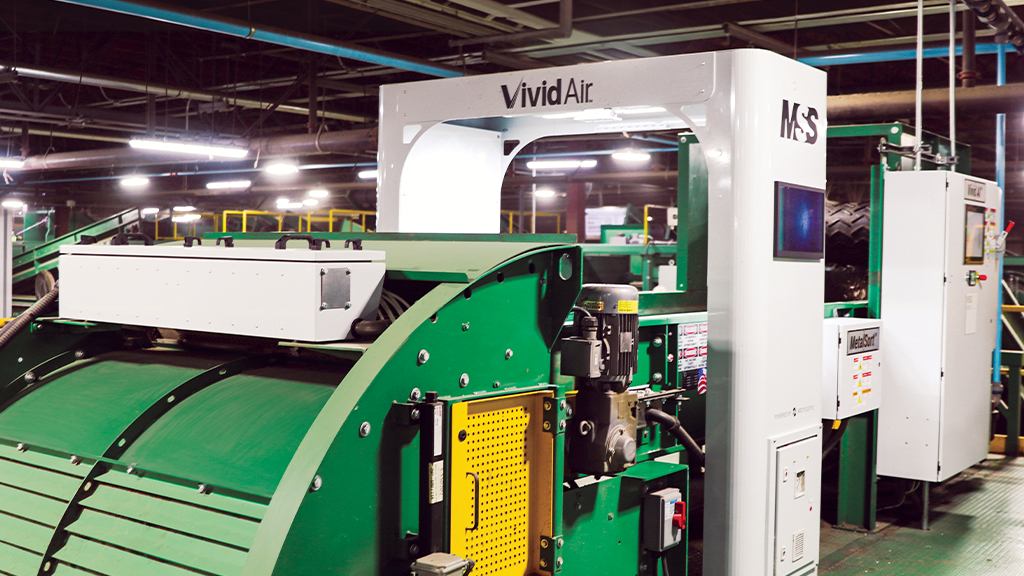
MSS and Recycleye introduced Vivid Air in 2023 as the first system to pair a standalone AI vision sensor with an air-ejection unit built for QC positions. Where an application suits a robotic picker, such as tight retrofits, Recycleye pairs vision with an arm instead.
Recycleye AI classifies objects by shape, colour, and texture — which lets it separate UBCs from non-UBC aluminum, thermoforms from bottles, and food-grade from non-food-grade packaging — while MSS air ejection removes the targets at high belt speeds.
In April 2026, CP Group announced its acquisition of a majority stake in Recycleye. MSS and Recycleye have completed more than 30 installations together in the U.S. and Europe. Recycleye, founded in London in 2019, maintains its leadership and engineering team. Its U.K. team also extends technical support coverage across time zones.
The Cal-Waste retrofits
Cal-Waste's MRF in Galt, California, has been at the forefront of implementing modern technology. CP Group rebuilt the majority of the system in 2019 and has supplied two major automation upgrades since. The most recent upgrade fully automated the container line with Vivid Air, which pairs Recycleye's AI vision with MSS air ejection.
The 2019 rebuild increased system capacity from 11 to approximately 30 tph. The equipment included a Primary Auger Screen, Glass Break Screens, a CPScreen, and an Anti-Wrap Screen, along with multiple MSS FiberMax and PlasticMax NIR optical sorters. In 2022, three MSS FiberMax optical sorters were added to automate fibre QC, improving brown and white fibre separation and recovering smaller fibre.
The container line came next, driven by workforce needs and regulatory requirements. In 2025, Cal-Waste installed four Vivid Air units to fully automate the container line: HDPE natural/colour separation, PET QC, aluminum QC, and last-chance container recovery. The last-chance unit sits at the end of the line and recovers any remaining containers.
Eight manual sort positions were removed from the container line, and two of those employees moved into maintenance and technical roles. Container recovery is now fully automated.
"If you're looking to increase recovery and optimize the existing headcount you have, I think it's the way to go," says Casey Vaccarezza, Director of Operations at Cal-Waste.
Sort targets on an AI unit are set in software, and the model can be retrained on new object classes. Cal-Waste can change what each unit targets as commodity values, accepted materials, and regulations shift. The facility expects that flexibility to matter as California's EPR requirements and end-market expectations become clearer.
Galt's sequence ran from rebuild to optical fibre QC to AI on containers. Each step built on the existing system. For operators weighing retrofit automation against a new build, it shows they can stage technology enhancements.
Data from the plant floor
The AI system also generates useful data. The camera counts and provides an average weight for each object it classifies, so every unit keeps a running composition record of the stream at its point in the plant. Operators can also use that record to fix issues upstream. That data becomes more relevant as EPR programs place greater emphasis on documented material flows.
That record is one of several data sources in the plant. NIR sorters record what material is made of as they sort it. AI vision records what each object is. Plant controls log equipment status, from conveyors and screens to motor loads. Joint development between CP Group, MSS, and Recycleye now centres on bringing those sources together, so operators can see how the whole system is performing rather than one machine at a time.
________________________________________________________________________________________
Ashley Davis is Director of Marketing and Communications at CP Group, a San Diego-based designer, manufacturer, and integrator of MRF systems. CP Group's companies include MSS and Recycleye.
This article originally appeared in the 2026 Recycling Technologies special issue of Recycling Product News.
Company info


300 Oceanside Drive
Nashville, TN
US, 37204
Website:
magsep.com
Phone number:
615-781-2669