
CP Group’s performance analysis system for MRFs harnesses in-field AI analyzers
POINT flags performance shifts and slowdowns in real-time while showing operators where material quality can improve
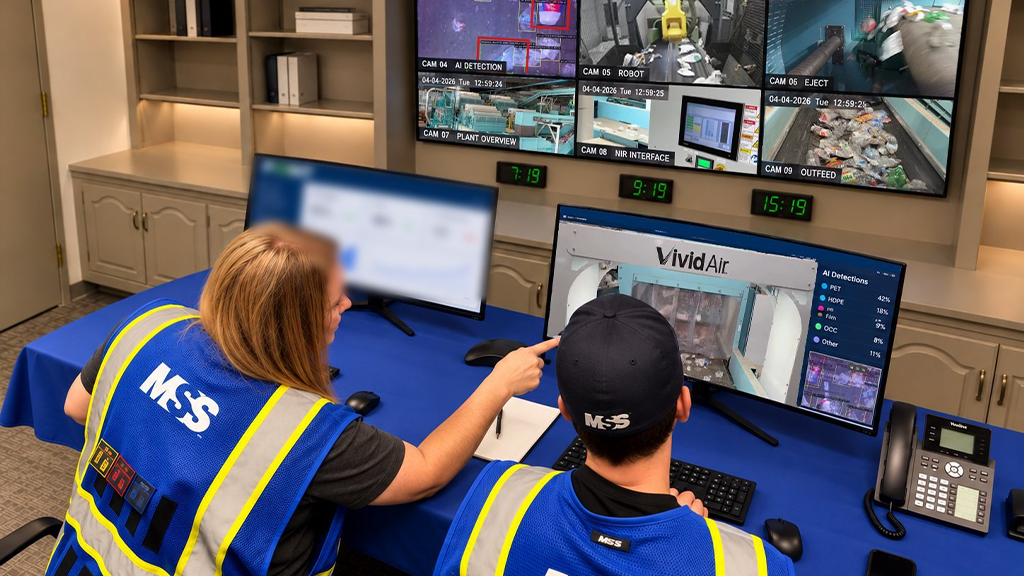
CP Group officially launched POINT Operator Intelligence, a platform for material recovery facilities that integrates two decades of plant controls innovation with modern AI-based insights and decision support.
How the POINT Operator Intelligence platform works
The platform analyzes commodities on the belt, system performance, and throughput, then alerts operators to act before quality or uptime is affected, and recommends adjustments that improve throughput and purity. POINT is under development, with early adopter installations beginning in the first quarter of 2027.
Operator Intelligence (OI) is CP Group's term for decision logic based on seasoned operators, encoded as trained scenarios and automatically evaluated against sensor data. CP Group will establish documented baselines for systems and equipment running as designed, giving operators performance benchmarks. Comparing live performance against that baseline also shows where a line can improve, so operators can raise throughput and purity and lower operating costs.
Optical sorting has paved the way for AI integration and advanced performance cues
As an OEM, CP Group designs, builds, and owns the complete technology platform: sort system equipment and design, near-infrared (NIR) optical sorters through its MSS division, AI vision developed in-house at Recycleye, and fully integrated plant controls. POINT draws data from each of those systems, plus a network of cameras through the facility. The NIR optical sorters are already characterizing material as they sort it, and the SCADA system carries historical equipment status and motor data. Depending on the controls and equipment package, data is processed on site in a motor control centre or in the cloud.
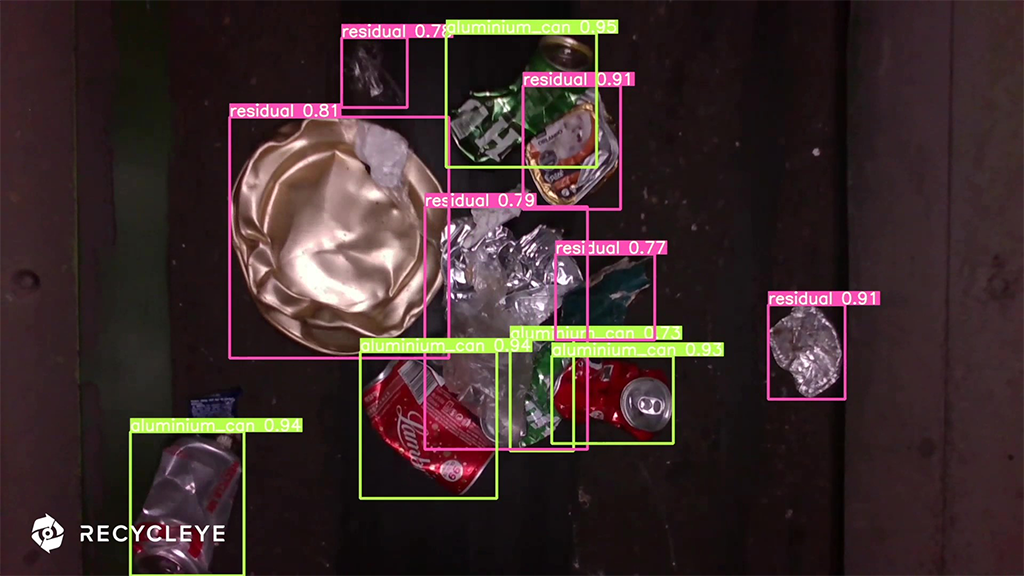
Among those sources, Vivid Vision — an over-the-belt AI camera — analyzes material composition at locations throughout the facility, including on residual lines and ahead of silos and bunkers. This produces item counts by commodity and a summary average weight for a given timestamp, supporting diversion reporting in states implementing extended producer responsibility (EPR) programs. The same data alerts operators to recovery and purity drift.
When performance drifts from expectations, POINT sends a real-time alert and recommended action.
The system analyzes and alerts for the following:
- Throughput against target, and tons per shift
- Downtime events and motor spikes
- Volume, rate, and purity of material reaching each bunker or silo
- Bunker and silo fill levels
- Prohibitives outside the parameters set for each commodity output
- Recoverable recyclables on the last chance line
- Sort accuracy at manual quality control stations, to support personnel training
- Burden depth and material distribution across and along the belt
- Material presentation to optical sorters
- Bridging and jams
"An experienced operator who has run a system for over a decade can look at a belt, listen to the facility, and tell you whether the speeds are right, whether the material is spread properly, and whether there is a partial jam upstream. But that level of skill takes years to develop and hone, and we see that natural staff turnover has made it harder to develop and maintain that level of skill in each building. That's what we mean by Operator Intelligence; we want the system to feel like there is a seasoned veteran operator onsite, offering support and recommendations to every system operator," said Richard Coupland, senior vice president of Strategy and Growth, CP Group.
POINT delivers clear and practical guidance for MRF operators
The company's patent, granted in 2011 with priority back to 2004, claims automatically adjusting a separator's operating parameters based on measured contamination in its output streams, and repeating that adjustment as the incoming material changes through the day. The Intelligent MRF architecture, first installed in 2013, integrated plant-wide controls, SCADA, and cameras from the infeed conveyor through to baling. In 2023, CP Group began collaborating with Recycleye on AI vision and sorting, and acquired the company in April 2026. Together, they are converting a reading into an alert and into a control change, such as adjusting a screen angle or stopping a conveyor in the future.
POINT can run on new and existing CP Group systems, as well as on standalone AI or NIR product installations. What it offers the operator scales with what it is connected to. A single product gives an operator one clear analytical view of that machine. Two or more open up cross-system analytics, alerts, anomaly detection, and recommendations. Tracing a performance drop back to specific equipment and settings requires CP Group controls. The company will release automated control adjustments in a later phase.
"Recycleye's AI has been trained on real waste streams in some of the most demanding sorting environments. That depth of data is what makes our vision systems robust enough to trust on the belt, shift after shift. Combined with CP Group's equipment and controls, POINT is built to close the loop, from seeing what's on the belt, to understanding why performance has changed, to acting on it. That's Operator Intelligence built for the operator: clear, practical guidance that helps every person running the system make the right call," said Victor Dewulf, vice president, Recycleye.
Company info


300 Oceanside Drive
Nashville, TN
US, 37204
Website:
magsep.com
Phone number:
615-781-2669