
Machinex's AI platform reshapes what recycling equipment can see and do
MIND builds on the company’s experience in cameras, optical sorting, robotics, data collection, and analytics
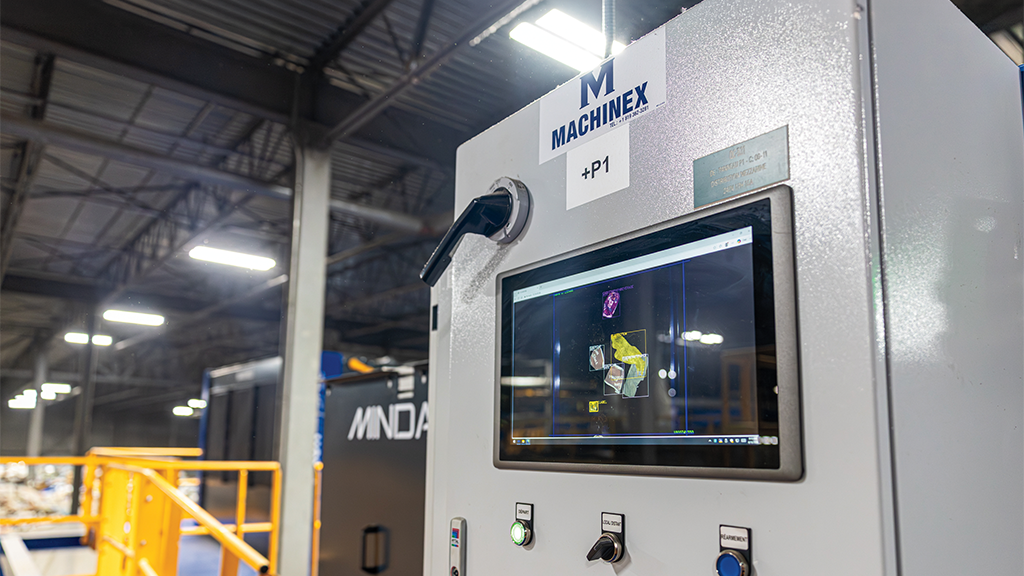
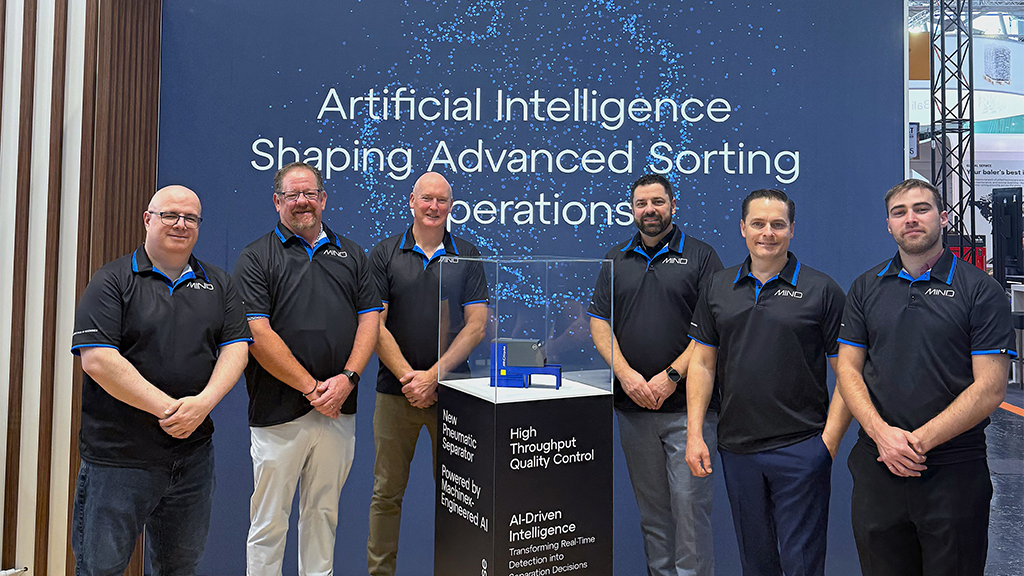
Machinex's MIND platform — made up of AI-enabled technologies including SamurAI, MIND Vision, Hyspec MIND, and MIND Airpulse — builds on the company's experience in cameras, optical sorting, robotics, data collection, and analytics. These technologies already allowed equipment to detect material, automate sorting tasks, and generate information about what was moving through a recycling facility. Artificial intelligence has added another layer to those capabilities.
One of Machinex's early applications of AI was in robotic sorting. AI-powered vision identified targeted material and directed its SamurAI sorting robot to pick it from the belt. Machinex later extended those capabilities to MIND Vision, using AI to identify material without physically sorting it and to collect data about the material as it moves through the facility.
Using computer vision and machine learning, AI can recognize and classify objects based on visual characteristics, allowing equipment to distinguish between materials that conventional detection technologies may see as the same. That intelligence has since been integrated with other sorting technologies. Hyspec MIND combines AI-driven vision with optical sorting, while MIND Airpulse uses AI recognition to identify targeted material before compressed air ejects it from the stream.
Each step expanded both what the equipment could recognize and the technology's learning curve. What began with AI informing individual sorting decisions has evolved into a broader opportunity to use data gathered by individual machines to improve material identification, understand system performance, and eventually allow equipment to respond to changing conditions elsewhere in the sorting process.
MIND brings that progression together, connecting AI-driven recognition and the data it generates with the sorting equipment designed to act on it. For Machinex, developing those capabilities alongside its equipment also gives the company greater flexibility over how that intelligence can be applied across the sorting system.
Building AI in-house
Machinex began its AI development with an internal team of experts. As applications expanded and customers began seeing value in the technology, the company created a dedicated division around MIND.
Developing those capabilities internally was a deliberate choice. Beyond giving Machinex control over its AI development, it gives the company ownership of the information those systems generate.
"We've always been a big proponent of building our own machines and having control over our destiny," says Sébastien Roy, Director of Sales Engineering at Machinex.
For Chris Hawn, CEO of Machinex Technologies, the opportunity lies in owning the available data so that it can be leveraged for purposes beyond just a spreadsheet.
That ownership is important because Machinex ultimately wants the information collected by one machine to inform how other equipment operates within a system. Instead of treating AI as a separate layer, the objective is to integrate it with the sorting equipment Machinex already designs. Bringing those capabilities together allows Machinex to look beyond individual AI-enabled machines toward how information could eventually influence the broader sorting system.
Using AI to improve material identification
Conventional optical sorting technology can identify materials based on composition. AI adds another layer of recognition, using visual characteristics, such as shape, colour, labels, and recurring patterns, to distinguish between objects made from the same material.
A bottle and a clamshell tray, for example, may both be made from PET, but a facility may need to separate them into different recovery streams. AI can use their visual characteristics to make that distinction. The same capability can be applied to identify specific food-grade polypropylene packaging or distinguish foil and food cans from used beverage containers.
Those finer distinctions can help recyclers recover more targeted materials; produce cleaner, more precisely separated commodity streams; and automate sorting decisions that previously depended on human eyes. As an AI model learns to recognize more packaging within a category, its ability to make those distinctions improves.
But recognition alone does not sort the material. The equipment still has to physically act on that information at the speed and volume required by the application.
That has been one of the lessons of AI's early adoption in recycling. Roy says the initial enthusiasm around robotic sorting sometimes overlooked the limitations of the mechanical equipment paired with the intelligence behind it. An AI model may recognize a target with high accuracy, but the value of that recognition still depends on whether the machine can physically sort the material at the required speed and volume.
"There's no way that an arm and an AI is a solution to everything," Roy says.
The question, then, is not simply how much of a sorting facility can be automated, but how much automation makes operational and economic sense. In some cases, human sorters may still be the more practical and cost-effective option.
For now, Roy says, "It's always been a fine balance between technology and the cost of manual labour."
For Machinex, the opportunity is in pairing AI recognition with the sorting technology best-suited to each sorting task. That can mean directing a SamurAI robotic arm, adding another layer of recognition to a conventional optical sorter with Hyspec MIND, or using compressed air to eject targeted material with MIND Airpulse.
How recycling AI models learn and improve
The effectiveness of these AI models depends on the images used to train them and, critically, how those images are classified.
Machinex has labelled more than 100 categories of material. Human input remains involved in making sure captured images are assigned to the correct categories so the model learns the right distinctions.
"The quantity is one thing, but how you manage it, and the quality of the data, is going to be instrumental," Roy says.
The models can then evolve as they encounter new material. If an item is not being recognized properly, an operator can place it under the camera while Machinex accesses the system remotely, collects additional images, and uses them to improve the model.
There is no definitive endpoint to that machine-learning process. Asked how long the learning curve lasts, Hawn's answer is simple: "Infinite, because it's always going to be changing."
Existing models can also provide a starting point for other facilities processing similar material streams. During recent retrofits of three plants operated by the same organization, Machinex developed multiple models for the first installation. Roy says the system was performing as expected on day one and final levels of optimization came after roughly one or two weeks of tweaking and tuning. Those models were then reused and further improved for the company's subsequent installations, with improvements transferred back to earlier systems.
Turning recycling data into actionable insights
As the volume of available information grows, the next challenge is deciding what is actually useful.
"Everybody is learning, both manufacturers and operators, what data is useful and what data do we just really not need?" Hawn says.
Different users also want different information. Operations personnel may want to understand material composition or identify where the system is underperforming. Management may be more interested in revenue. Other teams may use the information to identify opportunities for future investment.
Machinex already offers its MACH Intell platform, which allows customers with camera-equipped machinery to see a breakdown of the material stream detected by those machines. The company plans to begin rolling out expanded dashboards in 2027, adding more real-time data, tonnage information, and customizable thresholds that can alert users when conditions move outside selected parameters.
The objective is not simply to expose every available data point. Roy explains that Machinex is careful not to inundate the customer with data that they may not know what to do with.
Machinex is working with operators to determine what information should be displayed and how reporting can make it easier to act on.
"We're investing substantial effort to make the visuals speak and to [create] custom reporting of things that are good information for our customers," he says. "Making the data more useful is a very big chunk right now of our R&D."
Connecting AI across the MRF
Today, most autonomous MIND decisions remain at the individual machine level: recognize an object and determine whether to sort it.
"People think of the world where it's doing it all by itself," Hawn says. "It's not there yet. That's a direction it's going."
"Really, the AI is limited to single machines that work in a larger ecosystem," Roy says.
The broader facility, however, remains human-operated. Decisions such as when to start and stop the system, how fast it should run, and when safety-related intervention is required still remain with people. The next step is to automate those individual decisions.
A camera monitoring a residue stream, for example, could identify that too much recyclable material is leaving the facility. Today, that information can trigger an alarm, and an operator can respond by slowing the system or making another adjustment. Machinex envisions a future in which the equipment itself could respond, reducing system speed or adjusting another machine until recovery returns to the desired range.
The technology needed to move toward autonomous MRF operation is already available, but the economics have not yet reached a point where the market can broadly justify that level of investment. Safety requirements, material volumes, economics, and the capabilities of the sorting equipment all influence how far automation makes operational sense today.
For now, the evolution is more practical: help machines see more, use those observations to make better sorting decisions, turn the resulting data into useful operational information, and gradually connect those insights across the facility.
"AI is just another tool in our toolbox," Roy says. "It's a big one, but the rest has to follow."
______________________________________________________________________________________
This article originally appeared in the September/October 2026 issue of Recycling Product News.