
The Recycling Partnership’s push to make film and flexible packaging recyclable at scale
Kate Davenport discusses challenges, funding, and infrastructure shaping the future of film and flexible packaging recycling
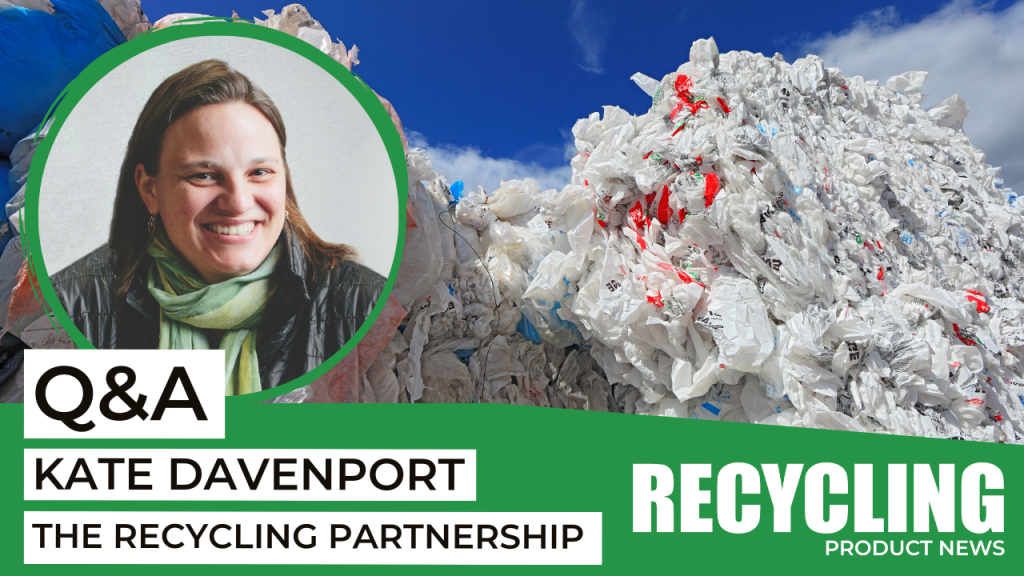
Film and flexible packaging are among the most challenging material types in the recycling system today. With a national recycling rate of less than one percent in the U.S., most of the nearly five million tons generated annually end up in landfills.
From collection and sorting to end-market development, every stage of the recovery process presents barriers. In California, the stakes have never been higher. Under SB 54, producers must show their packaging formats are trending toward recyclability or risk multi-million-dollar fines and potential bans.
To better understand the path forward for film and flexible packaging, I caught up with Kate Davenport, chief policy officer at The Recycling Partnership, to discuss the biggest challenges in building a viable recycling stream, how targeted funding and infrastructure investment are being deployed to meet looming compliance deadlines, and what it will take to bring film and flexible packaging recycling into the mainstream.
Slone Fox: What are the biggest challenges in creating a viable recycling stream for film and flexibles?
Kate Davenport: Film and flexible packaging (FFP) has an incredibly low annual recycling rate — less than 1 percent of the nearly 5 million tons generated nationally is recycled. This low rate is driven by a variety of challenges at each part of the recycling system: insufficient end markets, high costs to process the material coupled with low commodity prices, limited acceptance in curbside recycling programs, and a diverse packaging format that becomes dirty in residential recycling programs, further limiting end-market availability once sorted.
The challenges of FFP recycling are currently front and centre in the state of California. SB 54, the Plastic Pollution Prevention and Packaging Producer Responsibility Act, brings together ambitious targets and short timelines — ultimately requiring 25 percent source reduction, 100 percent recyclable or compostable packaging, and a 65 percent recycling rate by 2032, with steep penalties if targets are missed. Failure to meet these requirements could result in fines, potentially up to $18 million per year per package, and potential bans. For covered material categories at risk of not meeting SB 54 mandated targets, like FFP, demonstrating a compliance strategy by April 2026 is the crucial first milestone to avoid fines and/or bans.
Given that FFP is decades behind commonly recycled packaging in terms of investment, there is much work to be done quickly to show that higher rates of FFP capture are possible. While California is in a slightly better starting position than many states, with a higher percentage of communities already accepting FFP and MRFs already sorting FFP, the question remains how capture rates can be increased to historically unprecedented levels, and there are still significant challenges for those MRFs to find end markets for the sorted material.
We also estimate that there are approximately 500,000 tons of residential FFP produced annually in California, but current end markets can only absorb about 10 percent of that amount. Work must begin now to secure enough end-market capacity to handle future supply.
SF: Can you tell me a bit about the CalFFlex funding initiative and how it fits into the larger strategy for improving film and flexible packaging recovery?
KD: CalFFlex is an initiative of The Partnership's Film & Flexibles Recycling Coalition, which launched in 2020, to convene packaging producers and the industry at large to tackle the unique challenges of FFP. The Coalition has deployed over $11 million across over 25 grant projects to help demonstrate the methods, infrastructure, and markets for capturing and recycling this material.
The Coalition launched the CalFFlex initiative in March 2025 to address the urgent and timely regulatory requirements associated with SB 54. By leveraging our prior experience and extensive knowledge of the recycling system, The Partnership is identifying what must be proven to increase FFP capture in California and is quickly deploying funding to build scalable pathways to compliance.
CalFFlex has identified a comprehensive three-part strategy to deliver on this critical opportunity. First, by testing two key hypotheses focused on how to improve the capture and marketability of FFP where the material is already collected. Second, by addressing the need to develop responsible end markets (REMs), CalFFlex has identified at least 10 existing end markets in need of support and will further quantify their capacity, identify investment opportunities, and bolster demand for recycled FFP products. Finally, CalFFlex will provide replicable details to the Circular Action Alliance (CAA) to inform regulatory compliance strategies.
The Recycling Partnership aims to leverage this current opportunity, along with its 10-plus years of building a better recycling system, to support the successful implementation of EPR in other states. The work being done in California through CalFFlex is intended to create a transferable blueprint for other regions as well.
SF: Why is now the right time to invest in solutions for these materials?
KD: Public support for recycling remains strong, with 80 percent of Americans believing in its positive environmental impact. However, because of insufficient national funding, 76 percent of the more than 46 million tons of recyclable materials that flow through U.S. households end up in landfills or incinerators. Different types of materials, such as FFP, face unique challenges throughout the recycling system, ones that cannot be solved by increasing access alone.
With seven states having passed EPR policies and several others introducing legislation, tackling material-specific recycling challenges at a larger scale is now becoming possible. That being said, strong policies must be matched with on-the-ground support to invest in outreach and education, infrastructure, and development of end-market pathways.
For materials that are at risk of not being included on statewide recycling lists or that will face fines and/or bans, immediate investment is needed before EPR fee collection and program implementation begins.
FFP recycling in California is an all-hands-on-deck moment given SB 54's aggressive timelines, unprecedented improvements needed at each stage of the recycling system, and noncompliance fines of up to $18 million per package per year.
Everyone from brands and retailers to reclaimers and manufacturers is impacted by the risks posed to FFP's continued viability in California, and, as the fifth-largest economy in the world, the effects will be experienced throughout the U.S. supply chain. Achieving a "trending toward compliance" designation under SB 54 is a crucial milestone to maintain the viability of the packaging format, but we don't have much time; the input to the producer responsibility organization is due by April 2026.
SF: How are MRFs adapting to capture these materials more efficiently?
KD: One of the Coalition's key areas of focus is equipping processors with the tools and technology to capture and sort these materials. At MRFs, these materials can wrap around machinery, causing delays and contamination.
Recent grants have provided funding for equipment and technology, such as optical sorters to support cleaner recycling streams and maximize operational efficiency, while providing new potential pathways to sort film and flexible packaging for delivery to end markets.
A recent grantee success story can be found in San Antonio, Texas, where a new MRF operated by Circular Services installed advanced equipment to effectively separate and bale incidental FFP from the city's single-stream recyclables. With current recovery rates at more than 214 tons annually on just one shift, the facility aims to expand its operations and develop end market opportunities, projecting up to 1,530 tons by 2030.
SF: What are the most promising end markets for recycled film and flexible plastics?
KD: As we work to increase FFP capture, we must ensure adequate REMs are available and consider market availability for the diverse composition of the film and flexible packaging stream — no single end market solution will be the solution. One focus of Coalition granting — and a key component of the CalFFlex strategy — is identifying and engaging with a variety of end market solutions, fostering innovation and new technology. For example, grantee Hydroblox, a Pittsburgh-based drainage solution company, has moved to 100 percent post-consumer film and flexibles in its products.
The Coalition's most recent grantee, Enevi, a plastic waste management start-up in Santa Maria, California, is an example of a potential future end market that our grant is helping to move toward commercialization. The funding is supporting equipment installation that will better enable Enevi to transform FFP from farms, and soon from additional sources, including homes, into post-consumer resin pellets that can be made into new products.
SF: In your opinion, what still needs to happen for film and flexible packaging recycling to become mainstream across North America?
KD: The Recycling Partnership is proud of our system-wide work to improve the U.S. recycling system over the past 11 years, and we remain fully committed to growing the movement where companies, communities, and people across the U.S. are engaged and equipped with the tools, access, and trusted systems that deliver increased recycling performance. However, we know that we can't do this alone, and more than voluntary investment is required to fill the current gaps in the system.
The Partnership supports smart, well-designed EPR programs that can ensure that the nation's recycling infrastructure expands so that everyone can and does recycle. Strong policies must also be matched with on-the-ground support to invest in outreach and education, infrastructure, and development of end-market pathways. Collaboration with producers to prioritize design for recyclability and actively boost demand for post-consumer recycled material like FFP is crucial to building a viable recycling infrastructure.
While our current focus with CalFFlex lies in California, we hope that this work to build scalable models for recycling in the state can serve as a foundation or proof point for the infrastructure and market investment needed to scale FFP recycling across the U.S.