
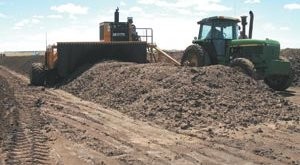
As with any issue, there’s always some debate on the right approach to achieve maximum results. Compost is no different, and the debate centres on the most efficient way to turn a pile. Since 1971, drum-style turners have been the mainstay of the industry and over the past 38 years they have steadily become the most widely used method for turning compost windrows.
However, approximately 18 years ago a new kid arrived on the scene – elevating-face technology. This method offered a new way to turn traditional windrows or create a continuous windrow stack, allowing more compost to be processed in less space.
In reality there is application for both in the industry, and each provides complementary and unique advantages to compost operations. According to Tim O’Hara with Wildcat Manufacturing, a large percentage of the 3,500 compost sites in the U.S. are using mechanical compost turners.
“I would say a vast majority of compost sites not using aerated static piles are using either a drum or elevating-face compost turner versus a loader,” says O’Hara. “Mechanical turners provide a more consistent pathogen and weed seed kill and a rapid temperature rise, because a mechanical turner mixes the material completely compared to other methods. They also help reduce cycle times allowing a compost site to produce more compost annually.”
The industry mainstay
Drum-style turners have been the traditional “big kid on the block.” They provide an efficient way to produce high-quality compost. The design is rather simple – compost is placed into windrows of varying height, width and length. A PTO-driven or self-propelled unit straddles the windrow and features a horizontal steel drum with paddles that turn rapidly to mix fresh air into the compost windrow.
However there are two different philosophies when it comes to drum turning. One philosophy uses a smaller-diameter drum that rotates at a higher speed. Some say this method provides for a better mixing action while others claim it tends to artificially break down / shred the compost, limiting air exchange in the windrow.
“The other camp believes a larger-diameter, slower-turning drum does a better job keeping material away from the drum and allows the flails to do their work in aerating and mixing the compost,” says O’Hara. “The slower-turning drum also does not prematurely degrade or shred the compost, allowing for natural air exchange within the pile. This helps extend the turning benefits.”
Elevating oxygen levels
Elevating-face technology is starting to make a big impact in the market. This technology features a combination of paddles and teeth that lift and tumble the compost material up the face of the compost turner and discharge the material at the rear of the machine. This innovative process does not artificially degrade the compost material and introduces the maximum amount of oxygen into the compost pile “Basically it breaks the compost off the pile into chunks and as those chunks travel up the face they are broken apart,” says Jeff Bradley with Vermeer Corporation. “The compost falls off the back of the machine into a windrow or is moved by a conveyor to the stack.”
Elevating-face technology doesn’t pack the compost back into a pile, which helps maximize natural air exchange into the pile or windrow and reduces the frequency needed to turn the compost.
“When the microbes run out of oxygen that determines when you need to turn the compost,” says Bradley. “So the microbes are chewing away and breaking material down and if they run out of oxygen, that’s when the compost starts dropping in temperature and the microbes start dying out. Piles or stacks that allow more air flow help keep the microbes active longer, thus reducing the turning frequency.”
Choices, choices, choices
When choosing whether a drum or elevating-face compost turner is right for your composting operation, keep these factors in mind.
“If you plan to compost mortalities, a drum-style turner will be better equipped to process the carcasses compared to the elevating-face technology,” says O’Hara. “Due to the lift and tumble action of the elevating-face technology, it is not as efficient in this application.”
For some composting operations, space is at a premium. The compost industry is growing rapidly and many operations are expanding their square footage by acquiring additional land. However, others are unable to expand and must identify ways to produce more in a limited area.
“Elevating-face technology allows a site to produce up to three times more compost per acre just by moving from traditional windrows to continuous windrow stack,” says Bradley. “In doing that, you should be able to maximize your footprint and the amount of material on your site. For sites in an urban setting with limited space, this is a big advantage to help address their increased inflows.”
Another advantage of elevating-face technology is that it requires 30 to 50 percent less horsepower per cubic yard. This is because drum-style turners are typically down in the pile whereas the elevating-face technology is breaking the pile apart, which requires less power.
If space is not an issue, many compost sites prefer drum-style turners. They also shine in dry environments where water may need to be added to the compost pile to help promote the decomposition process. In these cases, it’s easier to add water to a windrow versus a continuous windrow stack. In fact, many drum-style turners can be equipped to add water during the turning process. Water can also be added to an elevating-face style turner.
Many sites will utilize grinders to process and size incoming material, while others bring the material in and stack it along with yard clippings, green waste and manure. Once material has been assembled into windrows, the site will turn the pile using a mechanical turner. In these instances, a drum style turner is better suited due to its ability to cut and size material.
Considering more than just the purchase price
After having decided on which technology — drum or elevating-face — is right for an operation, as well as the size of unit wanted, there are a few more considerations to help finalize the selection.
Whether you’re looking for a drum or elevating-face unit, both Bradley and O’Hara offer the same advice. Number one, look for a manufacturer who can provide local dealer service and parts support. Then look for proven designs and technology updates.
“Do your homework and find out if the manufacturer is using new technology,” says O’Hara. “Are they still using V-belts or have they advanced to poly-chain drive, which provides better transfer of horsepower. What changes have they made in the design of the machine and why.”
It’s more important than ever to consider operating costs when purchasing a compost turner. Too many times buyers get caught up in the price of the machine and fail to properly consider the cost of ownership and operation.
The purchase price, in most cases, is a small factor in the overall cost of a compost turner during its estimated five-year to seven-year life span. The true costs begin the day the machine goes into operation, and without some research to truly understand what it will cost to operate the machine on an hourly and / or cubic-yards-turned basis, a site may experience buyer’s remorse.
Making the switch
Those currently using a windrow configuration who would like to consider moving to a continuous windrow stack should consider the following.
“First, the elevating-face technology can be used in both a windrow or continuous stack configuration,” says Bradley. “Second, it is going to take some planning, but in the long run you could save considerable time in your composting process.”
Imagine you have 50 pencils lying across your desk and they’re four inches apart. Those pencils represent your compost windrows. You actually have to transport or carry raw material to each one of those windrows, no matter where you locate your processing area. Once the compost is cured you once again need to move the finished product to the screening area. In other words, there’s a lot of transportation involved.
Continuous stacking allows you to place all of your incoming materials on one side of the site. If you’ve scaled your size and site correctly, every time you turn the stack it moves the finished material towards your screener. So you don’t spend all that time with loaders moving your material here and there, because by the time it gets to the other end of the site, the finished product has naturally moved to the screener area.
“Drum and elevating-face turners each offer unique advantages,” says Bradley. “What’s most important is finding a dealer who understands the market and can help navigate you through the selection process.”