

Tire solutions key to three Rs
Sealant technology and retreads prove to be the right combination for Ontario collection fleet
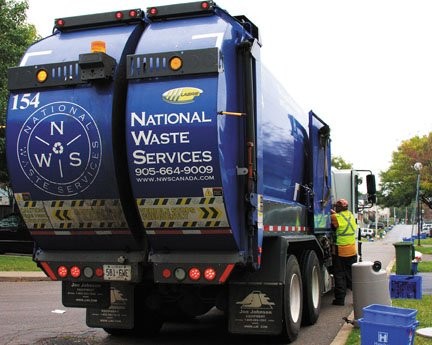
Ontarians throw out approximately 13.8 million tons of refuse annually. Over the years, as with all Canadians, they have become increasingly familiar with the phrase known as three R’s – reduce, recycle and reuse – as provincial and municipal governments work to increase participation levels and recycling rates.
As a company responsible for transporting nearly 400,000 metric tonnes of residential and commercial refuse and materials annually to recycling and disposal facilities, National Waste Services (NWS), based in Ajax, Ontario, has applied the reduce-recycle-reuse message to its own fleet operations. With assistance from Greg Walker, a commercial account manager with the Goodyear Tire & Rubber Co., and authorized Truckwise dealer Benson Tire, the company has chosen tires with treads and tread designs that better match its operational needs.
NWS’ tires of choice feature Goodyear’s DuraSeal Technology, which is a gel-like, solvent-free compound built into the inner liner of the tire. According to Goodyear, it can instantly and consistently seal punctures up to ¼-inch in the tread area (excluding sidewalls) without the need to repair the tire until it is retreaded. This allows drivers to continue operating after a tire is punctured. Additionally, NWS now gets more use out of its tire casings by having more of them retreaded.
“By going with a specific tread design on our residential recycling trucks, our tires are lasting longer, which means we have fewer tires going to the scrap pile,” says Steve Cooke, NWS maintenance manager. “We’re using a tire with a built-in puncture-resistant compound to reduce flats and we’re recycling our original tire casings through retreading. As a result, we are lowering our tire costs by getting longer wear out of our tires.”
NWS runs a fleet of nearly 150 power units, including rear-loading, side-loading, front-loading and roll-off trucks stationed at five different locations. It also runs 12 multi-axle highway truck and trailer combinations on Ontario Highway 401 from the Greater Toronto area to landfills. NWS provides residential, commercial and industrial solid waste collection service to more than 400,000 households and 3,000 industrial, commercial and institutional customers at about 5,000 locations in the Greater Toronto area and surrounding regions. The company serves an area that’s about 31,000 square kilometres. Specifically, NWS operates in and around the communities of Ajax, Brighton, Hamilton, Lindsay and Kleinburg. It also provides residential blue box recycling collection service in a variety of urban and suburban locations. Plus, it offers waste collection and hauling in and around Durham, the City of Kawartha Lakes and several municipalities in Northumberland County, east of Toronto.
Between September 1, 2009 and August 31, 2010, NWS picked up about 120,000 metric tonnes of industrial, commercial and institutional waste and about 65,000 metric tonnes of industrial, commercial and institutional recycling. In that same time period, the company also collected 113,000 metric tonnes of municipal waste and 94,000 metric tonnes of municipal recycling through eight municipal contracts.
About two years ago, the company began a test program to see if they could get more miles to removal, and reduce tire operating costs by switching from a deep lug tire – which is a typical tire of choice among waste haulers. At the recommendation of Goodyear, the company installed Goodyear G287 MSA and G287 MSA retreads on a roll-off truck and a rear-loader that operates on pavement in stop-and-go traffic, and in densely populated urban areas.
“[We are] one of only two tire manufacturers offering retreaded tires with treads that match those on the fleet’s set of new tires,” says Goodyear’s Greg Walker. The results of the test have paid off for NWS in longer tire wear and lower operating costs.
“We got almost a year of wear before we had to replace them – which in the waste hauling industry, is very, very, very good,” Cooke says. “Like many other waste haulers in roll-off applications, we were using deep lug tires on all of our trucks and we were replacing them every two to four months, long before we got any real wear out of the tread. We also needed tires that could withstand punctures, because we had trucks and trailers going in and out of landfills.”
In recent years, the conditions that NWS and other haulers have encountered with many of their collection trucks have changed. In Ontario, an increasing number of landfills have closed and provincial and municipal governments have responded by opening transfer stations.
“A number of our trucks don’t even go into landfills, so on those trucks, we really don’t need tires with deep lug treads,” Cooke says. That’s why, he says, the company is now using the Goodyear G287 MSA, both new tread and retreaded, on all of its units that travel on urban routes and which don’t go into landfills.
Tim Miller, Goodyear’s marketing communications manager, says that for waste haulers and recyclers whose trucks no longer travel in and out of a landfill, choosing tires with these tread designs can make sense.
“Shallow-tread rib tires are good for trucks that do not go into a landfill because they are more stable and less prone to squirming on pavement,” says Miller. “A deep-tread tire tends to be bulkier and noisier, and it wears faster. Deep lug treads are for trucks that go into landfills, where tires can sink into the ground or encounter all types of debris. It’s all about picking the right tread design for the application.”
NWS still has residential rear- and side-loading trucks and commercial roll-off trucks assigned to more rural areas, such as those based out of its Lindsay, Ontario location. There, they can encounter muddy conditions and a lot of nails and other puncture-causing debris in area landfills. That’s why Goodyear recommended testing the Goodyear G177 with DuraSeal Technology on the drive position of a roll-off truck based in Lindsay.
“We’ve had the DuraSeal tires on that Lindsay truck for two years now, they’ve run about 175,000 kilometres and there’s still a lot of rubber left,” Cooke says. “In those two years, we haven’t had a single flat, which is also extraordinary.”
Because of the success of that test, NWS now uses the Goodyear G177 with DuraSeal Technology on the drive position of trucks that operate in rural areas. Cooke said before the company tried the DuraSeal tire, it was common for its trucks to get two or more flats each week.
“Every time we had a flat tire, the cost of dealing with it really depended on where and when the flat happened,” he says. “It could cost anywhere from $60 to $150. And that doesn’t include the cost of downtime in terms of lost productivity, such as the cost of missing loads or the cost to customer satisfaction if the company misses a pick up time,” Cooke adds.
NWS’s success with the Goodyear DuraSeal tire on the company’s rural route trucks is why Cooke has now placed DuraSeal tires on their eight UAG open-top and four compact trailers.
“It’s critical for those highway units not to have any downtime,” he says. “It’s a time-sensitive run because the drivers have just enough time to make one trip down to landfills and then drive back to load up for the next morning. We can’t have the drivers sitting on the side of [Ontario Highway] 401 waiting to get a flat tire repaired.”
According to NWS, the uptime they’ve realized from using Goodyear’s DuraSeal Technology is not the only new benefit the company enjoys. Cooke says Goodyear also helps the company get the most out of its tires by keeping track of tire performance using fleetHQ, TVTrack, and GTRACS reporting tools, and establishing scheduled routine tire inspections and rotations. The local dealer, Benson Tire, also provides tire retreading using Goodyear retreading technology.
“Because we have five different locations, it’s impossible for one person to keep track of all the details,” Cooke says. “It’s better to have someone whose expertise is in tires to handle all of that. And retreading helps cut our tire replacement costs by giving us the opportunity to re-use the original tire casings, which can save us a lot of money.
“Goodyear is more than just our tire supplier,” he adds. “They understand our business and provide us fleet solutions to keep us up and running, allowing us to focus on customer service.”
The Goodyear Tire & Rubber Co.
Company info

200 Innovation Way
Akron, OH
US, 44316-0001
Website:
goodyeartrucktires.com
Phone number:
330-796-2121
