

BHS advances autonomous recycling through integrated sorting technology
BHS is connecting material identification, optical sorting, robotics, and controls to enable more autonomous decision-making in recycling facilities
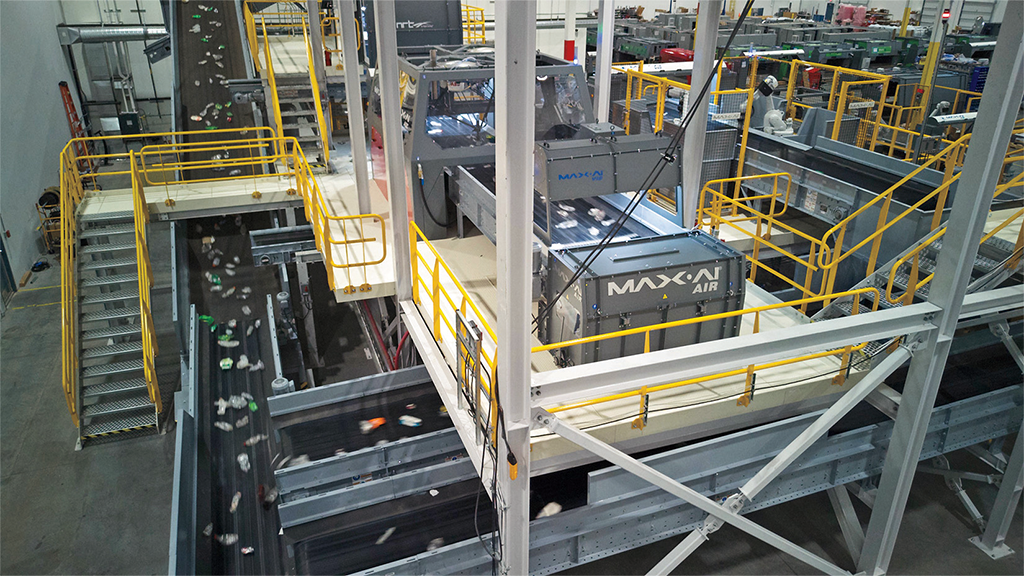
A highly automated manufacturing operation can run around the clock, spreading the cost of its equipment across more production hours and greater output.
Recycling facilities have traditionally operated differently, with people still playing an important role in monitoring material, adjusting the process, and making sorting decisions.
BHS CEO Steve Miller sees a future where all recycling operations move to that level of full autonomy. "Our vision is to have fully autonomous processes, sort of ‘lights-out sorting,' where the system operates independent of activity on the ground, deliveries of material, that kind of thing," Miller says.
Getting there requires more than automating individual sorting tasks. Equipment has to accurately identify and separate material, but the information generated in that process also has to extend beyond a single pick or ejection. Greater autonomy depends on technologies across the sorting process sharing that information so the system can respond to what is moving through it.
BHS is working toward that goal by bringing together technologies developed across its portfolio, including optical sorting, artificial intelligence, robotics, and controls and automation.
Improving optical sorting accuracy with in-flight detection
Long before AI became part of the recycling industry's technology conversation, optical sorting was already automating a fundamental task: identifying a target material and removing it from the stream. A successful sort, however, depends on more than correctly identifying that material.
In a conventional optical sorter, there is a physical distance between where an object is detected and where it is ejected. The system has to track that object as it travels between the two points and trigger the right air nozzle at precisely the right time.
That creates an opportunity for error. An object can shift laterally on the conveyor or travel slightly faster or slower than expected before it reaches the ejection point. Even if the sorter identified the material correctly, the air jet can miss its target or eject other material along with it.
National Recovery Technologies (NRT), BHS's optical sorting technology brand, developed its patented In-Flight Sorting technology to reduce the potential for tracking error between detection and ejection.
"What NRT optical units do that's different is they recognize the material after it leaves the belt," Miller says. "We process that reading at very high speed within milliseconds, and then we make an ejection while it's in flight."
By moving the detection point off the conveyor, the system reduces the opportunity for the material's position to change between the moment it is identified and the moment the air nozzle fires.
Detecting material in flight also addresses another challenge: keeping the optical sorter calibrated. Dust, changing lighting conditions, and other factors can affect optical detection when the conveyor belt forms the background against which material is being analyzed. Miller says conventional systems therefore require periodic calibration. With NRT's approach, he says the system automatically calibrates as it detects objects in flight.
"Since In-flight Sorting uses a different background than the competition, our design can auto-calibrate, and so our equipment stays calibrated," Miller says.
Using AI and hyperspectral imaging to improve material identification
As the mechanics of detecting, tracking, and ejecting material have evolved, so has the information available to make the sorting decision. NRT's SpydIR-HS uses hyperspectral imaging (HSI) to create a more detailed picture of a material's response to near-infrared light, providing more information to distinguish one material from another.
"Hyperspectral allows us to see material across a wide range of spectral imaging, whereas multispectral will look at bands," says Miller. "So HSI allows us to get a much clearer view of material as it's flowing through the system."
Hyperspectral information is only one way to identify a material. BHS has also built Max-AI around visual recognition. A camera captures the material, and a neural network processes the image to classify objects based on visual characteristics, such as size, shape, colour, and texture.
"We're able to see material in the way a person does, and based on the characteristics of what is seen, we can determine with a very high confidence level what it is," Miller says.
For BHS, AI is not intended to replace other sensing technologies. Miller describes the technologies as additive, with AI providing another source of information that can be combined with near-infrared, colour, induction, and other sensing technologies depending on the sorting objective.
"I would say that these are . . . not competitive," he says. According to Miller, approximately half of the optical sorting units BHS currently sells have AI embedded.
Combining sensing technologies can provide additional information on which to base a sorting decision. A system might identify a particular polymer, for example, while additional characteristics allow the sort to be narrowed by colour or another attribute.
Improving recycled commodity quality through more precise sorting
Better sorting decisions can translate into a higher-quality commodity leaving the plant. The more precisely a system can distinguish between materials, the more effectively it can target what belongs in a recovered fraction — and what does not.
"Our customers are commonly looking for that additional information, and that's because the industry is requiring increasing levels of purity and performance from the recycling world," Miller says.
Those requirements make sorting accuracy important beyond the recovery process itself. For the downstream processor receiving that commodity, its quality directly affects the next stage of production.
"You can't just generate something that sort of looks like the thing and send it off to the customer and expect that they're going to be happy," Miller says. "Their business is affected by the quality of the product that you're providing."
BHS's range of sensing technologies gives it different sources of information to draw on depending on the material and sorting objective. In addition to AI, near-infrared, and colour, Miller points to X-ray and induction technologies as part of that portfolio.
Advancing recycling automation through integrated systems
The next step is connecting those technologies so information can move beyond an individual machine and contribute to decisions across the sorting process. Miller sees BHS's ownership of multiple technologies as an important part of achieving that connectivity. While a recycling system can incorporate equipment and technologies from multiple suppliers, he says developing several of those technologies within BHS allows the company to connect them more closely.
"It's important that we own these technologies such that everything's under one roof," Miller says. "The technologies truly are integrated. They're talking to each other, and we're supporting the entirety of the plant through one group."
BHS's Autonomous Sorting Loop takes that integration to the process level. Instead of relying on a dedicated sorting line for each commodity, material is cycled through a common automated sorting line that can sequentially target different commodities based on defined recovery and purity priorities. Sensors gather information about the material stream while BHS's Total Intelligence Platform uses that data to guide sorting decisions as material moves through the loop.
"The system gets information from the various sensors around the system and makes sorting decisions that maximize the return to the customer without human intervention," Miller says. "And so it operates on its own."
The loop operates as an autonomous subsystem within the MRF rather than making the entire facility autonomous. BHS says operators can establish commodity-specific recovery priorities and purity thresholds, while the system determines how material is sorted through the loop to meet those targets.
BHS has deployed one Autonomous Sorting Loop and is installing a second. Miller sees systems like these as a step toward a longer-term goal: extending autonomous decision-making beyond individual processes to more of the recycling operation.
How autonomous recycling can improve equipment utilization
The potential value of greater autonomy extends beyond the sorting process. Reducing the amount of human intervention required to operate a recycling system could also change how facilities use their equipment.
"When you think about the recycling world, the way it varies from a typical production environment is just the number of hours that they operate," Miller says. "Most robust manufacturing operations run 24/7. They invest in capital, and then they spread that cost over more hours, units, so forth."
Increasing the number of hours a recycling system can operate reliably with less human intervention could allow recyclers to process more material through the same installed equipment and spread their capital investment across greater tonnage. Miller does not see any single technology getting the industry there.
"We think AI is part of that story, but the overall technology . . . whether it's AI, near infrared, the software that we develop in the controls automation, all of that comes into play," Miller says.
For BHS, bringing those technologies together is a step toward "lights-out sorting" and the potential for recyclers to get more operating hours from the equipment they've already invested in.
_________________________________________________________________________________________
This article originally appeared in the 2026 Recycling Technologies special issue of Recycling Product News.