

STADLERconnect turns sorting plant data into smarter maintenance and automation
STADLER’s digital platform combines machine and material intelligence to reduce downtime, improve performance, and support automated sorting processes
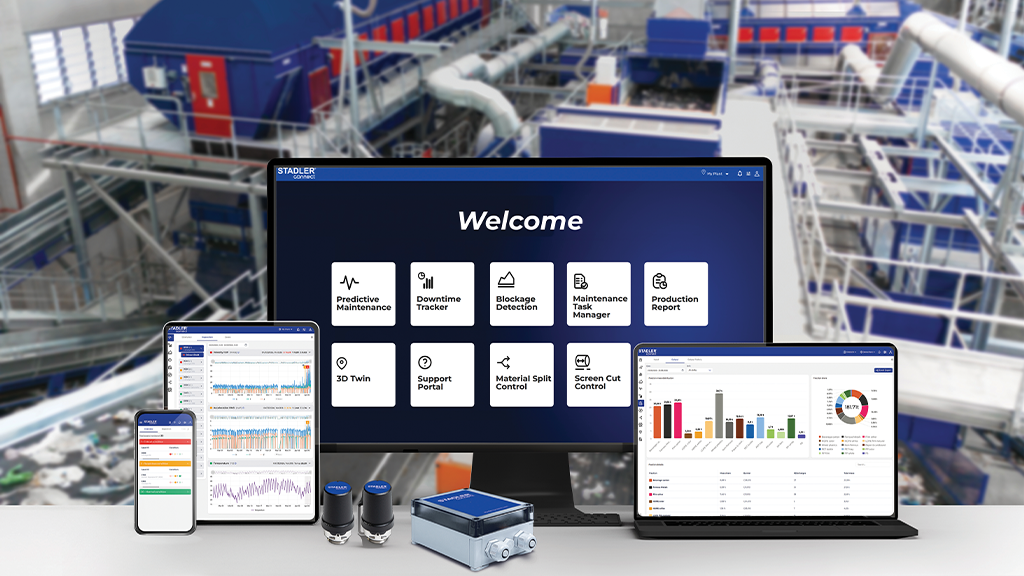
A MRF can generate enormous amounts of data without necessarily telling an operator what to do with it. A change in motor load could signal a developing equipment problem. Repeated short conveyor stoppages can add up to hours of lost production. Changes in the incoming material stream can affect both throughput and sorting performance. The challenge is making sense of those signals and responding early enough to make a difference.
STADLERconnect is designed to turn that plant data into actionable information. The cloud-based platform collects machine and material data from across the MRF to generate operational insights and recommended actions.
"Our plants get larger and larger and then also more complex to operate," says Dr. Nils Kroell, Head of Digital Solutions at STADLER. "We want to take some stress off the operators and support them with a better overview of the plant."
Cloud connectivity extends that visibility beyond the plant itself — it also brings together information that has often existed in separate systems.
Connecting machine and material data for better sorting performance
Machine data provides information about how equipment is operating, including machine status, motor loads, temperatures, conveyor behaviour, and downtime. Material data provides another view of plant performance, tracking the composition, quantity, and quality of material as it moves through the sorting process.
Looking at either independently leaves part of the story untold.
A machine's performance can affect throughput or the quality of the sorted material, while changes in the incoming material can alter how equipment behaves. Bringing the two data streams together gives operators more context for understanding not only what is happening in the plant, but what may be causing it.
STADLERconnect is structured around three areas: Digital Maintenance, Material Intelligence, and Adaptive Plant Control. Together they help operators understand what happened, why it happened, and what to do next.
The first of those areas, Digital Maintenance, encompasses four modules: Predictive Maintenance, the Support Portal, Downtime Tracker, and Blockage Detection.
Using predictive maintenance to prevent unplanned downtime
Predictive Maintenance focuses on identifying developing equipment problems before they result in unplanned downtime.
STADLERconnect's Predictive Maintenance combines existing plant signals, such as motor load and energy consumption, with vibration and temperature sensors installed on critical components, including bearings, motors, and shafts.
Data from the plant is collected and standardized locally through an edge device, a small industrial computer that connects the plant to the cloud platform. From there, algorithms monitor the data for anomalies and compare patterns with historical information collected from other machines.
Kroell says vibration is currently one of the strongest indicators. "We can detect very small increases in the vibrations," he says. "Typically, we see things before the operators even notice."
In one trial, STADLER detected an early indication of degradation and, under controlled conditions, continued monitoring the equipment as the issue developed. The machine remained operational for another six months, providing valuable insight into how the condition progressed from the first detectable signs through to eventual failure.
That kind of advance warning can change how maintenance is planned. Rather than reacting when a component fails and production stops, the maintenance team can order parts and arrange service support.
"What we try to do with Predictive Maintenance is basically move equipment replacement from an unplanned downtime to a planned maintenance," Kroell says.
Predictive Maintenance complements scheduled maintenance. STADLERconnect's Maintenance Task Manager tracks routine work based on calendar intervals and operating hours, while predictive monitoring identifies developing conditions that may require attention between those intervals.
Turning maintenance alerts into actionable recommendations
Detected anomalies can also be reviewed by the STADLER team before a recommended action is sent to the operator. "So we take some load off the maintenance lead," Kroell says.
That support extends into STADLER's After Sales network. The Support Portal provides a central record of service requests, including the status of current tickets and service history associated with individual machines. With customer permission, STADLER's After Sales team can also access relevant machine or plant data to support troubleshooting and respond proactively to developing issues.
The potential cost savings of catching problems before they result in unplanned downtime is substantial. Across plants monitored by STADLER, Kroell says a facility without predictive maintenance typically experiences about three to four major downtime events per year. He estimates that a major downtime event can cost approximately $23,000 USD to $113,000 USD, with potential annual savings from avoiding those events reaching approximately $512,000 USD for a large facility.
Twenty seconds at a time: Uncovering hidden downtime
Not every production loss comes from a major failure or hours-long stoppage. Some disappear into the normal rhythm of a shift.
STADLER's Downtime Tracker automatically records stoppages and analyzes their causes. The system uses information from the plant control system to identify the equipment and error associated with each stoppage, while operators can add operational causes such as material or staffing issues.
At one plant, the system traced a series of brief interruptions to a faulty sensor. The stoppages lasted only about 20 seconds each, but occurred roughly 30 times per shift. Individually, they were easy to overlook, but over time those seconds added up to dozens of hours of lost production.
Early blockage detection keeps production moving
Other sources of downtime can be identified before the stoppage occurs. STADLERconnect's Blockage Detection uses existing machine data to recognize when material begins accumulating on a conveyor.
Dr. Xiaozheng Chen, Head of Digital Solutions at STADLER, says the system can often detect a developing blockage within the first minute, giving operators an opportunity to intervene before it becomes more difficult and time-consuming to clear.
The system assigns each detection a confidence score from zero to 100 percent. A low score may indicate a developing blockage that could still clear itself, while a rising score signals a greater likelihood that operator intervention will be required.
"We have one customer that reported to us that they could save half an hour per shift through our Blockage Detection," Chen says.
Across a year, she says, those savings can add up to hundreds of hours of additional operating time. Earlier intervention can also reduce unnecessary stress on conveyors and sorting equipment, limiting the potential for blockages to contribute to equipment wear as well as downtime.
How material intelligence drives adaptive plant control
Identifying a problem does not necessarily mean STADLERconnect acts on it automatically. Predictive Maintenance can flag a developing problem and recommend an action, but the maintenance team determines how to respond. Blockage Detection can identify where intervention may be required, but an operator acts on the alert.
Material Intelligence provides information about what is moving through the plant. Volume flow sensors measure material flow while STADLER's AI Material Compass analyzes characteristics such as material type, colour, and shape depending on the sorting target. Chen says that analysis can move beyond broad material categories, distinguishing, for example, between different paper products, such as cardboard and office paper.
When Material Intelligence is combined with machine performance data, Adaptive Plant Control can use live material data to automatically adjust parts of the sorting process. With the Adaptive Material Split Control, a movable conveyor distributes material between two sorting lines. If one line begins receiving too much material, the system can automatically adjust the conveyor position to create a more even distribution and reduce the material overlap that can compromise sorting performance.
The connection between material and machine data becomes particularly important as conditions change. The operating point that produces the highest throughput is not necessarily the one that produces the best overall result. Kroell says pushing more material through the plant can also contribute to more blockages, greater downtime, or reduced sorting performance.
By monitoring those relationships, STADLERconnect can begin adapting equipment to the material actually moving through the plant rather than relying solely on fixed operating parameters. That capability moves the sorting process closer to what STADLER describes as a self-optimizing plant. The operator remains in control and can override the automation or establish a target, while Adaptive Plant Control makes the ongoing adjustments needed to maintain it.
Bringing digital intelligence to existing sorting plants
Retrofitting a MRF with STADLERconnect does not mean rebuilding its digital infrastructure from the ground up. The starting point is the data the plant already produces — and identifying what is missing.
"Basically every module can be retrofitted," Chen says. STADLER recently did so at a 15-year-old sorting plant. While an older facility may not generate all of the signals available from a new plant, STADLER can add the sensors or other hardware needed to close those gaps without reducing the functionality of the modules.
STADLERconnect can also integrate information from equipment supplied by other OEMs. This is significant in MRFs where screens, optical sorters, conveyors, and other equipment may come from several manufacturers, each with its own monitoring system.
Bringing those data sources together allows STADLERconnect to look beyond the performance of an individual machine and examine how equipment and processes interact across the plant. A change at one point in the sorting process can affect equipment behaviour, material flow, and performance elsewhere in the facility.
For operators with multiple facilities, the cloud platform extends visibility beyond a single plant, providing a standardized way to access and compare information across sites.
From automated processes to autonomous sorting plants
STADLERconnect already collects information about machine health, downtime, material composition, and plant performance, and Adaptive Plant Control can automatically adjust several key processes. Kroell says the goal is to build on that plant-wide intelligence to give operators clearer direction and automate more of the decisions that follow.
Extending that automation across more of the plant is the next part of that progression. STADLER is developing what Kroell calls "autonomous sorting plants," which understand the material entering the facility and automatically adjust the sorting process in response.
For now, the progression is happening in smaller, practical steps: identifying a bearing problem weeks before it becomes a failure, recognizing a developing blockage within minutes, or discovering that seemingly insignificant 20-second interruptions are quietly consuming hours of production.
The data was not necessarily the missing piece. In many cases, sorting facilities have been generating it for years. What is changing is the ability to understand that data in context and use it to determine what should happen next.
_________________________________________________________________________________________
This article originally appeared in the 2026 Recycling Technologies special issue of Recycling Product News.