

What defines the next generation of material handlers?
Technology, alternative power, and a greater focus on uptime are changing the productivity equation for recyclers
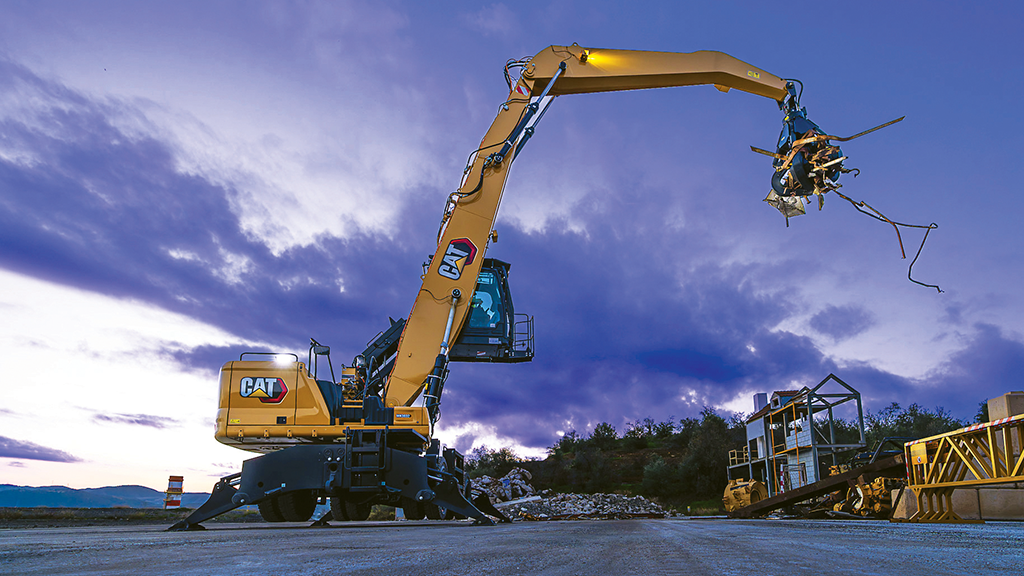
At scrap recycling yards, the material handler has a deceptively simple and instrumental job: pick up material, move it, put it down, and repeat that cycle hundreds of times per shift. But getting more productivity from that cycle relies on considerably more sophisticated tools and methods.
Reach, lifting capacity, and hydraulic performance remain critical specifications in material handlers, but manufacturers are increasingly looking beyond the traditional measures of material handler performance. Operator-assistance systems have the potential to reduce unnecessary movements. Electric drives are changing the energy and maintenance equation. Cameras and detection systems are improving visibility and safety around the machine. Energy recovery systems are reducing fuel consumption. Even parts availability and dealer service are a critical part of the discussion around machine productivity.
Recent developments from Caterpillar, Liebherr, SENNEBOGEN, and Brandt illustrate how differently manufacturers are approaching the same fundamental challenge: how can recyclers move more material while reducing the time, energy, operator effort, and downtime required to do it?
The result is a new generation of material handling equipment where productivity is increasingly about much more than tons per hour.
Make every movement count
Caterpillar's new MH3032 material handler provides one example of how technology is changing the repetitive work at the heart of recycling operations.
The 30-tonne machine fills the gap between the MH3026 and MH3040 material handlers and brings the company's Next Generation architecture into this size class. According to Caterpillar, the guiding principle behind the machine is straightforward: move and sort waste, scrap, or recyclables in as little time as possible, with as few movements and as little fuel as possible, without sacrificing safety or operator comfort.
The MH3032 has nearly 15 metres of reach and is available with drop-nose and straight-stick configurations. A standard 1-cubic-metre Cat orange-peel grapple targets typical scrap applications, and an optional 20-kW generator enables the machine to operate a magnet.
More telling about where material handler design is heading, however, is the technology in the machine.
Cat Payload provides operators with information about how much material is being lifted in each load and allows them to continuously monitor tonnage output. Instead of simply knowing that material is moving, operators can see how productive those movements are.
Cat 2D E-fence establishes a predefined working area for the boom, including keeping it away from the elevated cab. Swing Assist can automatically stop swing motion at an operator-defined preset point.
In an application where a machine may swing between the same two points hundreds of times per shift, eliminating even small amounts of unnecessary movement can matter.
Caterpillar says technologies such as these can reduce operator fatigue associated with repetitive tasks, while optimized movements can generate incremental improvements in time and fuel consumption.
This is an important distinction in the discussion around automation. A material handler doesn't necessarily need to operate autonomously to benefit from automation. Automating or assisting individual repetitive functions can allow the operator to concentrate on positioning the machine, managing the material, and maintaining production.
Electrification without sacrificing production
While Caterpillar is targeting the efficiency of individual movements, Liebherr's new LH 60 M Industry E, introduced at CONEXPO-CON/AGG 2026, tackles another increasingly important part of the productivity equation: how the machine is powered.
The electric material handler has an operating weight between 56.5 and 65 tonnes and is intended for demanding applications, including scrap, waste, and industrial material handling.
Rather than relying on batteries, the machine uses a cable connection. The exhibition machine featured an 82-foot (25-metre) trailing cable, and optional self-winding systems are available with 164- or 328-foot (50- or 100-metre) cables.
This makes the technology particularly interesting for recycling facilities where a material handler operates within a relatively predictable work zone.
At the heart of the LH 60 M Industry E is a 180-kW electric motor that powers the machine's primary working movements. A separate 15-kW motor supplies auxiliary systems and components, which ensures even energy distribution and maximum energy efficiency. Liebherr combines the electric drive with its energy recovery cylinder system for a stated total system output of 334 kW. Liebherr says the electric machine delivers the same performance and speed as a comparable conventional diesel-powered machine.
For recyclers, that is an important part of the electrification discussion. A material handler feeding a shredder, baler, or other processing equipment is part of a larger production system. Reducing emissions or energy costs offers limited value if the machine cannot maintain the throughput demanded by downstream equipment.
Electrification also changes maintenance requirements. Frequency converter technology allows motor speed to be adjusted to the application and enables the machine to adapt to common power supply networks. Smooth startup avoids inrush-current peaks and is intended to reduce stress on hydraulic drive components.
Removing the diesel engine eliminates several familiar maintenance requirements as well. Liebherr points to longer inspection and maintenance intervals along with the elimination of fuel filters, oil filters, and oil changes as contributors to reduced downtime and service costs.
For the right application, the business case for electrification extends beyond eliminating local operating emissions. Energy consumption, noise, service requirements, and machine availability all become part of the calculation.
Uptime becomes a design priority
Brandt's BMH60A introduces another consideration to the material handler productivity discussion: what happens when the machine isn't working.
Developed specifically for steel manufacturing, scrap metal, and recycling applications, Brandt positions the BMH60A as a North American-designed, built, and supported heavy-duty material handler.
The company has put particular emphasis on parts availability. The machine uses John Deere components aligned with North American standards, which Brandt says makes replacement parts easier and quicker to source.
That may not have the immediate visibility of a new assistance system or alternative powertrain, but downtime can quickly erase productivity gains achieved elsewhere.
A machine capable of faster cycles produces nothing when it is waiting for a replacement component.
Brandt has combined this serviceability strategy with technology designed to reduce operating costs. The BMH60A incorporates an energy recovery system as well as automatic idle and shutdown functions to improve fuel efficiency and reduce component wear. The machine is also designed around rapid cycle times, visibility, ease of operation, and operator comfort.
The development process is noteworthy as well. Brandt says its material handler lineup was developed through extensive consultation with contractors and operators, with productivity, downtime, and lower operating costs identified as central objectives.
That approach highlights a broader change in how material handler productivity can be measured. Maximum lifting capacity and cycle speed matter, but so does the percentage of scheduled hours during which the machine is actually available to work.
Expanding the definition of a material handler
SENNEBOGEN is approaching the movement of recyclable material from a different direction.
Its 360 G is not a conventional excavator-style material handler. It is an industrial telehandler designed for demanding material handling applications, and updates introduced at IFAT 2026 expand its capabilities further.
One of the most significant changes is a redesigned boom. Improved load handling and structural robustness allow the machine to use buckets with capacities up to 7 cubic metres, extending its potential in industrial material handling and recycling applications.
The machine combines its boom with a robust steel structure, powerful hydraulics, and Z-kinematics intended to provide strong power transmission and breakout forces.
For recyclers, machines such as the 360 G broaden the choice of what equipment should perform a material handling job. Instead of automatically choosing between a conventional material handler and wheel loader, an operation can consider the versatility of applications required, such as digging into stockpiles, carrying materials, loading a truck, or performing several jobs during the same shift.
The ability to perform multiple jobs can itself become an efficiency advantage if it allows an operation to increase machine utilization or reduce the number of specialized machines required.
Designing around the operator
Another common thread across this new generation of equipment is the attention paid to the person in the cab.
SENNEBOGEN's 360 G offers a configurable steering system that can use a conventional steering wheel, joystick-only steering, or a combination of the two.
Joystick steering replaces large steering wheel movements with smaller hand movements, an advantage in applications involving frequent direction changes and manoeuvring. The conventional steering wheel remains available for road travel.
In recycling operations where machines repeatedly move forward and reverse between stockpiles, trucks, and processing equipment, reducing repetitive operator input can contribute to both comfort and productivity.
The 360 G also has a new high-back comfort seat, with climate control and seat heating available as options.
Caterpillar has similarly designed the MH3032 around a dedicated material handler cab, reinforcing the idea that the operator's environment is increasingly viewed as contributing to machine performance. An operator who spends an entire shift performing repetitive loading cycles is an integral part of the machine's productivity. Reducing unnecessary physical inputs and providing better visibility can help sustain performance throughout that shift.
A better view of the recycling yard
Visibility is particularly important because recycling facilities can be difficult environments in which to operate large equipment.
Material handlers frequently work around trucks, employees, other mobile equipment, stockpiles, and processing machinery. Elevated cabs improve the operator's view of the material, but manufacturers are increasingly supplementing that visibility with electronic systems.
Caterpillar's MH3032 uses an in-cab monitor capable of displaying two external camera views to increase visibility and hazard awareness. E-fence adds another level of protection by controlling the boom's working envelope.
SENNEBOGEN has added a camera system with integrated person detection to the 360 G. The system is designed to identify potential hazards, particularly in confined or low-visibility areas, giving the operator more information about what is happening around it.
Conventional machine protection remains important. The updated 360 G incorporates an improved tank cover, reinforced impact protection for the engine hood, and additional protective grilles for the windshield. SENNEBOGEN says the measures are intended to improve durability, reduce downtime, and increase operational reliability.
Look beyond horsepower and reach
The developments from these four manufacturers suggest that recyclers may need to look at a broader set of criteria when evaluating their next material handler.
Traditional specifications aren't going away. Reach, operating weight, hydraulic capacity, lifting performance, and attachment compatibility will continue to determine whether a machine can perform the job.
How much unnecessary swing can be eliminated? Can the operator track actual tonnage? How much fuel or electricity is consumed for every ton moved? How effectively can the operator see people and equipment around the machine? How much scheduled maintenance does the powertrain require? How quickly can replacement parts be obtained? And how many different jobs can one machine perform?
Those questions shift the discussion from machine productivity to operational productivity. Caterpillar is using technology to optimize repetitive movements and provide operators with production information. Liebherr is demonstrating how a heavy-duty material handler can replace diesel power with electric drive while maintaining performance. SENNEBOGEN is expanding the types of machines and configurations available for moving recycling material. Brandt is emphasizing uptime, serviceability, and life cycle operating costs.
They are different approaches to the same challenge.
For recyclers, the best material handler will still ultimately be the machine that moves the required amount of material where it needs to go. But increasingly, the competitive advantage will come from how efficiently, safely, and consistently it can move every ton over the course of its working life.
______________________________________________________________________________________
This article originally appeared in the September/October 2026 issue of Recycling Product News.
Company info


Hwy #1 East, Box 3856
Regina, SK
CA, S4P 3R8
Website:
brandt.ca
Phone number:
1-888-227-2638

1015 Sutton Drive
Burlington, ON
CA, L7L 5Z8
Website:
liebherr.com/en/can/about-liebherr/liebherr-worldwide/canada/liebherr-in-canada.html