
How USM scaled from one truck to a national recycling operation
United Scrap Metal shares its story of growth through intentional design
Success stories in the recycling industry often begin with a compelling origin story. United Scrap Metal's is no exception.
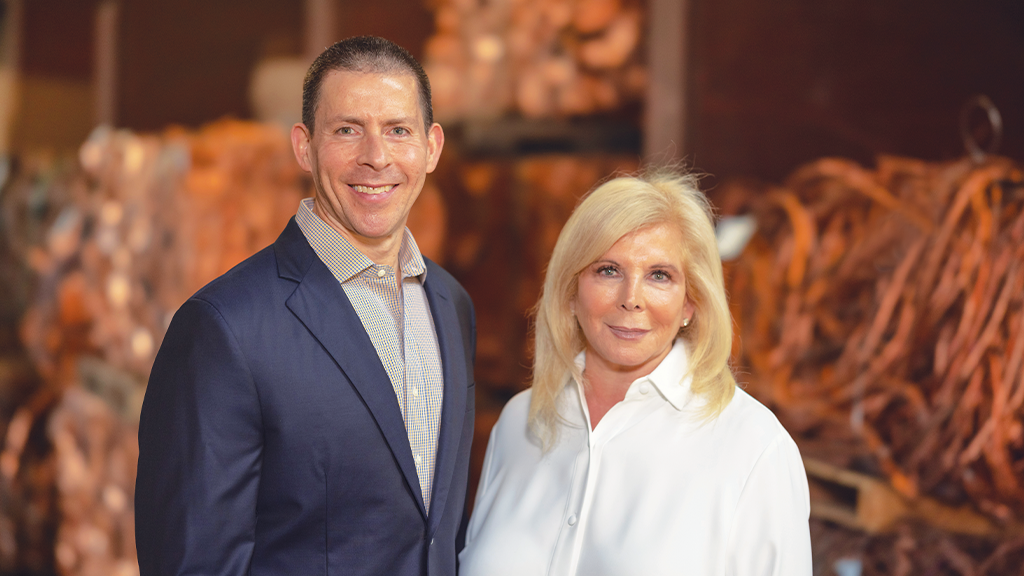
In 1978, Marsha Serlin started the company with $200, a rented truck, and determination to support her two children. The single mother had no experience in the scrap business. On her first day, she rented the wrong truck (a closed-top truck instead of the intended open-top type), and made the rounds to local yards looking for somewhere to sell her scrap.
It did not go as she thought it would.
"I think she went into eight different scrapyards, all of which kicked her out, told her to ‘Go home. Watch your kids, get out of here, lady.' The scrap industry, it's a male industry," recalls her son, Brad Serlin, now President of United Scrap Metal (USM). "Finally, at the ninth location that she visited, they gave her a hand and helped her. And we remained loyal to that company for a relationship [that] spanned almost 30 years until they were no longer in business. She never forgot."
For Brad, staying connected to the company's past means carrying those same small-business principles into a much larger organization. They continue to shape everything from customer relationships and leadership development to community involvement.
Nearly five decades later, United Scrap Metal operates 11 locations across nine states and employs roughly 800 people, making it one of the country's largest privately held recycling companies. The company purchases, processes, and markets ferrous and non-ferrous metals and other recyclable commodities, serving customers across manufacturing, metal service centres, utilities, construction, and demolition.
The company's growth is the product of something much larger than geographical expansion alone. Brad believes its success reflects decades of deliberate decisions about the kind of company USM wanted to become.
Finding opportunity in scrap recycling
The company's willingness to tackle difficult work predates its first permanent facility.
Brad remembers his mother taking on cleanouts, auction salvage, insurance claims, and virtually any opportunity that required determination more than experience. She cold-called prospective customers, knocked on doors, and pursued opportunities whenever she found them. Marsha's approach led to some unconventional contracts: when a leading sporting equipment manufacturer had an insurance claim for footballs and golf balls that fell off a semi-truck, she cleaned them up and resold the sporting goods.
Her willingness to figure things out was also invaluable during Chicago's blizzard of 1979 when nobody was running trucks on the road. Marsha learned that a major food conglomerate's canning plant couldn't move scrap out because of the snow, so USM stepped in and ran their entire truck fleet back and forth throughout the day hauling loose tin plate from the facility. USM's work kept material moving and allowed the plant to continue operations.
"I think what my mom identified early was that anybody can do the easy work," Brad says. "But who's willing to take on the labour-intensive, challenging work that just requires a lot of ingenuity? You have to be willing to take a risk and just do it."
That mindset would become one of the company's defining characteristics.
Learning the scrap business from the yard
When Brad joined United Scrap Metal after graduating from Arizona State University in 1989, he expected to spend only a year in the business before attending law school.
"I originally took my law school admission test, and I was going to go to law school," he says. "This was going to be my gap year. It was going to be spent at United Scrap Metal in the back of the yard cleaning, organizing, and just working hard to save up some money and then go back to school. There was no pressure to come inside the business."
Instead, Brad found himself captivated by the operational side of recycling. Working six days a week in the yard, he supervised projects, dispatched trucks, marketed commodities, managed the company's early recycling centre, and learned every aspect of operations first-hand.
"I loved it out back," he says. "That's where I built my foundational knowledge."
Those years proved formative. It would be eight years before Marsha pulled him into the front office. By then, United Scrap Metal had reached a point where she needed help managing its growth.
"She was just like, ‘Help. Come on up. We're growing this thing fast. There's not enough of me to go around, and you've been in the operation long enough,'" Brad recalls. "Usually . . . the next generation [are being dragged] outside because they don't want to get dirty. They don't want to do that type of work. I was opposite. I didn't want to go in the front office."
After spending nearly a decade learning the business from the yard and developing an understanding of the physical realities of moving, processing, and marketing scrap, Brad's operational experience continues to influence how the company approaches growth today.
Turning utility recycling into a growth strategy
United Scrap Metal's expansion wasn't driven by opening locations for the sake of increasing geographic coverage. Instead, the company identified operational challenges in specific industries and designed comprehensive recycling programs to address them.
One of the earliest examples came through the utility sector. At the time, a major utility company worked with multiple recycling vendors and invited each to propose improvements. According to Brad, United Scrap Metal was the only one out of nine companies that responded with an entirely new operating model.
USM proposed consolidating the utility's entire recycling program, replacing individual vendors with one integrated system. The company would coordinate recycling across nuclear and fossil-fuel generation plants, substations, field operations, and individual projects and provide the reporting and oversight required to manage the program as a whole. That decision became a turning point.
"That turned out to be a catalyst to our growth," Brad says. "From there, we replicated that program across the country."
Today, utility recycling remains one of United Scrap Metal's core specialties. The company developed the compliance, reporting, and destruction processes required by highly regulated industries while maintaining high levels of pollution insurance. Those capabilities allowed USM to expand beyond processing material, helping customers manage compliance, reduce liability, improve sustainability, and recover greater value from their scrap streams.
Maintaining company culture as USM grows
The utility program demonstrated that United Scrap Metal could replicate its operating model. The company's next challenge was ensuring it could replicate its culture.
When expanding into new markets, United Scrap Metal moves experienced team members into new locations to help establish operations and carry the company's culture forward before local hiring begins.
The company reinforces that culture through practices that are surprisingly personal for an organization of roughly 800 employees. Every new team member receives a handwritten welcome note from Brad. Work anniversaries are acknowledged with handwritten letters and gift cards. Managers write monthly notes recognizing team contributions as part of the company's incentive program. Those gestures aren't treated as optional.
"They're the rules of the road," Brad says.
Behind those personal touches sits a more structured approach to leadership development.
United in Leadership (UiL), the company's internal leadership program, was created as United Scrap Metal expanded geographically. Participants develop communication skills, complete leadership projects, and present their work to senior executives. The objective is to prepare future leaders who understand the company's culture as thoroughly as they understand its operations.
Brad points to numerous team members who began in operational roles before advancing into executive positions, including leaders who relocated multiple times to help establish new operations.
"We have so many living success stories," he says.
Performance as a recycling business growth strategy
But culture alone doesn't build an organization operating across nine states. For Brad, culture only matters if it supports performance. When asked which of United Scrap Metal's core values best defines the company today, he pauses between passion and performance before settling on the latter.
"I would say performance," he says. "That's going to drive our growth and the expansion of the enterprise. Really what we're all about is building a bigger enterprise that affords our team members opportunities to grow in the future."
Every team member participates in a company-wide incentive program tied to six organizational goals rather than individual locations. The objective is to encourage collaboration instead of internal competition. Leadership development, team recognition, operational excellence, safety, and wellness all receive the same attention as production metrics.
For Brad, measuring performance also means measuring how well the company creates opportunities for team members to grow. USM has supported team members pursuing MBAs, promoted leaders from within, and encouraged them to build careers across multiple operational roles before moving into executive positions.
A recycling business focused on community impact
Although operational excellence receives significant attention, Brad insists that USM's mission extends beyond recycling commodities.
Community involvement is woven into the company's identity. Team members volunteer with Ronald McDonald House Charities, Big Brothers Big Sisters, Junior Achievement, veterans' organizations, environmental initiatives, and numerous local programs. Monthly company-wide initiatives encourage teams to support different causes, and events, such as the company's annual recycling fundraiser for Ronald McDonald House, bring together USM, customers, families, and local residents.
"We feel it's incumbent upon businesses to give back," he says. "Think outside of their four walls and be a part of the solution."
Planning for continued growth in scrap recycling
Brad believes the company's longevity depends on something far less tangible than its facilities, geographical footprint, or processing capacity. It depends on resisting complacency.
"It's the kiss of death in business," he says. "We've seen great companies just go downhill . . . They don't stay with the times. We never put our heads in the sand."
That mindset shapes the company's long-term planning. Its current road map, United in 2028, outlines ambitious operational, geographic, and organizational goals leading into United Scrap Metal's 50th anniversary.
According to Brad, the company has already achieved one major milestone two years ahead of schedule. The leadership team immediately turned its attention to the next challenge and to setting the next goal.
Brad credits that relentless drive for improvement to his mother.
"My mom's never fully satisfied," he says. "I can thank her for that trait."
Nearly 50 years after Marsha Serlin started the company with $200 and the wrong rented truck, the company continues to look ahead without losing sight of the values that shaped its beginnings.
"I think our mission and our core values are never going to change," Brad says. "We're never going to stray away from what has gotten us here."
______________________________________________________________________________________
This article originally appeared in the September/October 2026 issue of Recycling Product News.