
Binder+Co's AI system makes advanced metal recycling more accessible
Why AI optical sorting is changing advanced metal recovery
Producing premium metal commodities has traditionally come at a premium cost. Consumers demand cleaner, more precisely sorted commodities, while recyclers face rising labour costs and tighter margins. Premium products can unlock higher prices, but achieving those specifications has traditionally required either labour-intensive hand sorting or costly sensor-based technologies.
Artificial intelligence is beginning to change that equation.
Rather than introducing entirely new ways to separate metals, AI-enhanced optical sorting is making many existing sorting applications more economical, allowing recyclers to recover more value from material streams without the investment traditionally associated with advanced sensor technologies.
One example of that shift is Binder+Co's CLARITY AI sorting system, which combines conventional optical sorting hardware with machine learning to recognize materials in ways that traditional colour-based optical sorting may miss.
"We're not presenting these new ways to sort materials," says Ferdinand Schoen, senior sales manager for Binder+Co USA. "It's that AI can do a lot of the sorting that's being done today, but do it better or cheaper than conventional sorting technologies."
How AI sees beyond colour
Traditional optical sorters identify materials primarily by colour. While effective for many applications, those systems can struggle when materials no longer appear exactly as expected.
A weathered piece of copper, for example, may appear brown, grey, oxidized, or coated rather than bright copper red. Human operators can still recognize it immediately, but conventional optical sorters often cannot. AI changes that by evaluating a much broader range of visual information.
"The AI sorter works with just an optical camera system that employs a neural network architecture to process and analyze complete image information in real time. It's basically an enhancement to a conventional optical sorter, enabling maximum performance through intelligent visual data interpretation," says Schoen.
Instead of focusing mainly on colour, the system analyzes characteristics such as shape, edges, surface texture, and other visual cues to build a more comprehensive understanding of each object passing beneath the camera.
Training AI for metal sorting
Teaching the system follows a process similar to training a person. Representative pieces of a specific material are presented to the system, allowing the AI to develop its own recognition model based on their shared visual characteristics.
"You have to present the machine with . . . at least a thousand pieces," says Schoen. "The more the better." While that may sound like a lengthy process, pre-sorted material can pass through the AI sorter in just a few minutes, after which the software processes the information on Binder+Co's server and creates a new or updated sorting program within a few hours.
Binder+Co currently favours site-specific training rather than relying entirely on centralized databases. According to Schoen, creating the training dataset using material from the customer's own operation consistently produces the most reliable results because every recycling stream has its own characteristics. While material libraries exist, programs are tailored to individual applications and retrained when operators determine conditions have changed significantly.
Making advanced AI metal sorting more accessible
The most significant impact of AI is not only improved sorting accuracy but improved accessibility.
Advanced technologies such as X-ray Transmission (XRT) and X-ray Fluorescence (XRF) have enabled increasingly sophisticated metal separation for years. However, their cost has limited adoption primarily to larger recycling operations.
AI optical sorting offers an alternative for many applications. Schoen says that, for certain sorting tasks at comparable throughput, AI systems can often perform the same sorting tasks while requiring roughly one-third to one-half of the initial investment of comparable XRT or XRF systems. Since the systems rely on optical cameras rather than X-ray technology, he says that operating costs can decrease by eliminating X-ray components, reducing spare parts costs, and avoiding the additional requirements associated with X-ray safety standards. AI sorting can also run faster than conventional XRT/XRF sorting, further reducing operating costs. On a 2.1-metre-wide sorter, for example, Zorba can be run at over 20 tph.
This gives larger recyclers the capacity to do more with fewer machines and gives smaller companies the flexibility of quickly running different products and different programs. Instead of dedicating individual machines to one specific application, recyclers can switch between customized sorting programs as production requirements change. Used as a batch process, a single AI sorter can move between different sorting applications throughout the day, allowing facilities to recover a wider range of higher-value materials with one machine. That lower cost changes the economics for many recyclers.
"I think the real advantage of AI is that you can implement a very versatile system that can handle a number of applications that are a much lower investment cost compared to previously existing technologies," says Schoen.
For many mid-sized recyclers, that may represent the first practical opportunity to move beyond producing standard non-ferrous products and begin upgrading material into higher-value products.
"I think it will really be a door opener for many recyclers to do more with sorting," says Schoen. "It gives them a lot more opportunities."
AI sorting across multiple recycling streams
That flexibility extends across a wide range of metal recycling applications.
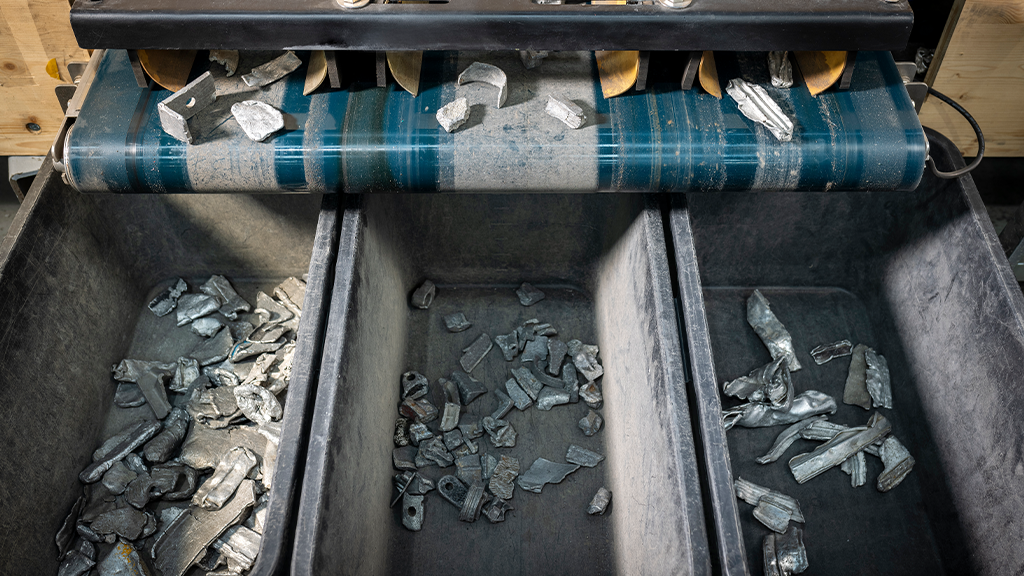
Within mixed, non-ferrous material streams such as Zorba, Twitch, and Zurik, AI can separate copper, brass, zinc, cast and wrought aluminum, radiators, and extrusion products into cleaner commodity streams. Many of these separations were already possible using other technologies, but AI makes them economically attractive for a broader segment of the market.
The technology is also finding applications in shredder residue and automobile shredder residue (ASR), where recyclers continue searching for additional value after primary recovery processes have been completed. Insulated copper wire is one of the primary targets, but AI can also automate many manual picking tasks that remain common in those streams.
Electronic scrap presents another area where AI offers significant advantages. Unlike more uniform material streams, e-scrap contains an exceptionally diverse mix of products, components, plastics, metals, and assemblies. According to Schoen, that complexity plays to AI's strengths.
Circuit boards, electric motors, copper, aluminum, and other visually identifiable components can all be targeted through customized sorting programs, reducing reliance on manual sorting and, for some applications, more expensive sensor-based technologies.
Calculating the ROI of AI sorting
Ultimately, the business case depends on the application. Recovering a few percent of copper from a high-volume Zorba stream generates a very different return than recovering insulated copper wire from ASR. Even so, Schoen says customers frequently calculate payback periods measured in months rather than years.
He shares one example of a customer who previously sold Zorba containing residual copper and brass, but now removes those materials before sale. The recovered metals are marketed separately, while the remaining aluminum fraction is upgraded and sold as Twitch. The result is not simply cleaner material but multiple premium products from the same feedstock.
Labour savings can further strengthen the business case. Automating manual picking tasks not only reduces operating costs but also helps recyclers address the ongoing challenge of finding workers for repetitive sorting roles.
Beyond the immediate operational cost savings, Schoen says the greatest opportunity lies in separating valuable metals into cleaner commodity streams, so recyclers can produce higher-value products and capture more of the material's value themselves.
The next stage of advanced metal recycling
The next stage of metal recycling may not be recovering more metal, but recovering more value — more intelligently.
For Binder+Co, AI is emerging as a complementary technology for existing sorting systems and as an affordable way to make advanced sorting accessible to more operations. For many recyclers, the biggest breakthrough may not be what AI can identify, but what it makes economically possible.
This article originally appeared in the July/August 2026 issue of Recycling Product News.