
What’s new in ferrous recovery
Separation equipment is closing the gap between recovered ferrous and marketable ferrous
The recycling industry has spent decades refining the technology used to pull ferrous material from mixed streams. Magnets, belts, and drums are well-understood tools, and most processing lines have some version of them. What's shifting is the quality standards that recovered ferrous material has to meet before it has value to the people buying it.
As steel mills tighten scrap specifications and plastics processors reject granules contaminated with metal particles, the tolerance for impurity in recovered ferrous is narrowing. What makes ferrous separation unusual is that the same material can be the target or the problem depending on the stream — wanted in one context, a contaminant in another. That shift is driving development in ferrous separation equipment: recycling systems are being designed not just to recover iron and steel, but to do so cleanly enough to meet the requirements of increasingly demanding end markets.
The response of equipment manufacturers has taken two main forms. One is to extract more purity from the magnetic separation stage itself, rather than accepting a lower-grade output and addressing contamination downstream. The other is to chain multiple separation technologies together, so that what one stage misses, the next catches. Both approaches are reflected in recent product developments.
Getting more from a single pass
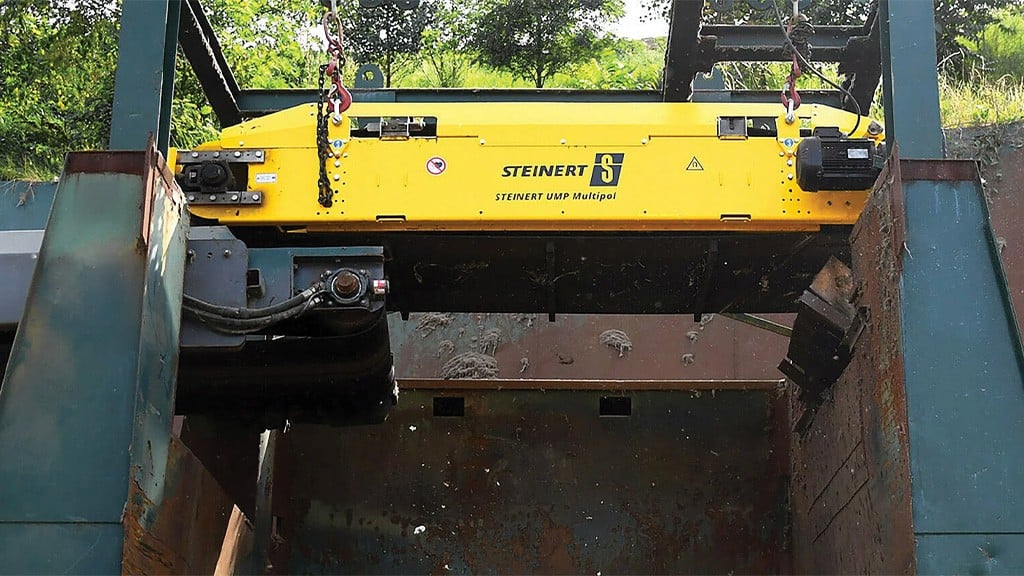
STEINERT's UMP Multipol represents the first approach. Overhead magnets are familiar equipment on most separation lines, but the UMP Multipol features one main operational difference. Rather than sustaining a constant magnetic field, it alternates polarity multiple times as material passes beneath the belt, repeatedly turning iron pieces over and shaking loose any contaminants that might otherwise find their way into the ferrous fraction when they're entangled with metal at the moment of separation.
The system uses permanent magnets rather than electromagnets, keeping energy consumption low and simplifying maintenance. STEINERT has designed it for integration into existing processing lines, which makes it an ideal option for operators working within the constraints of an established facility.
For operators already running a secondary cleaning stage, the UMP Multipol offers a simpler alternative to conventional cleaning methods. For those not currently cleaning their ferrous concentrate at all, it provides a practical route to higher-purity output without the complexity of a traditional secondary processing setup.
The UMP Multipol is targeted at shredder scrap, e-scrap, auto shredder residue, and other waste streams where entrapment of non-magnetic material in the ferrous output is a consistent problem. In WEEE applications specifically, the alternating polarity design has been shown to reduce copper losses, which is significant given the value of copper and the difficulty of recovering it once it has been mixed into a ferrous fraction.
Multi-stage separation for fine fractions
For processors handling finer material, a different set of issues applies. Plastics recyclers in particular face contamination at particle sizes where conventional magnetic separation becomes less effective. Standard drums and overband magnets pull out larger ferrous pieces, but fine iron, stainless steel fines, and non-ferrous metals can carry through into the final product. Filters in melting screws can jam, and chemical processing equipment can become blocked, reducing output quality and increasing maintenance costs.
Goudsmit Magnetics has addressed this with a three-stage separator designed to run material through three distinct separation technologies in a single pass. An overband magnet handles coarser steel first. A high-gradient head pulley then removes fine iron and stainless steel, including particles attached to rubber or plastic. An eddy current separator follows, targeting non-ferrous metals including copper, aluminum, brass, precious metals, and lead.
Material is fed as a wide, thin layer through a vibratory feeder before reaching any separation stage. The overband magnet's first-pass removal of coarser steel reduces the contamination burden on the head pulley and eddy current separator, allowing both to perform more effectively on a cleaner feed. The modular design allows the overband magnet to be removed for installations where it isn't needed, giving operators the ability to configure the system around their specific feed material and available footprint.
A shared direction
Both of these developments approach ferrous recovery from different angles: one improves what a single magnetic pass can produce, and the other stacks technologies to catch what any individual stage would miss, but they're responding to the same underlying pressure.
The question facing ferrous recovery equipment today isn't whether a system can attract iron. It's whether what comes off the magnet is clean enough to be useful. Recycled content mandates are increasing, and end markets that once absorbed lower-grade recovered ferrous with minimum scrutiny are now applying specifications that require tighter control at the separation stage.
Multi-stage polarity switching and sequential multi-technology separation are two different answers to that problem. The right fit depends on the material stream, the type of contamination, and what the recovered fraction needs to look like, but both reflect the same shift: precision at the separation stage is no longer optional.
This article originally appeared in the May/June 2026 issue of Recycling Product News.