
9 shredder metrics every yard should track
Measure, adjust, and improve operations by spotting small changes early
The deterioration of shredder performance usually shows up as lost tons per hour, steadily increasing electrical costs, or reduced casting life, rather than something blatantly obvious. In fact, many operators believe their shredder is running completely fine when the data says otherwise. Here are nine key metrics that can help operators spot small changes early to measure, adjust, and improve day-to-day operations over time.
1. Tons per hour
Although tons per hour is the most visible shredder metric, it's often misunderstood. Many yards focus on daily or weekly tonnage without evaluating it against scheduled production time.
"Maximizing throughput during the scheduled production time is really the goal," said Randy Brace, president of Riverside Engineering, during a session at the most recent ReMA Safety and Operations Forum. "Understanding what your shredder is capable of — depending on what size you have and what motor you have — plays a big part in understanding what you should be accomplishing through your shredder."
Tracking tons per hour allows operators to see whether performance is improving, flat, or slipping. It also provides context for other metrics, like energy use and wear costs. Without that baseline, any talk about optimization is mostly guesswork.
2. Uptime percentage
Brace noted that when yards report exceptionally high uptime, it usually means downtime is not being tracked accurately. Uptime should reflect planned production time, not adjusted expectations after breakdowns occur. Reactive maintenance, unplanned stops, and extended cleanups all count against uptime.
"Anybody that's doing more than 90 percent uptime is either not tracking it, and they just think they're doing that well, or they're doing a really good job," said Brace. "The only way to do that is to be proactively doing your maintenance. If you're having to do reactive maintenance, you're stopping in the middle of a run, and you really shouldn't be stopping the clock. You're supposed to be shredding."
3. Motor utilization
Motor utilization reveals how hard the shredder is actually working. Brace explained that many operators believe they are running at capacity when motor data actually shows long periods of underuse. Tracking motor utilization highlights inefficiencies caused by poor feeding practices, inconsistent operation, or unnecessary pauses.
4. Gaps in feed
Material blockage at the feed rolls and gaps in feed are two of the biggest thieves of production time, according to Brace.
Without automated tracking or defined thresholds, yards rarely recognize how much time is lost to underfeeding. By measuring how often the shredder drops below a defined load level, yards can quantify this loss and address it through training, scheduling, or equipment adjustments.
5. Top downtime causes
Not all downtime is equal. Brace cautioned against chasing the most visible or frustrating problems instead of the most costly ones. Tracking the top five causes of downtime focuses attention where it matters most and prevents yards from solving minor issues repeatedly while major losses go unaddressed.
"It's really important to know your top five delays so that your business can focus your resources — your people, your money, your time — on your big delays instead of just hitting the squeaky wheel, so to speak."
6. Energy use per ton
Energy consumption can be one of the highest operating costs for yards, and can vary dramatically based on shredder size and operating conditions.
"We're seeing a lot of the smaller shredders coming into our industry. The smaller the shredder, the lighter the hammer, and the more power or energy it takes to process scrap," said Brace. "It takes twice as much energy to process scrap in a small shredder as it does in a big shredder because of the efficiency gains that get bigger as you process more scrap inside the shredding tube."
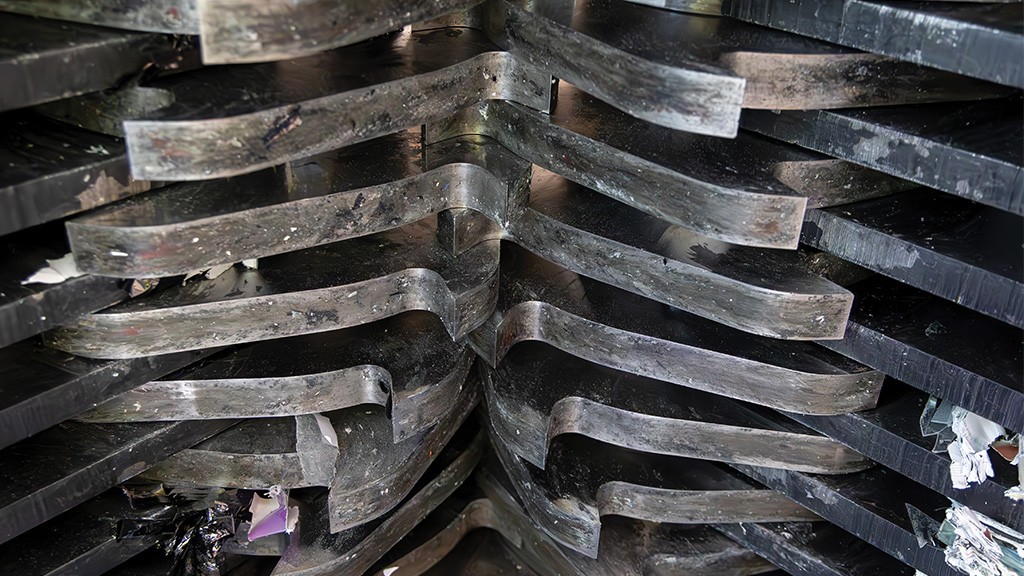
7. Hammer and grate condition versus throughput
One of the most common optimization mistakes is running castings too long in pursuit of maximum wear life. Brace warned that this approach often backfires.
"Trying to get every pound of wear out of those sometimes is not worth the loss in throughput or the efficiencies in the shredder," he said. "Running hammers and grates past their optimal condition, they run hotter. You're starting to do more grinding instead of shredding inside the shredder, and it consumes more energy."
8. Density of shredded material
Shred density is another good indicator of efficiency. If the density of shredded materials is too low, that could point to underfeeding or poor box loading. Density that is too high can increase wear and electrical costs.
"What I hear in the industry is 85 pounds per cubic foot," said Brace. "How you measure that is different for every yard, because if you're using a really small box, it's hard to get 85 pounds per cubic foot."
9. Daily start and stop times
At the most basic level, Brace stressed the importance of disciplined record keeping.
"If you don't have a computer system, you have to at least be tracking when you started, when you ended, the tons that you produced, and the reasons for lost time," said Brace.
Daily start and stop times anchor all other metrics, and without them, throughput, uptime, and downtime data lose accuracy. Brace emphasized that collecting data is only the first step: reviewing it and acting on it is what drives improvement.
This article originally appeared in the March/April 2026 issue of Recycling Product News.