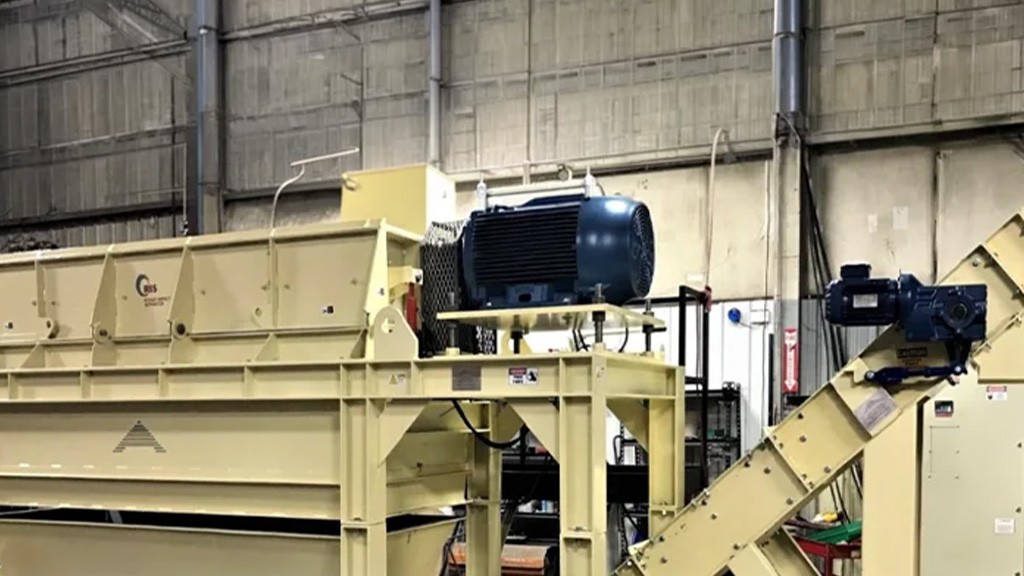

Mobile screening plants redefine flexibility for material processing
How Ecostar and eFACTOR3’s partnership is changing the economics of screening

The North American recycling and waste processing landscape continues to evolve as inbound waste streams become increasingly heterogeneous. Commercial and industrial waste, construction and demolition debris, and fuel preparation feedstocks now contain higher levels of film plastics, textiles, moisture, and composite materials than ever before.
Evolving streams are placing significant strain on conventional screening technologies and driving demand for mobile equipment capable of maintaining performance under variable operating conditions. One of the technically distinct solutions gaining adoption in North America is flexible dynamic disc screening technology developed by Ecostar and deployed across the United States through its exclusive distribution and service partnership with eFACTOR3.
The evolving engineering requirements of modern screening
Screening systems have traditionally been evaluated primarily on throughput and particle size separation. However, modern processors increasingly require screening equipment capable of delivering:
- Stable throughput despite material variability
- Resistance to wrapping and plugging from film and fibrous materials
- Consistent particle size distribution for downstream fuel or recycling processes
- Reduced maintenance frequency and faster service intervals
- Adaptability to mobile deployment environments
- Energy efficiency and reduced mechanical stress
These performance requirements are exposing inherent limitations within traditional screening technologies when processing mixed post-consumer waste streams. Here are some of the advantages of the dynamic disc screening technology over traditional methods.
Screening surface efficiency
Although trommels, for example, offer a large overall screening area, only a portion of the drum surface is actively screening material at any given time. Material tends to cascade inside the drum, creating layered material beds that reduce screening accuracy. This layering effect becomes more pronounced as the moisture content increases or when processing film and fibrous materials that tend to ball and roll instead of stratifying.
Ecostar disc screening systems utilize a horizontal screening surface where material is continuously bounced and conveyed across the entire surface. This results in higher screening efficiency per square foot of footprint compared to traditional rotating drums.
Performance with high-moisture feedstocks
In trommel systems, wet materials often adhere to perforated drum surfaces or blind screen openings. Once blinding occurs, the effective open screening area can be reduced dramatically, leading to throughput losses and inconsistent particle separation.
Ecostar's Dynamic Disc Screen (DDS) uses hexagonal or octagonal Hardox discs on counter-rotating shafts to generate a "jolting" up-and-down movement (dynamic movement) as material flows over them. The flat disc profile and jolting motion agitate wet, sticky, or bulky clumps, stratifying particles so undersize falls through fixed gaps while oversize conveys forward. This prevents clogging, maintaining steady flow even in high-moisture waste, like MSW, organic, or mixed commercial waste.
Limited wrapping risk for film, textiles, and more
Rotating drum screening surfaces are prone to wrapping from plastic films, textiles, and fibrous materials. Once wrapping begins, it typically requires manual cleaning and unplanned downtime.
Ecostar's patented Hyper Dynamic Disc Screen (HDDS) makes dealing with tricky, tangly materials like textiles, long plastics, films, or straps less of a headache. It uses "hyper flaps" right next to the Hardox discs that grab the stringy bits and push them along to the oversize pile without snagging anything.
Loose manifolds prevent twisting, and the system's bouncy jolting action creates steady flow, enhanced separation (even for cans or bottles), and fewer pauses for cleanup, whether it's messy MSW, C&I waste, or RDF. Operators spend less time fixing jams and more time keeping things moving.
Wear distribution and component longevity
Ecostar disc screening technology uses tough Hardox steel while improving separation with two main factors working together: controlled shaking to loosen material and a steady forward push across the whole screen. This lifts and spreads particles repeatedly for better layering and cleaner cuts.
Throughput stability under variable feed conditions
One of the most significant operational advantages observed in disc screening technology is throughput stability. In trommel systems, throughput often declines disproportionately when moisture or film content increases because material bed depth rises inside the drum, reducing screening efficiency.
Ecostar disc screens maintain consistent throughput because material is continuously conveyed across the screening deck and reaches a productivity level of up to 200 T/H. This stable throughput is particularly valuable in mobile operations where feedstock composition can change daily, and operators require predictable production rates.
Footprint efficiency and mobility advantages
Because Ecostar disc screens utilize a horizontal screening architecture with high active screening area utilization, they typically achieve comparable or greater throughput than trommel systems while occupying a smaller equipment footprint.
This footprint reduction provides important advantages for mobile screening plants, including:
- Reduced transport weight and dimensional constraints
- Faster mobilization and site setup
- Improved compatibility with temporary or space-constrained processing sites
- Reduced civil infrastructure requirements when transitioning to stationary installations
Energy efficiency
Disc screening systems operate with lower rotational mass compared to large trommel drums, translating into lower startup energy requirements and reduced stress on drive components. Moreover, the efficiency of the Dynamic Disc Screening technology enables the use of smaller electric motors of 7.5 kW up to 20 t/h, and saves up to 70 percent on energy consumption compared to traditional screens.
Downstream process optimization
Particle size uniformity plays a critical role in downstream processes such as refuse-derived fuel production, biomass processing, and optical sorting performance.
Ecostar dynamic disc screening systems provide tighter particle size control due to the jolting movement and consistent screening gap geometry. Improved particle size consistency can enhance:
- Combustion efficiency in fuel applications
- Optical sorting accuracy in recycling applications
- Conveyor and shredding equipment performance
- Air separation efficiency in windsifting systems
Emerging applications
Ecostar mobile screening machines are increasingly being utilized in solid recovered fuel and refuse-derived fuel production; commercial and industrial waste processing; plastic film and lightweight packaging separation; construction and demolition waste recovery; and biomass and compost feedstock preparation
The ability to maintain screening accuracy across diverse and variable feedstocks has made disc screening a preferred solution in applications where traditional screening methods struggle to maintain uptime and consistency.
The role of eFACTOR3
While screening technology selection is critical, successful deployment also requires application engineering tailored to regional feedstock characteristics. As Ecostar's exclusive U.S. dealer, eFACTOR3 provides technical support, including feedstock characterization and process modeling; equipment configuration and integration design; demonstration and rental equipment programs; field commissioning and aftermarket service; and integration with shredding, separation, and conveying systems.
This engineering and service infrastructure ensures Ecostar screening technology is optimized for the specific operational realities faced by North American processors.
Screening as a performance multiplier
As recycling and waste-to-energy markets continue to demand higher product specifications and operational reliability, screening systems are transitioning from a basic preprocessing function to a critical performance driver within material recovery operations.
Disc screening technology combined with mobile deployment capability is enabling processors to adapt more rapidly to changing feedstocks, market requirements, and infrastructure constraints.
Through the partnership between Ecostar and eFACTOR3, U.S. processors have access to screening solutions designed to address both current operational challenges and the evolving demands of future recycling and fuel production markets.
This article originally appeared in the March/April 2026 issue of Recycling Product News.
Company info

Suite 140
1379 McDow Drive
Rock Hill, SC
US, 29732
Website:
efactor3.com
Phone number:
704-944-3232