

Have U.S. and Asia recovered paper trade tonnages bottomed out?
Total annual recovered paper shipments from the U.S. increased while imports fell, raising the question of whether an oversupply is developing
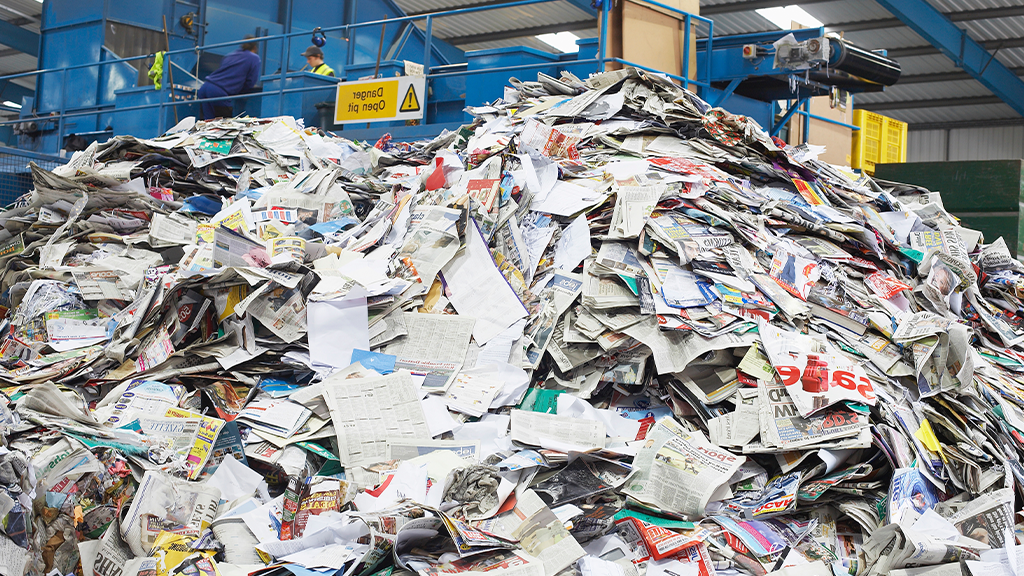
The total recovered paper exports from the U.S. in the first seven months of 2025 were 7.22 million metric tonnes (8 million net tons), up 4 percent annually from approximately 7 million metric tonnes, according to Census Bureau data.
Monthly shipments from the West Coast slipped 30.2 percent to 29,901 metric tonnes in July from 42,856 metric tonnes in June 2025. Volumes from the East Coast in this period were almost flat at about 21,000 metric tonnes.
Although the overall data shows improved export volumes compared to the January-July 2024 review period (negative 8 percent annually), shipments appear to have slowed. The rate of annual increase has been consistently 1-4 percent.
Market participants state that the year began slowly and will likely end on that note. Many consider this a sign of stability; however, this year's recovered paper export and domestic price trends tell a different story.
Soft demand exacerbated by mill closures
Global demand for recycled fibre has been soft, mainly because paper mills in the U.S. and worldwide have been on extended outages. The number of sites that have closed has also been higher this year than in 2024 or 2023.
A few significant mills that have been mothballed are Georgia Pacific's Cedar Springs, Georgia, containerboard facility, which will reduce the company's overall linerboard and corrugated medium capacity by about 1.2 million metric tonnes per year.
Smurfit Westrock plans to cut nearly 450,000 metric tonnes of recycled containerboard capacity at its St. Paul, Minnesota, site, and International Paper plans to reduce annual containerboard volumes totalling about 900,000 metric tonnes after shutting its Riceboro and Savannah mills in Georgia.
Sharp export price trends
The weekly Davis Index export prices for Baled #11 Old Corrugated Containers (OCC) have fallen by about $3 to $5 per net ton, FAS New York and FAS Los Angeles, respectively. The sharpest weekly decline was seen in October this year. Even though levels peaked at about $150-155 per net ton in April, current prices seem to be reaching new lows of $115-120 per net ton (see Figure 1).
Moderate oversupply
According to market participants, with fewer recovered paper shipments leaving U.S. port cities, domestic mills seem to have more than enough inventory. Many indicate that this may be a long-anticipated oversupply. Scheduled downtimes, permanent or temporary closures, and soft demand have significantly influenced tonnage movements this year. The impact is also evident in recent import data and domestic recovered paper prices.
Between January and July, recovered paper imports into the U.S. were 411,844 metric tonnes (453,980 net tons), down 29 percent from 579,181 metric tonnes in the same months of 2024. This is in contrast with 50 percent higher imports in the first seven months of last year compared to 2023.
Canada and Mexico are still the top sellers of the material. However, this year's annual shipments from both countries were 20-60 percent lower than the 47-110 percent increases seen last year against 2023.
The domestic demand and supply of recycled fibre have also taken a hit. U.S. mills have reduced imports, and many are also holding off on large local purchases. The monthly Davis Index for Baled #11 OCC held firm at $95-111 per net ton, FOB seller's dock, in the Southwest, Los Angeles, Midwest, and the Northeast in Q1. From April onward, the indices dropped to new lows of $70-85 per net ton FOB seller's dock (see Figure 2).
The outlook for Q4 2025 and Q1 2026 appears to be soft to sideways in both export and domestic recovered paper markets. Market participants have hinted that export prices could fall up to $10 per net ton on a weekly average and up to $20 per net ton domestically.
Strained trade relations
Census Bureau data show that tonnage across all U.S. port cities appears to be cooling, and recent trade policy changes have played a role. On the one hand, recent policy changes exempt certain wood pulp from the reciprocal tariffs; on the other hand, China has restricted pulp imports.
The U.S.' exemption of a few pulp products stems from a significant effort led by industry associations to safeguard vital imported raw materials such as Bleached Eucalyptus Kraft (BEK) pulp. Efforts by the AF&PA and representatives of Brazil's pulp mills appear to have secured an uninterrupted supply of BEK and other pulp categories.
As far as restrictions from China are concerned, although the Asian nation isn't a direct buyer of U.S. export-grade recycled fibre, it does purchase from other Southeast Asian countries, which remain the largest importers from the U.S.
Thailand, Malaysia, and Indonesia have been among the top three importers of recovered paper from the U.S. In the first seven months of 2025, of the total 7.22 million metric tonnes shipped abroad, 35 percent or nearly 5.3 million metric tonnes were headed for Asia. Of this, almost 2.6 million metric tonnes were bound for Thailand, Malaysia, and Indonesia. If China ramps up import regulations on dry brown fibre, most Southeast Asian nations could also reduce recycled fibre imports.
Reprieve remains to be seen
Soft demand, trade restrictions, and global mill outages have continued to influence U.S. paper trade in more ways than seen before. The near-to-medium-term outlook for domestic and export prices of recovered paper remains bearish.
There are, however, a few market participants who noted that with new or revamped mills anticipated to come online in Q1 or Q2 2026, some of these challenges could ease. What remains to be seen is the extent of reprieve that mill buyers and sellers could receive in the next couple of quarters.
This article originally appeared in the November/December issue of Recycling Product News.