
Nova Scotia expands packaging and paper recycling with new EPR
Circular materials will assist with modernizing EPR guidelines and recycling infrastructure
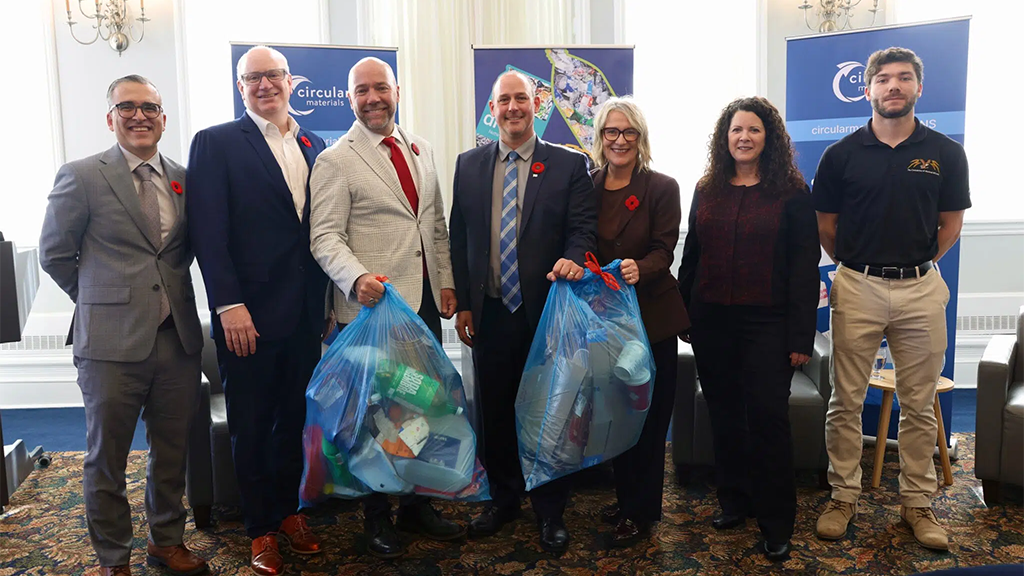
Circular Materials will launch a new extended producer responsibility (EPR) law for packaging and paper on December 1, 2025, marking a milestone in modernizing the province's outdated recycling system. To celebrate this transition, Circular Materials was joined today by Divert NS, government officials, municipal and First Nations partners, and industry representatives at an event held at Halifax City Hall.
Advancing recycling in Nova Scotia with EPR laws
EPR represents a fundamental shift in how recycling is managed in Nova Scotia. Under this model, producers — the businesses that supply packaging and paper to residents — will fund and manage the collection and recycling of these materials. This approach enhances efficiency, drives innovation, and ensures materials are collected, recycled, and reintroduced into the economy to be used again and again.
Beginning December 1, Nova Scotia will transition to EPR, with Circular Materials assuming responsibility for the residential recycling program across the province. As part of this transition, Circular Materials will also begin collecting recyclable materials from multi-family dwellings, schools, and campgrounds throughout Nova Scotia.
The program will maintain Nova Scotia's familiar dual-stream blue bag system, keeping recycling easy and accessible for all residents, while introducing a uniform material list to ensure residents in every community can recycle the same materials consistently.
The updated list expands the types of materials accepted in the program to include hot and cold beverage cups, pet food bags, frozen juice containers, and other paper packaging, as well as plastic packaging such as toothpaste tubes, hand cream tubes, and deodorant sticks. Circular Materials is also partnering with a network of Eastern Recyclers Association Enviro-Depots for the collection of foam packaging, flexible plastics such as candy wrappers and chip bags, and aerosol containers, available for recycling at participating drop-off locations.
Key facts about Nova Scotia's EPR transition:
- The program will operate under the Nova Scotia Readiness Report for Packaging, Paper Products, and Packaging-Like Products.
- 37 fully registered communities or representative organizations are participating in the program.
- 7 First Nations communities are participating.
- Over 40 participating drop-off locations across Nova Scotia. More information at circularmaterials.ca/NSdepots.
- Over 25,000 multi-family building units, 125 schools and 33 campgrounds have registered with Circular Materials to receive service on December 1, 2025. Additional multi-family buildings, schools and campgrounds will begin service on May 1, 2026.
- An audit centre will monitor recycling performance year-round, using sample data to guide education and improve program effectiveness.
Nova Scotia government to work with circular materials
"Nova Scotia has a long history of leadership in waste diversion, and this critical step builds on this experience and strengthens that legacy," said Allen Langdon, CEO of Circular Materials. "Through EPR, we are creating a more consistent, modern recycling system that expands what residents can recycle, improves material recovery, and advances a circular economy that benefits people, communities, and the environment."
"This is an important milestone for our province," said Timothy Halman, minister of environment and climate change. "One of the best ways to cut down on what ends up in landfills is through extended producer responsibility programs. This approach helps build a stronger circular economy by encouraging producers to design products and packaging that are easier to recycle, repair, and reuse. We'll keep working with municipalities, the recycling sector, and Nova Scotians as this program rolls out to make sure it's effective and sustainable supporting a greener future for all Nova Scotians."
Circular Materials is working closely with Divert NS, municipalities, and Mi'kmaq partners — the Confederacy of Mainland Mi'kmaq and the Union of Nova Scotia Mi'kmaq — to ensure an inclusive and seamless transition.
"This is a truly collaborative effort," said Andrew Philopoulos, managing director, Atlantic Canada, Circular Materials. "We've engaged extensively with municipalities, First Nations, and Divert NS to build a unified approach that strengthens recycling performance and supports communities through this important change."
"Nova Scotia's move to EPR represents a new era for recycling in our province," said Stacy Breau, CEO, at Divert NS. "Through our collaboration with key partners in the waste management industry across the province, we expect a smooth transition that delivers improved outcomes for residents, municipalities, and the environment."
Advancing recycling infrastructure in Nova Scotia
As part of broader system modernization, Circular Materials has recently announced the development of a new pre-conditioning recycling facility in Halifax, Nova Scotia. The facility, owned and operated by REgroup, part of the Municipal Group of Companies, will serve both Nova Scotia and New Brunswick and is expected to be operational in early 2027.
Located near the Burnside Industrial Park (Halifax Regional Municipality), the facility will feature advanced sorting technologies, including near-infrared (NIR) optical sorters and advanced imaging systems, to increase recovery rates and improve material quality. Funded by producers under the EPR framework, this investment will benefit residents and communities.
"This facility reflects the forward-thinking collaboration that defines our approach," added Langdon. "By investing in advanced infrastructure, we're helping ensure that more materials remain in circulation and continue to deliver environmental and economic value. Together, we're strengthening Nova Scotia's recycling system for the long term."