
BIR celebrates largest membership yet at World Recycling Convention in Bangkok
The next BIR Convention will take place in Gothenburg, Sweden, from June 1-2, 2025
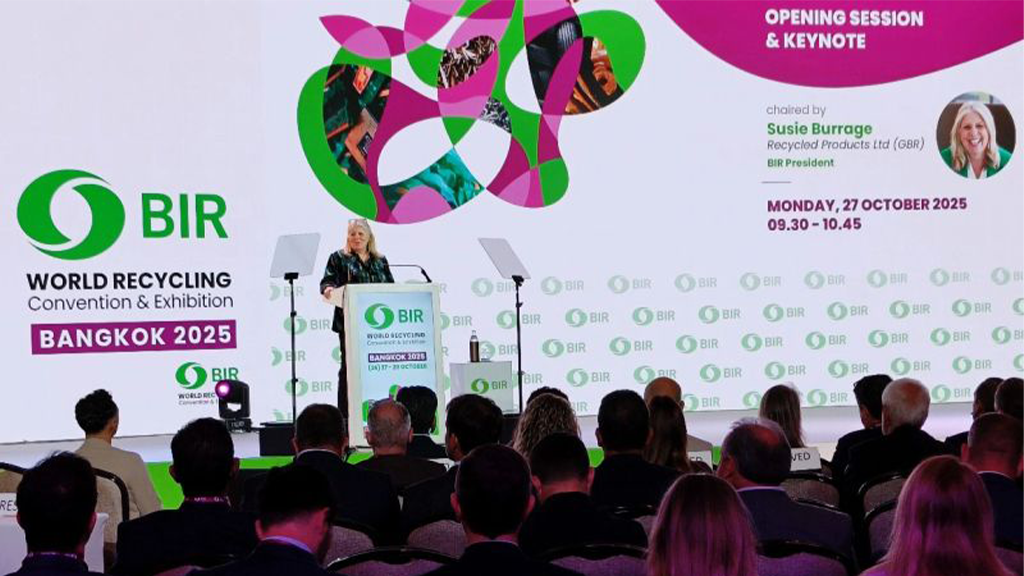
The 2025 Bureau of International Recycling's World Recycling Convention in Bangkok is focusing on how recyclers benefit from the growing demand for secondary materials during a seismic shift in the world order. As well, the convention has also opened the event by noting a remarkable increase in industry participation; the 2025 convention has officially achieved its largest membership in its 77-year history.
BIR President Susie Burrage OBE opened the convention by celebrating the success of the event held at the Centara Grand and the Bangkok Convention Centre. The venue underscored Thailand's growing leadership in recycling and circular economy initiatives.
She also announced that the next BIR Convention would be in Gothenburg, Sweden, from June 1-3, 2026.
Keynote speach
At the event's Opening Session chaired by BIR President Susie Burrage, delegates were assured by keynote speaker Juan Verde that the sustainability agenda was not under threat; it was being re-labelled and recycling remained critical.
Verde, a corporate and government strategist who has advised U.S. Presidents Biden, Obama, and Clinton, spoke about super-powers, trade trends and the future of sustainability and recycling.
"We are at a historic crossroads," he told convention delegates. "Rules that applied to free trade and the global economy are no longer valid. We are at the birth of a new world order that will have a significant impact on your industry in particular."
Verde's presentation covered three key areas:
- Changes in geopolitical power, notably the rise of China
- Global trends in technology, supply chains, conflicts and protectionism
- The future of sustainability and recycling
On China's rise, he said: "It happened because the United States and Europe were very successful at sending our manufacturing and industrial capacity to China, and so did the rest of the world. As a consequence, China is now a superpower able to contest and compete with the United States."
Industry transformed
One of the consequences of this rivalry, the speaker argued, was competition for resources and, notably, critical materials. Technological changes such as 5G, artificial intelligence, quantum computing, biotechnology, and space technology, were part of the superpowers' strategic rivalry.
"This is transforming the world economy and it will transform your industry in ways that we cannot even begin to understand today."
Verde noted a shift to greater regionalisation and more "friend-shoring" by which giant economies such as the U.S. bring back parts of key industries and their supply chains to the U.S. which results in greater protectionism and a race for resource security with implications for recyclers.
"This new protectionism is actually quite good for your industry because it is going to force nations to invest unthinkable amounts of money to increase their recycling capacity."
The drive for sustainability had been good for the recycling sector and Verde doubted those who thought it could not continue.
"The arrival of Donald Trump in the White House — a president who does not believe in climate change — does not change the direction," he said. "It changes the speed at which this green revolution is taking place."
Recycling growth
The previous U.S. president, Joe Biden, a democrat, injected huge amounts of dollars into the green economy with his Inflation Reduction Act. Verde believed it would not be reversed by republicans because of the wider benefits of the Act to Republican states and voters. Crucially, the agenda was also being embraced by the private sector in the name of resilience, national security and industrial competitiveness
The speaker pointed out that the market for recycling critical minerals is projected to grow by around 15 percent annually until 2033 and was the fastest-growing segment of the recycling industry. Meanwhile, global investment in recycling and the circular economy from 2019 to 2024 exceeded U.S. $160 billion, a 40 percent increase in five years.