
STADLER installs 50 tph sorting facility in Stockholm
The facility uses automated sorting lines to recover organic waste, plastics, and metals from residential streams
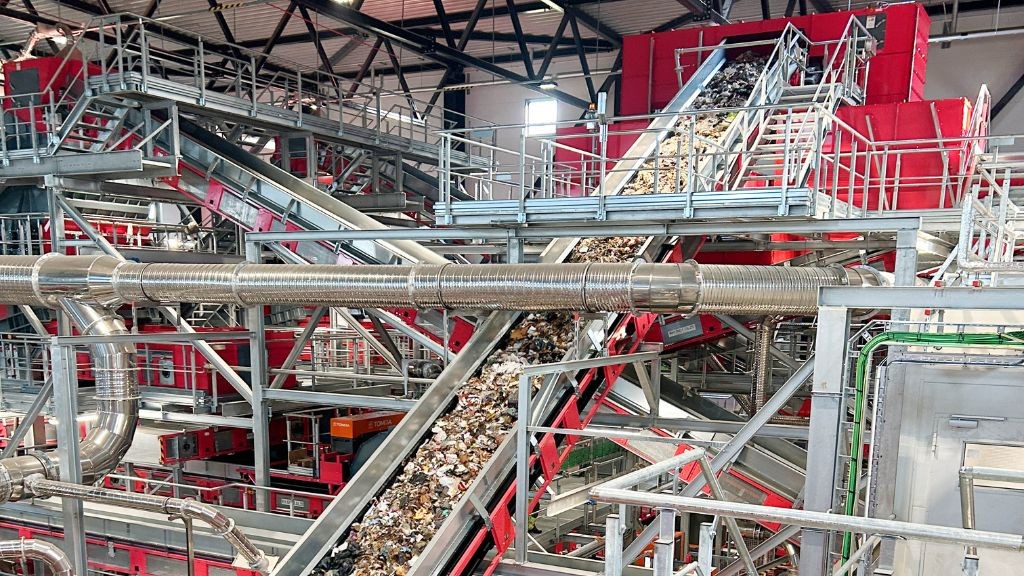
STADLER Anlagenbau GmbH successfully completed the new municipal solid waste sorting plant for Stockholm Vatten och Avfall (SVOA). Designed to process 50 tons of waste per hour, the new facility is equipped with fully automated sorting lines that recover organic waste from household garbage, as well as plastic and metals accidentally mixed in the residual material arriving at the plant.
The sorting capabilities reduce the volume of materials destined for incineration to generate power and heat water, consequently lowering CO2 emissions.
With its fully automated process and two parallel sorting lines that can operate independently, the facility brings resilience and efficiency to Stockholm's waste management system. Commissioning was completed in August 2024, and the plant was officially inaugurated in October.
A high-performance facility for smarter waste management
At the heart of the facility is a sorting process that separates green bags containing organic food waste, as well as any mixed plastics, ferrous and non-ferrous metals, with a high degree of precision and automation, ensuring they are identified and diverted from the residual waste arriving at the plant.
Incoming municipal waste is delivered directly into five walking floors equipped with hydraulic covers, ensuring seamless reception. The material is transferred to dosing conveyors, producing a uniformly distributed stream of waste to feed the plant. After initial manual pre-sorting to remove bulky or hazardous items, the material stream is separated by particle size through STADLER's screening drums.
A standout feature of the plant is the Coloured Bag Sorting System, which combines five Near-Infrared (NIR) and visual spectrometers (VIS) to accurately and quickly identify and extract green bags containing food waste without requiring them to be opened. These bags are weighed and routed for biological treatment, preserving the quality of the organic fraction.
The remaining material moves through a series of NIR sorting systems to recover plastics by polymer and colour, and through magnetic and eddy current separators to extract ferrous and non-ferrous metals. An innovative system of movable conveyors beneath the screening drums allows the plant to quickly adapt to changes in waste composition without interrupting operations.
Designed for operational efficiency
The Resursutvinning Stockholm plant was designed with a focus on operational efficiency, the environment, and safety. The equipment has been positioned on multiple levels to fit within the facility's compact footprint, with a layout engineered for both accessibility and safety. All drives and maintenance points are accessible via walkways and dedicated platforms, ensuring that servicing can be conducted quickly and safely.
The facility features innovations representative of STADLER's engineering approach. A residual fraction buffer weighing system featuring two weighing bunkers provides accurate weight data while enabling continuous material flow. Movable conveyors under the drum screen allow for flexible adjustments to the downstream material fraction size, accommodating changes in input composition or seasonal variations without stopping the line. Additionally, a central vacuum system and cleaning points strategically placed throughout the plant facilitate efficient cleaning, contributing to a safer and more productive work environment.
Plant automation is central to its operation. The facility is run entirely through a centralized control system, with manual input required primarily for routine maintenance and cleaning.
"With our design, we were able to deliver a facility that combines performance, precision, and adaptability within a highly compact layout," explains Uroš Tintor, project manager at STADLER.
"What stands out in this plant is its adaptability," adds Nejc Božič, project manager at STADLER. "Everything from the parallel line design to the movable conveyors under the screens gives SVOA the flexibility to handle seasonal variations, keep the line running, and optimise performance with minimal manual intervention."
Supporting Stockholm's circular economy
Impacting 1.5 million residents and businesses in the Stockholm area, Stockholm Vatten och Avfall is Sweden's leading water and waste management company. Its mission is to ensure access to clean drinking water, treat wastewater, and provide environmentally friendly waste management for everyone.
The Resursutvinning Stockholm plant is supporting SVOA's goal of increasing material recovery and reducing environmental impact in the Stockholm region. It enables the separation and recovery of valuable materials that would otherwise be incinerated for energy. By isolating organic waste for bioprocessing and capturing any plastics and metals accidentally included in the residual waste for recycling, the facility helps reduce the city's carbon footprint while turning waste into resources.
The design of the plant, featuring two parallel sorting lines, allows for continued operation during maintenance or partial outages, thus ensuring uninterrupted service and long-term reliability. Its advanced sorting technology enables it to adapt to changes in waste streams and future requirements.
The Resursutvinning Stockholm project embodies the highest standards of engineering, environmental stewardship, and client collaboration. With STADLER's support, SVOA is establishing a new benchmark in municipal waste recovery and progressing towards a circular economy.
"The Resursutvinning Stockholm plant is a leap forward towards ambitious environmental goals while ensuring reliable, high-quality waste management," says Lars Nyquist, project manager at SVOA. "It is important that packaging is sorted at home, but plastic and metal packaging can accidentally end up in the residual waste. With STADLER's expertise, we now have the technology and infrastructure to improve resource recovery, reduce emissions, and move closer to closing the loop on waste in Stockholm."