
Don’t leave valuables in the car
Powerhand’s VRS 200 turns ELVs into multiple clean, profitable streams
In an industry where margins are tight and material purity drives profitability, end-of-life vehicle (ELV) recyclers are reevaluating their approach to how vehicles are dismantled before shredding. While many yards still send full cars straight to the shredder or rely on time-consuming manual disassembly, a growing number are turning to pre-shred dismantling to extract higher-value materials before downstream sorting.
One of the systems helping lead this shift is the VRS 200 from Powerhand, a Scotland-based manufacturer with over a century of experience in building equipment. Designed specifically for vehicle dismantling, the VRS 200 enables yards to recover copper wiring, aluminum radiators, starters, alternators, engines, gearboxes, and more before the vehicle body ever hits the shredder.
From copper wiring to catalytic converters
Instead of treating vehicles as single scrap units, the VRS 200 makes it possible for recyclers to approach each one as a collection of separate, high-value material streams. Recyclers using the system have found that removing components like engines, catalytic converters, aluminum parts, and wiring looms ahead of shredding not only increases resale opportunities but also improves material purity downstream.
"We have customers who strip parts off that they need . . . and they sell the different materials for a higher value than the car shell," says Murray Clark, Powerhand's managing director.
Others are driven by the need to reduce contamination in their ferrous output. "A lot of them have realized that . . . they can actually get out more material [with pre-shred dismantling]," he explains.
Wiring looms, in particular, represent a major opportunity. "They [have] a much higher recovery rate," says Clark. "Because you're getting less copper in the shred, you [have] a lot less contamination of the steel." Removing copper wiring before shredding also prevents it from getting tangled in upholstery and ending up in the landfill.
Built for power and dexterity
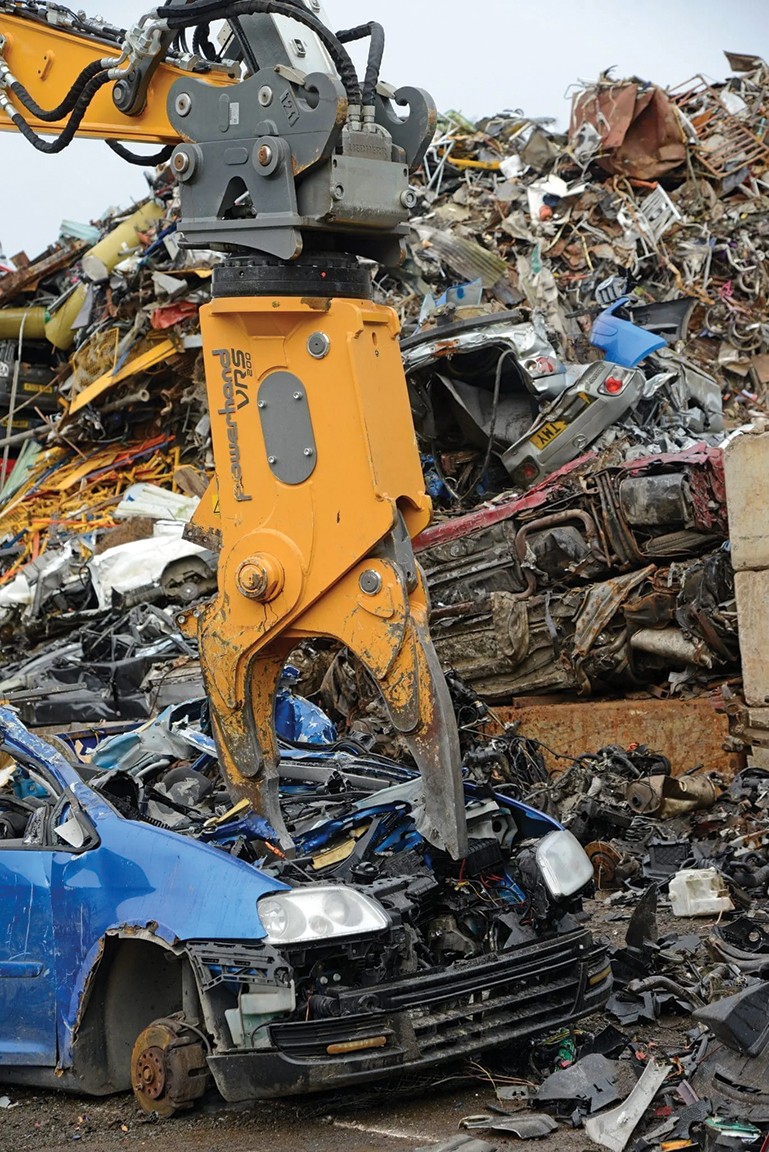
The VRS 200 is built entirely from high-strength Swedish alloy steel for continuous operation in demanding conditions. The attachment combines two tools: a clamp and a grapple. It operates as a synchronized system that combines performance with surgical control.
"It's been designed and developed to be as efficient as possible at taking all the value out of a car as fast as possible," says Clark.
The clamp legs secure the vehicle body from above and below, adjusting both vertically and horizontally to stabilize the car at any angle. Once pinned, the Dexterity Grapple moves in, designed like a pair of long, surgical pliers with one fixed and one moving jaw for exacting control. Operators can remove wiring looms, starters, alternators, and radiators with direct visibility into tight spaces.
An integrated side shear slices through axle brackets or rusted components when needed, while optional wire stripping tools on the clamp leg clear the cable of plugs and insulation, leaving behind clean, high-value cable ready for collection. Each function is purpose-built to isolate valuable material from the shell quickly and efficiently, turning the vehicle from a single scrap item into a series of profitable, clean streams.
A factory fit for productivity
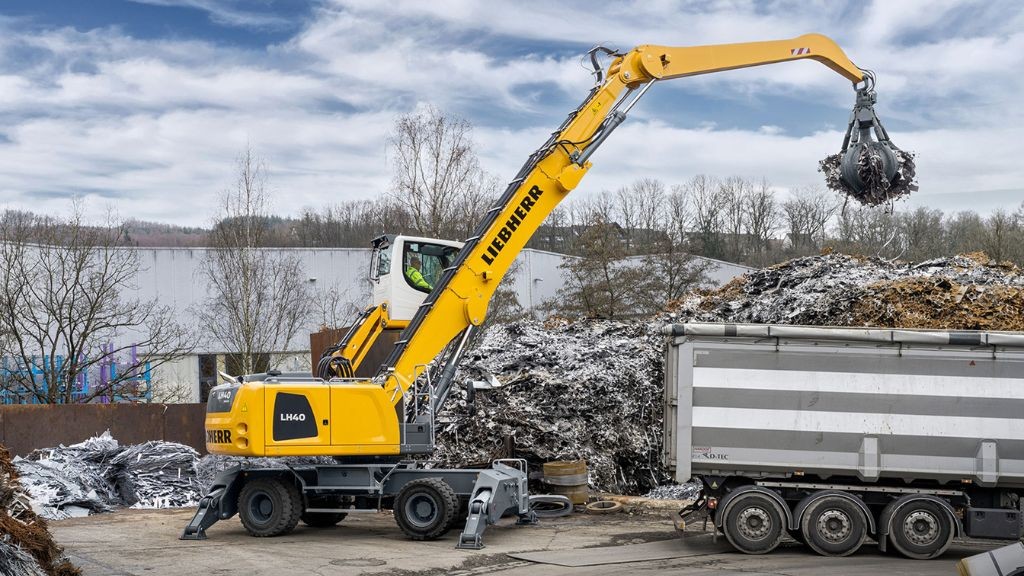
While the VRS 200 can be mounted on most 20- to 25-tonne carriers, Powerhand has worked closely with Liebherr to develop a factory-installed, plug-and-play configuration for Liebherr's R 922 crawler excavator.
"We cooperate with Liebherr's factory in Colmar, France," says Clark. "They prepare the machine for the VRS 200 system, and it just plugs straight on."
Although Liebherr is the only OEM with a factory install program, Clark says the system can be fitted to other makes and models. It can also be fitted to material handlers similar to Liebherr's LH 22 or LH 30 for operations that want multi-use machines.
If a recycler wants one machine to serve multiple purposes in their yard, Clark says the addition of a quick coupler on the end of the boom makes that easy. "They'll switch between doing car processing with the VRS in the morning, and then they'll do some scrap sorting or some handling in the afternoon."
On the ground and in the yard
The VRS 200 has been active in North America for about six years. Several systems are operating in Western Canada, including one at Mitchell Metal Recycling in British Columbia.
Mitchell Metal Recycling is among the Western Canadian firms actively investing in advanced pre-shred technologies. As the operator of one of a growing number of Powerhand VRS 200 units currently in use in Canada, Mitchell is able to efficiently extract high-value materials from ELVs before shredding.
Clark notes that some of these customers also operate metals trading businesses in addition to recycling yards, using the VRS 200 as part of a broader value recovery strategy.
For high-volume operations, the flagship VRS 200 remains the top choice, but Powerhand also offers smaller models for 14- to 20-tonne carriers, suitable for low-throughput dismantlers looking to scale up gradually.
Precision requires practice
While the machine is designed to be easy to learn, real efficiency depends on skilled operators who understand vehicle construction.
"The machine's pretty intuitive . . . most people can pick it up pretty quickly," says Clark. True process optimization comes from knowing how different vehicles are built and how best to take them apart. "It takes time to get really good . . . to learn how different cars are put together."
Understanding how to remove a wiring loom from a Ford versus a Volkswagen, or knowing which seats need to be removed to access side-mounted cables, can make the difference between a partial recovery and a clean extraction.
"If you've got a guy who's just thrashing the car to bits, they're not gonna get half the value compared to somebody who's making it look like surgery and taking out exactly what he wants and not taking out what he doesn't want," explains Clark.
From waste to revenue stream
Manual dismantling methods are still common in many ELV processing sites, but they're slow and labour-intensive, and too often valuable material is left behind. Another common practice, traditional four-tine grabs, might allow an engine to be yanked out, but leave behind or destroy valuable components in the process.
Powerhand's VRS 200 delivers a more strategic solution: engineered pre-shred recovery that improves material purity, boosts resale value, and reduces contamination downstream. In a tightening market, it's not just about what goes into the shredder — it may be about the money recyclers are leaving on the table.
Company info

1015 Sutton Drive
Burlington, ON
CA, L7L 5Z8
Website:
liebherr.com/en/can/about-liebherr/liebherr-worldwide/canada/liebherr-in-canada.html