
Compost industry news from across Canada
Compiled and written by Susan Antler, Executive Director, Compost Council of Canada
Québec invests in organics recycling and compost
Québec Minister of Sustainable Development, Environment and Parks, Pierre Arcand, recently authorized RECYC-QUĒBEC to prioritize focus on the advancement of organics recycling and composting across the province.
Emphasis on collection and processing infrastructure efficiencies, awareness and education, as well as the nurturing of end markets for both compost and digestate will be among priorities.
“The responsible management of organic residuals is the fundamental priority,” Arcand said. “We will support municipalities and the IC&I sector to develop modern, efficient systems to manage organics, thereby improving overall environmental performance.”
The direction comes with a “Year 1” investment of four million dollars which will provide resources for RECYC-QUĒBEC to solicit input and move-forward action from a cross-section of community, industry and government partners to achieve overall provincial recovery targets of 60 percent by 2015.
Action plan to support compostable packaging
A partnership between the Municipal Waste Association (MWA) and The Compost Council of Canada has been established to develop a resource guide and recommended action plan for manufacturers and brand owners intending to introduce compostable packaging and products into the Canadian marketplace.
Propelled by the recent discontinuation of Kraft Canada’s “earth pack” compostable bottle for Dentyne, Trident and Clorets gum, the new guide has relevance to ensure the practicality and reality of existing composting infrastructure is taken into account when compostable products and packaging are introduced. The compostable packaging and products Action Plan is targeted for review and discussion at the upcoming National Compost Conference in Montreal in mid-September.
Manitoba’s green plan offers opportunity for composting
Over 100 proposed initiatives form the basis of an uplifting environmental protection strategy recently released by Manitoba’s Premier, Greg Selinger. The strategy, focused on both environmental and economic sustainability, is dubbed “TomorrowNow – Manitoba’s Green Plan”.
The plan encompasses proposals designed to capture ongoing environmental benefits achieved through individual action, environmental technology investment, wildlife protection and ecotourism, clean and efficient sustainable energy, as well as improved resource utilization and re-utilization.
Proposed as an eight-year strategic plan, there is tremendous opportunity to move compost and organics recycling forward in Manitoba through this initiative. The proposal is now in the forum of public consultations with input being requested by October 31, 2012.
Sustainable Sites Initiative to support compost advances
A new program called SITES is designed to link landscapes with sustainability, and it is good for composting. The program is focused on landscapes surrounding both developed and non-developed sites, and is destined to become a 4-level certification program.
The creditation process outlined in SITES’ 2009 Report on Guidelines and Performance Benchmarks is being piloted initially by 150 sites, including two in Canada, using criteria for sustainable land practices that will enable built landscapes to support natural ecological functions. Notably, the use of compost is encouraged throughout the guideline, having applicability in the criteria for Soils and Vegetation, Materials Selected for Site Design, Nutrient Cycling, Local Material Usage, amongst many others.
The importance of supporting the advancement of this “beyond LEED” initiative, which in turn has the potential to significantly drive compost market demand, cannot be underestimated by the Canadian Compost Industry. Reflective of this, the opening keynote address for the upcoming National Compost Conference, in Montreal, September 2012, will focus on the details of SITES and the many ways that compost and organics recycling will fit in within this dynamic.
Calgary site targeted for Municipal Compost Facility
The City lands within Calgary’s Shepard landfill have received approval from the City’s Standing Policy Committee on Utilities and Corporate Services as the potential site for a new composting facility to process the organic residuals from Calgary residents and other sources. Selected from over 30 potential sites both within and outside the city limits, the Shepard location received the highest ranking, using screening criteria factors which included: ease of access to transportation network, proximity to residents and businesses, suitability to accommodate the facility, environmental factors, approvability and schedule, as well as lifecycle costs.
Calgary is piloting an organics collection program involving 7,500 residents in four areas across the city. Results to-date are very positive with approximately 710,000 kilograms of organic residuals being collected in the first 16 weeks of the pilot, and garbage being reduced by 40 percent compared to the rest of the City. The City is targeting a city-wide organics collection implementation program in 2016.
Ontario Environmental Commissioner gives back to the earth
The backyard garden of the Environmental Commissioner of Ontario, Gord Miller, and the other tenants of Canderel’s 1075 Bay Street location in Toronto received a “soil lift” as part of this year’s Compost Week celebrations.
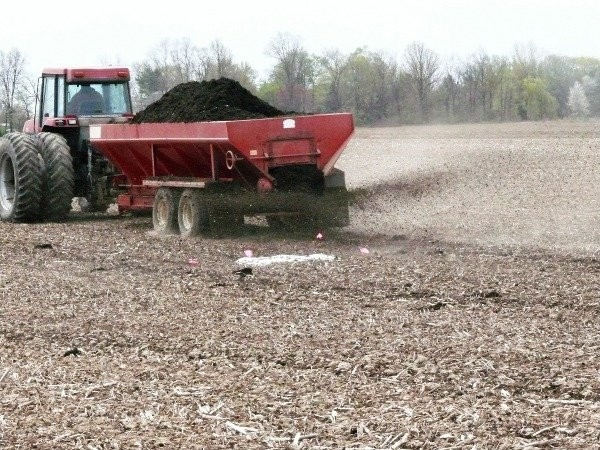
With compost and mulch supplied by Compost Quality Alliance (CQA) members, All Treat Farms, Miller Compost and the Region of Peel, and the landscaping and gardening expertise of Landscape Ontario and the Toronto Master Gardeners, Miller worked with his staff and volunteers from Canderel and The Compost Council of Canada to aerate the lawn and “spread the compost” to get the grounds ready for a great growing season. “While this is just a small area, this serves as a great example of how we can all make a real difference by adding compost,” Miller said. “If we raised the organic matter of this soil by just one percent, this soil patch here would hold an extra 2000 litres of water on a hot day. That’s the kind of real benefit that comes from increasing organic matter to get a richer, living soil.”
ADI International (PEI) wins compost facility pumpkin growing contest ADI International (PEI) Inc. is this year’s growing champion in the Compost’s Giants annual pumpkin growing contest. Now in its’ eleventh year, Compost’s Giants provides a bit of friendly competition amongst compost facilities across Canada for the “weightiest” pumpkin each gardening season. This is the fifth time that ADI International (PEI) has weighed in as the national champion. ADI’s compost facility in Brookfield, PEI receives organics material from PEI businesses and residents through Island Waste Management Corporation’s organics collection program.
The Composting Across Canada feature was written and compiled by Susan Antler, Executive Director, Compost Council of Canada and was included in the July/August, 2012 issue of Recycling Product News.