

the future in bio-sawdust
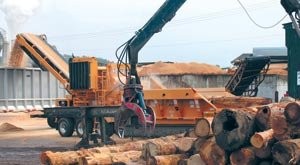
Technology developed by Bandit Industries for its Beast horizontal grinders may change the way that material is processed for biomass power plants, pellet plants, and for the production of biofuels, according to the company.
An increased demand for wood pellets and decreased supply of raw material from sawmills has led to some recent challenges in the renewable energy marketplace. Designed to meet the growing demand for miniscule wood fibre, Bandit has developed technology that allows a 1/4-inch-minus sawdust-type material – known as bio-sawdust – to be produced from debarked round wood in a single pass. Benefits of this new system for users include greater fuel efficiency, higher production levels in pellet mills, and the potential for expansion into biofuel and bioelectricity production.
Because the process used to produce bio-sawdust is a cutting action, as opposed to the beating action used in horizontal grinders and hammermills, far less energy is consumed in producing fine material. When using a diesel-powered Beast, the company says, up to three tons of material can be produced per gallon of diesel fuel consumed.
Additionally, with this new technology wood fibres are cut, not fractured, and pellet operations are reporting that this type of material packs much more efficiently into pellet dies, yielding greater production.
Pellet operations in British Columbia for example, receiving material from the Beast, are reporting a 10 to 12 percent increase in production at pellet mills, (when running material from the Beast compared to other grinders.)
When using a stationary unit with electric power, users can regrind all material coming into a pelleting operation before the material goes to the hog. And by using the cutting system in the Beast, the amount of energy required to size the material is also reduced.
According to Bandit, when it comes to producing bio-sawdust, the unique, patented design of the cutterbody used in their Beast Recyclers is ideal. The cutterbody is shaped like a sawtooth on a chain saw, which enables the chipping system to make a precise, regulated cut. Material entering the Beast is also controlled by the unit’s infeed system, which forwards material to the cutting chamber at the exact speed required to produce the desired chip length. Plus, the screening system (standard on all Beast Recyclers) keeps end-cuts and slivers inside the chamber until the material is properly sized.
When producing bio-sawdust, a chipping operation can generally yield better than 95 percent acceptable material (1/4-inch-minus) in one pass. Similar results are achieved in regrind applications when processing chips and hogged material.
Bandit says the uses for bio-sawdust will likely expand as more applications are tested. The ability to produce a finely ground material efficiently and cost-effectively will likely change the size of material that is used for woodchip-fired boilers as well as home chip-heating systems, while fine material is more volatile and should be more desirable for suspension boilers. The company predicts that bio-sawdust will likely also find its way into biofuel production. Given its unique size and shape, bio-sawdust breaks down faster than other feedstocks in the production of cellulosic ethanol, for example. And carbon-based biofuel plants will benefit from bio-sawdust’s ability to break down rapidly, as it speeds up the gasification process. For those producing premium fuel pellets, debarked material is often used to limit ash content. For pellet operations looking for a bark-free material, ring and drum debarkers seem to hold the greatest potential for supplying debarked material to produce bio-sawdust.
Additionally, because Beast Recyclers have larger openings than what is commonly found in whole tree chippers, it allows them to process larger diameter material, more stems at a time, and simplify feeding. The opening on the model 4680 for example, is 45 inches by 60 inches, enabling it to chip 45-inch diameter material. Thus, over-sized material and cull logs can easily be converted into biomass fuel without splitting.
Company info

6750 Millbrook Road
Remus, MI
US, 49340
Website:
banditchippers.com
Phone number:
(800) 952-0178