
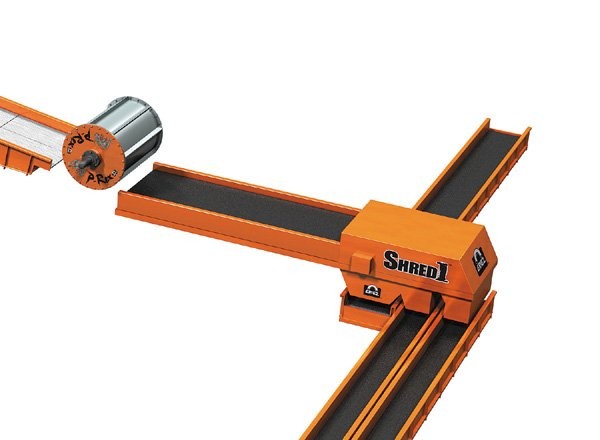
Eriez’s new CleanStream Process combines the power of the company’s P-Rex drum magnet and the new Shred1 separator. This system is specifically designed to increase recyclers’ profitability, and according to Eriez, the P-Rex drum improves ferrous recovery by one to two percent while the Shred1 Separator produces a low copper content #1 shred (<.20%).
In the CleanStream Process, materials first pass through Eriez’ Permanent Rare Earth Drum Magnet (P-Rex) to recover all potential ferrous material. P-Rex’s powerful permanent magnetic circuit, designed using sophisticated modelling techniques, is up to 40 percent stronger than an electro drum, requires no “operating” power and is capable of moving large spherical objects at twice the distance.
According to Eriez, current electromagnetic drum technology simply is not capable of sustaining a deep enough magnet field to attract much of the heavy spheres referred to as meatballs and knuckles. Next, materials go on to the Shred1 Separator, which uses “ballistics” to automatically separate high-grade, iron rich ferrous from mixed metals and waste. It utilizes a high speed conveyor belt and subjects the material to forces that push different materials into varying trajectories. The result is that the smallest and purest items are pulled from the natural trajectory of the larger and less pure ferrous and ferrous composite items such as meatballs, tires, etc. These more pure ferrous items report to the #1 Shred chute and move to a stacking conveyor. Material that is not collected into the #1 Shred chute goes to one of two other collection chutes.
The second fraction is larger sized ferrous items and lower grade ferrous including meatballs and wiring harnesses, as well as various waste. This stream represents the remaining ten to 20 to 30 percent of the original stream and proceeds to a hand picking stations. Since the CleanStream Process has reduced the volume, the hand picking stations can be equipped with slower and narrower belts and require fewer picking personnel.
The third stream represents the non-value wastes. According to Eriez, the bulk of this material is shredded steel belted rubber tires.
“We saw that there was a defined need for an innovation such as the CleanStream Process in the recycling industry,” explains Tim Shuttleworth, Eriez’ President and CEO. “The alternative approach is to use an x-ray scanning system. Not only are these systems incredibly expensive to buy or lease and operate, they are not as efficient as the CleanStream Process.” “Unlike the revolutionary CleanStream Process, these expensive and delicate technologies still require heavy hand sorting. We believe these scanning systems can be eliminated.”
“The CleanStream Process delivers payback in three ways,” continues Shuttleworth. “First, the number of hand pickers required is reduced. Second, CleanStream enables shredders to consistently deliver low-copper content shred, for which steel mills will pay a premium, because too much copper in a melt will embrittle the steel batch and affect the surface quality of the end product.
“Finally,” says Shuttleworth, “you must factor in the value of meatballs, other copper and nonferrous items recovered as discrete saleable commodities. Meatballs are worth several times more by weight than shredder steel and automated equipment recovers more of the material than manual sorters can.”