

IPS and Siemens key to completion of MSW Composting Facility in Lebanon
By Ramy Mehanna, Grossimex, & Richard Nicoletti, Siemens Water Technologies
For the past several decades, all municipal solid waste (MSW) in the region of Tyr in South Lebanon was dumped in the region of Ras El Ain just to the side of a main irrigation channel. In 2004, in an effort to reduce this unregulated dumping and the environmental and health risks associated with it, the union council decided to install a sorting and composting facility to treat all of its MSW, and dispose of the remaining non recyclable waste in a sanitary landfill.
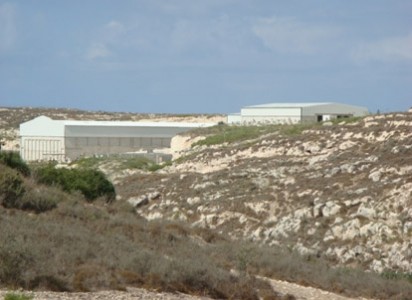
The Union of the Municipalities of Tyr composts up to 150 tons per day of MSW (mainly household wastes) generated by more than 40 villages and roughly 300,000 people. The composting system selected by the Union is an enclosed in-vessel, agitated, aerated, automated process with effective biofiltration odour control. This system was selected for its ability to produce the highest quality compost, from a highly variable and contaminated waste stream, in the most efficient time. MSW is inherently inconsistent when it comes to size, composition and moisture content -- key factors to a composting process. Therefore, flexibility of the compost system was critical in the design process. The facility, designed and equipped by the engineering firm Grossimex sarl of Lebanon, consists of ten 2-meter-wide bays (Manufactured by IPS Composting Systems, Siemens Water Technologies Corporation) to process incoming MSW and Green Waste (yard trimmings).
Facility Process Steps
The following narrative describes the steps throughout the process. It begins with the MSW receiving area and concludes with the distribution of the end product. Steps include receipt of mixed solid waste, active composting, refining and curing.
MSW Receiving Area
Trucks and other vehicles deliver an average of 150 tons of mixed solid waste each day to the receiving area and deposit materials onto the tip floor. A front end loader breaks down these loads to allow for primary bulk separation (pre-sorting). During this phase, large contaminants like tires, home appliances, carpets, etc., are removed from the stream. The front-end loader then places the mixed solid waste into receiving hoppers.
Segregated bags are then opened manually and all contents are dumped onto two 14-m- long sorting lines where manual sorting of all recyclables (plastics, steel, aluminum cans) is done; all the removed recyclables are routed directly into recycling pits. The organics stream then passes under a magnetic pulley to remove any small steel contaminants before being dumped into a 100-horsepower (hp) hammer-mill to reduce contaminant size to less than 5 cm.
The hammer-milled organics are then transferred to the front of the composting bays with a skid steer. There, the automated 50-hp Siemens IPS agitator simultaneously mixes, shreds and translates the material from the front end of the bays to the discharge end of the bays over the next 14 days. During this time in the bays, the compost aeration and temperature is controlled automatically via a forced aeration system. The composted material is transferred to a 1500-m² curing area where it matures for 45 days before it is screened. After screening, the compost is distributed to farmers or used as a soil enhancer for municipal green spaces.
The entire facility is enclosed for odour containment and control, and is equipped with a ventilation system that is designed to maintain the entire building under negative pressure, with all of the air pulled out via 12 fans directly to the biofilter.
Project Information
Owner: Tyr Municipality Union
Start Up: August 1, 2009
Engineers: Grossimex sarl
Capacity: 46,800 tons per year of Municipal Waste
Processing: Municipal Solid Waste (household waste)
Technology Used: IPS 10-bay agitated, in-vessel technology complete
with aeration system
Facility Size: Total of 7250 m² of rigid steel covered facility, including a 2450 m² for the receiving and separation
zones, and 4800 m² (10 bays, each 53 m long, 2 m wide and 2.16 m high) for the composting line. Curing area has
a total area of 1500 m².
Odour Control: Three biofilters, each 646 m²
Grossimex sarl is a company dedicated since September 2000 to finding solutions to environmental issues focusing on the water, wastewater (industrial and domestic), solid waste and solar industries. Strategically based in Lebanon, the company offers a comprehensive range of design, manufacturing, contracting and installation services as it pursues its corporate drive “towards a cleaner environment.”
Contact: Ramy Mehanna, Grossimex, Manager - Project Division
Badaro 2000 Center, Badaro, Lebanon
Tel/ Fax: 00961 1 383180-181
P.O. Box: 116-5063 Email: [email protected] Website: www.grossimex.com