

Choose Your Weapon
Tips from Terex Fuchs: Many Scrap and Recycling Yards Stick with Their Preferred Attachment
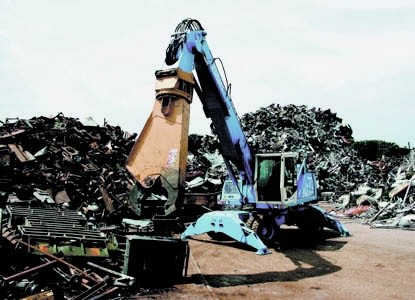
Similar to construction and demolition contractors with their excavators, scrap yards and recycling facilities have a number of attachment options for equipping their material handlers. The attachments for both excavators and material handlers are designed to meet specific needs for maximizing productivity in a number of applications. However, the methods for which the different operations employ theses attachments vary significantly.
Many C&D contractors will have multiple attachments on site – from buckets and hydraulic breakers to mobile shears and grapples – to quickly tackle whatever task the job throws at them. Often, the excavator will be used as a multipurpose machine at the demolition site with different attachments being switched out frequently.
In sharp contrast, material handlers used for the scrap and recycling markets – where some of this C&D material ultimately winds up – will typically see very few, if any, attachment changes to the stick. The applications for which these machines are used often allow operations to select a single, preferred attachment to get the job done.
“It depends on the application and will vary from yard to yard as to whether or not an operation will switch out an attachment,” explains Steve Brezinski, heavy equipment product manager, material handlers, for Terex Fuchs. “Factors weighing in the decision include the size of the operation, number of material handlers on site, the material processed and preference of the operation.”
Scrap operations sometimes choose to switch between Cactus grapples and magnets. Additionally, contractors expanding from demolition to scrap and recycling applications may be inclined to change out attachments more frequently than established operations. Brezinski offers a bit of advice to these companies when selecting a material handler. “Make sure the machine is equipped with some sort of system to help reduce the time it takes to change an attachment, such as our quick attachment system,” he recommends. This will allow the operator to change the attachment in about 15 minutes.
Beyond the debate of whether or not to change out an attachment at the scrap yard or recycling facility, there are a number of things to consider when selecting an attachment for an operation.
The Right Choice
A number of new and low-volume scrap and recycling operations often opt for excavators, and sometimes wheel loaders, to sort, stockpile, and load and unload material from trucks and containers. As business grows, however, the operation typically considers switching to material handlers to help increase efficiencies and keep up with incoming material. “The material handler is purpose built to boost production at scrap and recycling yards,” Brezinski explains. From elevated cab designs that enhance visibility when loading and unloading vessels and containers to faster cycle times with the ability to rotate the upper carriage and attachment to better fuel efficiency, material handlers offer significant advantages for a growing business.
When making the move to a material handler, one thing will become quickly evident to companies switching from an excavator. “Excavators and attachments are sold primarily by weight class, while a material handler is sold by productivity as well as weight,” explains Frank Miscavage, northeast region manager for Terex Fuchs. “The company will have to properly size the attachment according to the handler’s lift chart.”
Several factors must be weighed when selecting the appropriate attachment: its weight; the density of the material; and the size and capacity of the material handler. Brezinski recommends the company start by determining the overall productivity goals and work backwards to find the right attachment. “The type of attachment is based on the material an operation will process and the size is dependent upon the production requirements,” he says.
For scrap yards, most often the attachment of choice is the cactus grapple. Also referred to as orange peel or tulip grapples, these tools are designed for relatively high load capacity and high productivity. Four or five tines come together at a center point to grab large amounts of material. The tines come in a variety of designs. Open tines work well for handling big and bulky items such as cars. “For finer materials, we also offer half-shell and completely closed tine designs,” Brezinski adds.
Grapple weight and capacity must be considered when selecting an attachment. Small to medium sized material handlers will typically be equipped with cactus grapples offering from 0.5 to 1.0 yd3 (0.4 to 0.8 m3) capacity and weighing in the range of 3,000 to 4,000 lb (1,360 to 1,815 kg). The largest material handlers will accept grapples delivering up to a 1.8 yd3 (1.4 m3) capacity with an approximated weight of up to 6,300 lb (2,860 kg).
While matching a material handler to the right attachment is important, Brezinski offers one additional piece of advice. “Consider what you will be unloading and loading with the attachment,” he counsels. “If it will be trucks or rail cars, then make sure the open tines will fit within these containers without damaging them.”
Used in conjunction with or instead of Cactus grapples, magnets are often used to load, unload, separate, stockpile and move ferrous material as well as clear the ground of ferrous debris. “One large scrap operation in the Northeast uses both five-tine grapples and magnets on their material handlers,” Miscavage mentions. “Sometimes they’ll switch out a grapple for a magnet during the day to help stockpile material and then switch back to the grapple at night.”
Magnets come in a variety of diameters, load capacities and power requirements, so operations must ensure the right magnet size is matched to the handler. Additionally, the handler must have an on-board power source to properly operate the magnets. “All Terex Fuchs scrap material handlers have an on-board generator as standard equipment,” Brezinski says. “Companies must make sure the generator has enough power to operate the magnet. Otherwise it will reduce the magnet’s performance capabilities or, worse, tax the generator and system components.”
It’s in the Stick
Most recycling operations have different attachment requirements than do scrap yards. While the material is typically sorted before entering a scrap facility, many recycling centers are sorting cardboard from plastics from paper. As a result, four and five tine cactus grapples may be found at a recycling yard, but more often narrow tine (overlapping) grapples and rake blade attachments are often preferred as they offer more precise picking and sorting capabilities.
Most material handlers have four hydraulic lines for operating the attachment – one each to open and close it and one each to rotate it to the left and right for easier truck loading. To meet the specific needs of recycling facilities, Terex Fuchs and other material handler manufacturers have developed a stick designed specifically for recycling yards, which includes an extra hydraulic cylinder and line. “The extra cylinder is mounted on top of the stick and gives the operator an additional level of control – the ability to move the attachment up and down,” Miscavage explains. This helps to increase the efficiency of the picking and sorting process.
Additionally, recycling and scrap facilities sometimes have a need to further reduce the size of material on site prior to loading it into trucks and rail cars. “Aluminum and copper are often cut into smaller sizes to maximize the space utilization and weight of the material loaded into a car,” Miscavage adds. For this reason, many third party attachment manufacturers will offer a shear attachment option manufactured to a material handler’s specifications. This allows the same handler to not only move, load, sort and stockpile but also size the material when necessary.
When purchasing a material handler, operations anticipating the need to equip it with a shear attachment should inquire with the manufacturer to make sure the attachment will work with the handler and allow it to be quickly attached to the boom. “We offer the Terex Fuchs Quick Connect system that allows the operator to quickly switch from the stick to a shear attachment without leaving the cab,” Brezinski says.
Regardless of operating in a scrap yard or recycling facility, material handlers can be equipped with a number of different attachments and stick options to help companies maximize productivity and boost operating efficiencies. When selecting the right attachment for the operation, companies must consider production needs, size of the handler and the type and density of the material being managed. When the right attachment is found, most often this will turn out to be a most valuable tool that will not often be switched out.
TEREX FUCHS