

Bunting Up-Stacker pulleys handle flat circular parts
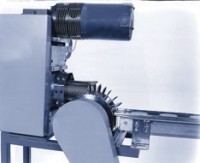
These Magnetic Up-Stacker pulleys are specifically designed to position flat circular ferrous parts for further processing. The Up-Stacker’s magnetic field and surface contour are designed to orient such parts radially around the pulley. For example, metal lids fed from a horizontal conveyor to an Up-Stacker Pulley are automatically repositioned for stacking or processing.
In addition to the Up-Stacker Pulley, a variety of permanent magnetic conveyor components that turn conveyors into magnetic conveying systems designed for efficient handling of ferrous parts or for separation of ferrous debris are available from Bunting. Magnetic Plate Rails, T-Rails and Pulleys enable users to make or modify their own conveyors so that they can move, sequence, stabilize, lift, transfer and turn ferrous parts. Magnetic Drive Rollers are engineered for trouble-free, efficient handling of sheet stock, and Magnetic V-Pulleys create a magnetic field that captures ferrous pipe sections and orients them inside the pulley’s V-groove. Bunting Magnetic Separation Pulleys attract tramp metal as it comes into their magnetic field and hold ferrous contaminants against the conveyor belt until they pass out of the field on the underside of the conveyor.
In addition to the Up-Stacker Pulley, a variety of permanent magnetic conveyor components that turn conveyors into magnetic conveying systems designed for efficient handling of ferrous parts or for separation of ferrous debris are available from Bunting. Magnetic Plate Rails, T-Rails and Pulleys enable users to make or modify their own conveyors so that they can move, sequence, stabilize, lift, transfer and turn ferrous parts. Magnetic Drive Rollers are engineered for trouble-free, efficient handling of sheet stock, and Magnetic V-Pulleys create a magnetic field that captures ferrous pipe sections and orients them inside the pulley’s V-groove. Bunting Magnetic Separation Pulleys attract tramp metal as it comes into their magnetic field and hold ferrous contaminants against the conveyor belt until they pass out of the field on the underside of the conveyor.