

Volvos Put the Rev in the Recycling Revolution
Two generations ago, the Wheeldons farmed pigs for a living on the family smallholding near Manchester, but a simple request from a supplier led to a dramatic change in the business. Today, they are one of the leading waste management companies in the north west of England, employing over 55 people and expanding by the year.
“My Grandad was a pig farmer, who needed large quantities of waste food every day to feed his animals,” says company director James Wheeldon, who runs the business with his brother and father. His mother and sister are also directors. “One day in 1965, one of the suppliers asked if we could replace the feed barrels with a larger container as it would be quicker and easier for them to fill. By the end of the week, he had converted the cattle truck into a waste truck by mounting a skip on it – that’s how Wheeldon Brothers Waste Ltd started!” Within a short time, waste management became the focus of the family business and the pigs were moved on to new pastures.
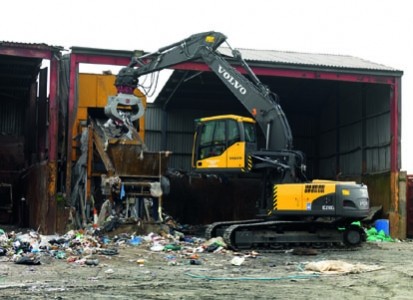
The company is based in Bury, a suburb of Manchester, but recently opened up a second depot 10 miles (16kms) away in Oldham to meet the rapidly increasing demand for their services. They have a fleet of over 3O vehicles, including two Volvo EC210C excavators with hydraulically elevating cab, one EC140C, two L120E wheel loaders and four Volvo FM12 trucks.
Recycling Programs
“A few years back, 100 % of our waste went into landfill,” James explains. “That’s all changed over the last five years following the introduction of recycling programmes and incentives and the government’s increase in landfill tax. Now, over 80 % goes for recycling.”
Delivered by local government authorities as well as private companies and their own trucks, 1,800 tonnes of mixed material passes through the gates every week. Nearly all (90%) of the material is light waste, such as paper, cardboard, carton, general rubbish and polystyrene.
The material is pre-sorted, using the EC210C excavators equipped with Demarec rotating selector grabs to remove the larger items. “Switching from fixed cabs on the excavators to hydraulically elevating cabs has been a fantastic improvement,” adds James. “Loading the material onto the trommel (a mechanical cylinder used to separate waste by size) is so much easier now and the all-round visibility is superb.”
The waste is carried by a conveyor belt into the indoor area of the transfer station where it is manually picked and sorted. The company has five picking lines in total with five men working on each. Four of the lines sift through light waste but one is reserved for demolition material including bricks, concrete, metal, wood and tyres. Most of the sorted waste is transported to local recycling units, though some paper and cardboard is shipped to China. Hazardous material such as asbestos and oil are processed separately, while 15,000 tonnes of tyres are shredded every year and put to a variety of uses, including racehorse tracks.
“We do what we do because we’re an old family business trying to make a bit of money, but it’s a fantastic bonus that we are doing some good for the environment too,” he adds.
Simply much better
The responsibility for purchasing new machines and maintaining the fleet falls to James. As a trained mechanic, it’s a task that he relishes. “The introduction of Volvo machines to the fleet has brought significant benefits,” he says.
“We bought our first Volvo in 2004 and haven’t looked at rival manufacturers since. One reason is that the loaders are far more manoeuvrable than the other machines and they’ve got a lot more power. We found the Volvo is simply a much better, more reliable, productive tool to use.
“Volvo Construction Equipment has also thought through the design of the cab very well. It’s superbly laid out and the controls are very accurate. You step into the cabs of other machines and everything feels a bit plasticky and cheap. In a Volvo you feel the quality as soon as you sit down.”
The proximity and efficiency of the local Volvo dealer has also been a major factor behind Wheeldons’ preference for the brand.
“The Volvo guys are just down the road in Warrington so if we need a spare part we can get there and back in under an hour,” James explains. “The dealers for other machines are much further away and for one of them we have to go all the way to Sheffield, which takes us half a day. By the time we’ve fitted the part once we’ve got back from there the machine has pretty well been out of action for the entire day.”
Helped by the efficiency of their Volvo fleet, the Wheeldon family business has been going from strength to strength in recent times. “When we opened the new site at Oldham, I thought this would keep us busy for the next couple of years at least, but we’re already looking at expanding again.”
Do Wheeldons’ have plans to buy more Volvo machines in the near future? “Yes, in about five minutes in fact!” he adds. “I bought one this very day! and it should be arriving through the gates any moment now. We already had one L120E loader and it’s been superb for us, so we’ve snapped up a second one – and I’m sure we’ll be back for more.”