

Plastic resin recovery
Using magnetic separation
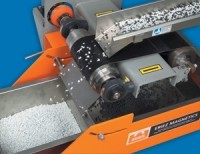
Eriez’ cutting edge PolyMag Process utilizes the time-tested method of magnetic separation to reclaim valuable plastic resins. The PolyMag Separator uses extremely powerful Erium Rare Earth Permanent Magnets to separate mixed resin regrind particles. The PolyMag Process uses an additive, similar to a colourant loading, that turns plastic resin into a candidate for magnetic separation. The process, using only one percent of the PolyMag additive, is designed to eliminate costly hand sorting and other labour intensive procedures moulders have traditionally used to recover valuable mixed resins.
Sequential 3D blow moulding, two-shot injection, co-extrusion and overmoulding processes frequently produce scrap. This scrap is often made up of dissimilar plastics that need to be separated for maximum recovery efficiency and cost savings.
One challenge multi-material processors face is segregating and recovering dissimilar resins. Salvage labour is expensive and inconsistent. Cutting, peeling and sawing multi-material moulded parts creates ergonomic risks for employees. Add to this rising resin prices and there is a special urgency to recycle these mixed plastic resins.
In the PolyMag Process, the first step is to blend a very small amount of the PolyMag Additive into one of the co-moulded resins with an additive feeder or colour auger. Then to recover the scrap that occurs from start-up, process variations or design changes, users simply granulate the multi-material mouldings using a standard plastics granulator. The regrind material is now ready to be run through the PolyMag Separator. The end result is a high percentage of resin separation, in less time and with greater safety than ever before possible.
By design, the PolyMag Additive imparts a low level of magnetic susceptibility without materially affecting the physical properties of the resin or moulded part. The additive is a dry, free flowing pellet, with a non-polymer carrier that is compatible with a wide range of resins.
All resins, including thermosets and thermoplastics, are candidates for the PolyMag Process. As long as the multi-material part can be ground, PolyMag can help separate it. When chemically bonded materials with a high percentage of surface contact are used, it may be necessary to produce a smaller regrind particle to liberate the two resins.
Sequential 3D blow moulding, two-shot injection, co-extrusion and overmoulding processes frequently produce scrap. This scrap is often made up of dissimilar plastics that need to be separated for maximum recovery efficiency and cost savings.
One challenge multi-material processors face is segregating and recovering dissimilar resins. Salvage labour is expensive and inconsistent. Cutting, peeling and sawing multi-material moulded parts creates ergonomic risks for employees. Add to this rising resin prices and there is a special urgency to recycle these mixed plastic resins.
In the PolyMag Process, the first step is to blend a very small amount of the PolyMag Additive into one of the co-moulded resins with an additive feeder or colour auger. Then to recover the scrap that occurs from start-up, process variations or design changes, users simply granulate the multi-material mouldings using a standard plastics granulator. The regrind material is now ready to be run through the PolyMag Separator. The end result is a high percentage of resin separation, in less time and with greater safety than ever before possible.
By design, the PolyMag Additive imparts a low level of magnetic susceptibility without materially affecting the physical properties of the resin or moulded part. The additive is a dry, free flowing pellet, with a non-polymer carrier that is compatible with a wide range of resins.
All resins, including thermosets and thermoplastics, are candidates for the PolyMag Process. As long as the multi-material part can be ground, PolyMag can help separate it. When chemically bonded materials with a high percentage of surface contact are used, it may be necessary to produce a smaller regrind particle to liberate the two resins.