

6 safety checks every recycler should make before transporting lithium-ion batteries
Improper packaging, inaccurate labels, and inadequate insulation can create serious fire hazards and leave recyclers exposed to regulatory penalties
When you order a kit built for shipping damaged lithium batteries, you trust that what arrives can do the job. Right now, people are doing the right thing, getting the wrong packaging, and carrying the consequences. That should concern everyone in this industry. We want people to learn from the lesson here.
The problem
Picture a receiver at a retail store. A customer has brought back a swollen e-bike battery. The receiver orders a DDR battery kit, as the store's procedure says. A kit arrives. The receiver follows the printed steps, seals the drum, calls for pickup, and signs the paperwork. They have done everything the kit and its paperwork told him to do.
Now picture the inspector at the roadside. The drum has no UN stamp. The hazard label is a sheet of printer paper under packing tape. The paperwork names two different battery types, and one UN number that does not exist. Under the law, the person who signed the bill of lading and sent that drum out for shipping is liable. That is it. The ticket has his store's name on it.
How can you punish someone for trying to do the right thing? The person on the dock doesn't really have a choice. The system was put in place for everyone's safety, and trusting it is the only practical option they have. But the failure is upstream, and the punishment lands at the bottom.
What arrived when a kit was ordered
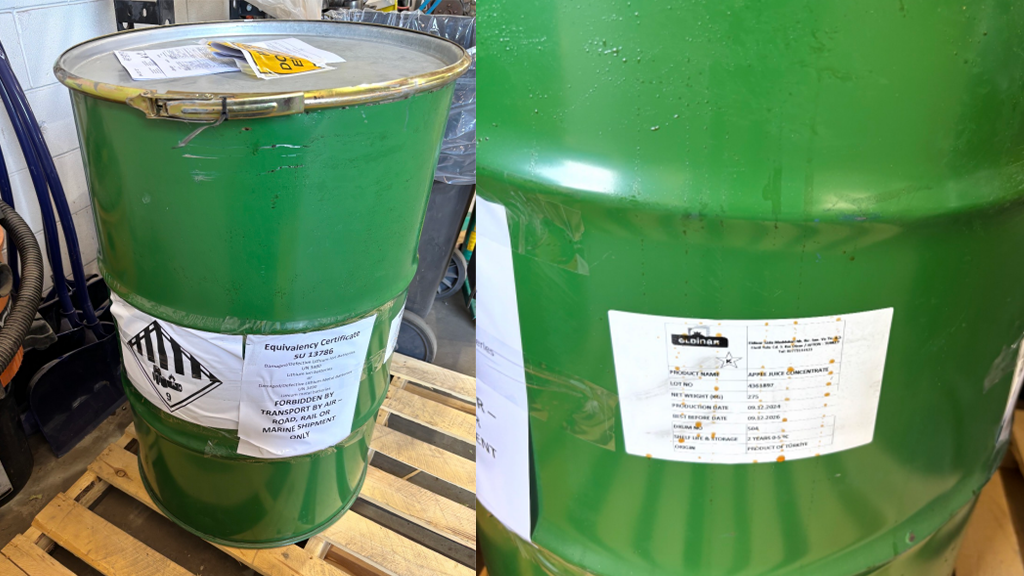
Earlier this year, a client retained Clean Core Research to audit their systems. As part of that project, we ordered a lithium-ion damaged, defective and recalled (DDR) battery kit and photographed what arrived, as received, before anything was added.
One is a Class 9 lithium battery label. The other names an equivalency certificate and lists two battery types joined by the word "or". We ordered this kit for lithium-ion batteries, which are UN 3480. A label is supposed to say exactly what is inside the drum. This one offers a choice, and its second number, UN 3490, does not exist. The real number for lithium metal is UN 3090.
Turn the drum, and the original label is still on it. This was a food drum. It held apple juice concentrate, made in Turkey, with a best-before date of December 2026. There is no UN stamp anywhere on the drum, top, bottom, or side, and no reconditioner's mark. Nobody has tested this drum to hold anything dangerous.
This is the inside. A loose plastic bag. No fitted liner covering the walls. The kit did come with a bag of vermiculite to pour around the batteries; that is the one part of the kit that answers the regulation on paper.
The supplier's own published guide for this kit describes a UN-marked steel drum, a drum liner, batteries bagged one per bag and buried in fill, and an overpack box. The guide warns that substituting components or packing methods may make the package non-compliant. What arrived is the substitute the guide warns about.
What a drum like this does when it goes wrong
A damaged lithium battery does not just burn. When a cell fails, it vents gas: hydrogen, carbon monoxide, hydrogen fluoride, and flammable electrolyte vapour. In the open air, that gas disperses. Inside a sealed drum, and inside the closed trailer the drum rides in, it pools and waits for a spark.
On March 31, 2023, a tractor-trailer parked at a Flying J truck stop in north Birmingham, Alabama, blew its roof off. The trailer was carrying at least 25 drums of lithium batteries, the same 55-gallon size, headed for disposal. Officials believed gas built up inside the trailer and ignited.
A trucker parked nearby described watching the roof of the trailer being thrown 70 feet into the air. Hazmat crews worked for more than an hour to contain it. Nobody was hurt, for one reason only: the truck was parked, and the driver was away from it.
What if this was on the highway? What if it was parked outside a school on battery drive day? Schools run battery collection drives too.
These drums do not move by special convoy. They ride ordinary trucks on ordinary routes, stopped at a red light beside a school bus, rolling past a playground at pickup time. The driver is a courier, not a hazmat technician. The packaging is the only thing standing between those batteries and everyone within reach of the fire and the gas. That is what the container rules are for, and that is exactly what a juice drum with paper labels does not provide.
The vermiculite problem
The vermiculite in the kit deserves a closer look. It probably satisfies the words of the regulation, and it would do almost nothing in a real failure.
The rule asks for sufficient non-combustible, non-conductive thermal insulation around each battery. It names no product, no quantity, and no performance test. Vermiculite is non-combustible and non-conductive, so on paper it qualifies. That is the gap: the rule describes what the material is, not what it has to do. Fill materials are not equal, and the difference shows up in the first three seconds of a failure.
A failing lithium-ion cell does not smoulder. It bursts, shoots burning gas like a torch, throws sparks and molten metal, and pushes the batteries beside it into the same failure.
Vermiculite was made to soak up liquid spills, and that is what it is good at. It weighs almost nothing, so it settles on a moving truck, and the batteries migrate down through it until they rest against each other or the steel wall. The venting jet blows it away from the failing cell at the exact moment it is needed. It quenches no flame, and its mass is too low to carry away meaningful heat. And it does nothing about the hydrogen, carbon monoxide, and electrolyte vapour collecting in the drum. The fire is interrupted by nothing; the gas is managed by nothing.
Sand is non-combustible and heavy enough to stay put, but a 200-litre drum of sand blows past the drum's weight rating, and it still does nothing about the gas. Engineered thermal fills, such as the expanded-glass granulate the supplier's own kit guide specifies, are built for this one job. They pack tightly around each battery, absorb the heat of a cell in runaway, sinter into a crust around it and starve the flame. These are the media inside the packaging certified under U.S. DOT special permits for damaged batteries, where the package has to survive a cell driven into runaway inside it.
A bag of vermiculite in a juice drum meets the words of the rule and fails the fire. That is the strongest reason for certificates to name a tested package instead of a material.
What the permit on the drum actually does
The sheet on the drum cites a Transport Canada equivalency certificate. That certificate is real and runs to October 2028. Almost nobody at a collection site has ever read it.
An equivalency certificate is Transport Canada's permission to skip one specific rule, on the condition that safety stays the same in another way. This one skips exactly one rule: Part 6 of the Regulations, which says people who pack dangerous goods must be trained. The certificate lets an untrained person at a collection site pack damaged batteries, provided they follow the detailed instructions the certificate holder is required to give them.
That is all it does. It does not approve a drum. It does not change what the container must be. Its own text says the batteries are packaged under Special Provision 137, which is the ordinary rule for damaged lithium batteries: a UN-tested drum, a liner, each battery in its own bag, surrounded by fill that does not burn or conduct, correctly marked, with a shipping document.
Every Transport Canada certificate carries the same warning. If any condition is not met, the certificate is treated as if it did not exist for that shipment. The moment the drum is wrong, the training exemption disappears with it, and the person on the dock is now an untrained shipper of damaged lithium batteries in a drum never tested to hold them.
The certificate puts two duties on its holder: give the people packing the drum detailed packing, closure, and shipping instructions, and make sure they know the conditions. The kit in the photographs shows the distance between those duties and what is arriving at collection sites.
Why the shipper is the one who gets the ticket
Section 5 of the Transportation of Dangerous Goods Act spells out the shipper's responsibility: use a permitted container, meet the safety standards, display the marks, and have the documents with the shipment. Nobody else is named, and nobody else gets the ticket.
The tickets under the Contraventions Regulations are written the same way: failing to use a permitted container, $2,000; failing to display safety marks, $2,000; container safety requirements, $2,500; a misleading dangerous goods mark, $2,000. Prosecution runs to $50,000 for a first offence, $100,000 after that, or two years in prison. Each drum is a separate contravention.
There is a defence. Section 40 of the Act says you are not guilty if you took all reasonable measures to comply, and following the instructions that came with a purpose-sold kit is a reasonable measure. Save every document and photo, and you can defend this in court. But you pay the court costs, the time, and the headache to get there.
Meanwhile, the training materials that come with these kits remind customers that organizations which do not comply may face fines from Transport Canada. That standard runs both ways. It has to apply to what is shipped out as much as to what is shipped back.
Six things to look for before you ship
Ordering a purpose-built kit is the right thing to do. Checking what arrives is how you protect yourself. You do not need TDG training to catch a kit like this one. Two minutes and six checks. The photographs above are what failing looks like.
1. Find the UN stamp. Every drum that is allowed to carry dangerous goods has a code stamped or printed on it. It starts with the UN symbol or the letters UN, then something like 1A2/X300/S/25/USA/M6484. Look on the side, the top, and the bottom. If you cannot find it, the drum is not a dangerous goods container. Here's how to read 1A2/X300/S/25/USA/M6484:
| Part | What it tells you |
|---|---|
| 1A2 | What the container is. 1 means drum, A means steel, 2 means removable lid with a locking ring. A 1 in that last spot means a sealed top. |
| X300 | How hard it was tested, and the heaviest the full drum may weigh. X is the toughest level, passing the tests for all three packing groups. Y is the middle level. Z is the lightest. Damaged batteries need X or Y. The 300 means 300 kg maximum gross weight. |
| S | Built and tested for solids. |
| 25 | The year it was made: 2025. |
| USA | The country whose authority certified it. A Canadian drum reads CAN. |
| M6484 | The registered manufacturer. Every maker of these drums is registered with its regulator and stamps its code on every drum it builds. |
Every element of that code means a real drum of this design was drop-tested, stacked, and pressure-tested, and passed. No code, no test, no proof. A drum without one is just a drum.
2. Look for any other product label. A drum that still says what it used to hold has not been reconditioned. A reconditioned drum carries its own stamp, something like CAN/29- 1 258 ABC /25/RL. A juice label, a chemical label, a paint label, anything that is not a UN or reconditioner mark, means stop.
3. Look at how the hazard label is attached. A real Class 9 label is printed on label stock or painted on and will survive rain and handling. If the label is a sheet of office paper under packing tape, it is not a compliant mark. It will peel off in the first downpour, and an inspector will treat it as no label at all.
4. Read the words on the label and make them agree with what is inside. The mark has to say one thing. Lithium ion is UN 3480. Lithium metal is UN 3090. If the sheet says both, joined by "or", it is not telling anyone what is in the drum. If it shows a number like UN 3490, that number does not exist for batteries. A certificate number taped to the drum does not fix any of this. That number belongs on the shipping document, and it only helps when everything else is right.
5. Look inside before you fill it. There should be a liner fitted to the drum, not a loose bag. There should be enough fill supplied to make a bed on the bottom, surround every bagged battery, and reach the rim. If the instructions that came with the kit do not describe exactly that, the instructions are the problem, and the certificate requires its holder to have given you better ones.
6. Look the certificate up yourself. Every equivalency certificate is public. Transport Canada's Approvals search is free: type in the number printed on the kit and read what the certificate actually allows. It takes two minutes from any computer. If your floor has no internet and phones are not allowed on the job, do it once from the office before pickup day and keep a printed copy of the certificate with the kit.
If all six pass, follow the kit instructions and ship. If any one fails, do not ship.
What to do if the kit you were sent fails the check
1. Do not ship it. A drum that has not left your building has not been offered for transport, and no offence has happened yet.
2. Keep the damaged battery safe where it is. Put it in a metal container with a lid, away from anything that burns, away from exits, and away from other batteries. Sand or the vermiculite from the kit is fine as a temporary bed.
3. Photograph the kit exactly as it arrived, inside and out, including the paperwork. Date the photos.
4. Call the supplier and say the kit does not match their own published packing guide. Ask for the packaging their certificate describes and ask them to put the answer in writing. Write down the date, the time, and who you spoke to.
5. Tell your own health and safety lead or manager, in writing, that you have a damaged battery on site and the supplied packaging failed a visual check. That record is what protects you later.
6. Report it to Transport Canada. Each region has a dangerous goods office that takes complaints: Ontario ([email protected]); Quebec ([email protected]); Atlantic ([email protected]); Prairie and Northern ([email protected]); and Pacific ([email protected]). Attach your photos.
If the supplier cannot provide a compliant kit, your organization can buy a compliant DDR container from a packaging supplier, or engage a licensed dangerous goods carrier to collect the battery. Either costs money. A ticket, a fire, or a lost day in court costs more.
7. Keep the failed kit, untouched, until you have the photographs and the written record. Do not return it before then.
What should change
The person at the dock should not be the only one the law can reach. Three changes would fix most of this.
Certificates should name the package. Transport Canada's equivalency certificates for battery collection describe who may ship and what rule is relaxed. They should also describe the container: the UN marking, the liner, the fill, the quantity. A certificate that names a tested package gives an inspector, a receiver, and the supplier the same checklist, and leaves no room for a juice drum.
The certificate holder should be accountable for what it ships. A kit that cannot meet the certificate's conditions is the holder's failure. Responsibility should sit with the organization that printed the sheet and shipped the drum, not with the person who trusted it.
Kit users should get the certificate, not just the number. Every collection site operating under someone else's certificate should receive the certificate itself and a one-page picture guide of the compliant package. If the kit on the floor does not match the picture, the receiver knows to stop and knows why.
Until then, the six checks above are the only protection a collection site has. Use them.