
EverestLabs’ new multi-agent AI platform layers innovations for optimal processing
Navigator combines three layers of AI into a single system to improve efficiency, throughput, and financial performance
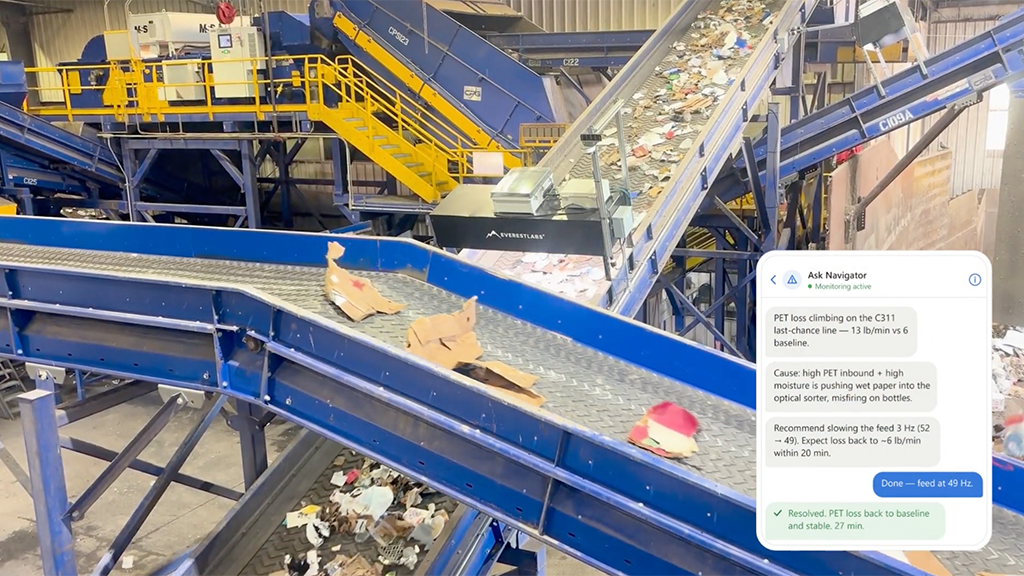
EverestLabs is launching a new multi-agent AI platform built for material processing, recovery, and recycling facilities. Navigator provides plant operators with real-time operational intelligence and acts on it to improve efficiency, throughput, and financial performance across recycling and processing facilities handling plastics, fibre, and metals.
How Navigator layers technology to boost throughput and revenue for recyclers
Navigator brings together three layers of AI to operate in a single system: edge vision models that classify materials at the belt, vision-language models (VLMs) that interpret each stream in context, and reasoning and conversational agents that recommend and act.
Navigator moves beyond static dashboards with specialized AI agents that monitor equipment health and coordinate systems in a continuous closed loop, allowing for ideal material processing and sorting in real time. It is trained on billions of data points and processes chaotic and highly variable material flows at millisecond speeds.
Navigator plugs directly into existing plant control networks and older, legacy equipment without the need for expensive retrofits or halting production.
Navigator fundamentally alters the profit-and-loss statement for material processing facilities through the following benefits:
- Boosting facility throughput up to 30 percent: Navigator mitigates material flow problems and idle belt time, which can often boost a facility's capacity between 20 and 30 percent, thus increasing revenue.
- Millions saved through reduced downtime: Navigator applies AI agents to predict belt or equipment failure and track anomalies, catching issues before they happen and deploying fixes before it becomes a problem. This can save millions of dollars in avoided downtime, spare parts, and other costs.
- Avoid costly losses to landfill and increase reuse of valuable commodities: Faulty sorting by legacy equipment results in the loss of plastics, metals, fibres, and other commodities, costing operators potentially millions of dollars annually. These commodities end up in landfills instead of being reused as feedstock. Navigator finds these losses, pinpoints the sources of loss, and optimizes equipment to improve sorting and reuse of the commodities.
- Regulatory audits and EPR compliance made easy: Navigator continuously monitors material composition and tracks facility-level recovery and residue rates, which are mandated by municipal contracts and Extended Producer Responsibility (EPR) regulations. Navigator helps operators and regulators assess fees, contract structures, and investment decisions with data previously not available.
"The next great frontier for AI is in the scrap yards, recycling. and waste streams that underpin our industrial economy," said R. Paul Singh, CEO of EverestLabs. "By deploying Physical AI to recover the 93 percent of raw materials we currently never reuse, we're not just boosting recycling; we're building supply chain sovereignty, turning every recovered ton into a domestic asset that insulates manufacturers from global volatility."