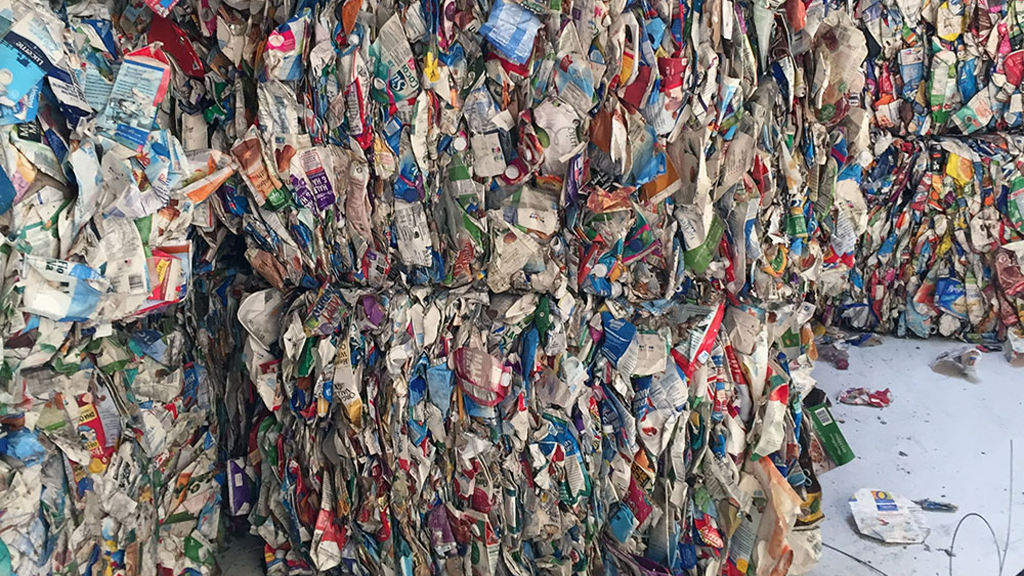

AF&PA survey shows decrease in recovered paper consumption
Data across industries indicates a 4% reduction in recovered paper use, with overall paper production shrinking by a similar margin

The American Forest & Paper Association (AF&PA) released its 66th Annual Paper Industry Capacity and Fiber Consumption Survey. The report provides detailed data on U.S. paper industry capacity and production compiled by the AF&PA statistics team.
Though U.S. paper and paperboard production declined 3.7 percent in 2025, to 66.3 million tons, several sectors showed continued resilience. Containerboard operating rates held firm at 91.9 percent, while printing-writing operating rates improved to 82.8 percent, reflecting continued capacity adaptation to changes in demand. Packaging paper production increased 1.7 percent, boxboard production was essentially flat at 12.4 million tons, and tissue production remained near 7.8 million tons.
Overall fibre consumption used to make paper and paperboard products in 2025 decreased by 3.5 percent compared to 2024. Wood pulp decreased by 3.2 percent, and recovered fibre decreased by 4.0 percent.
Several market factors and industry trends are responsible for the shifts in recovered paper fibre use. Despite the reduction in recovered fibre use, the paper packaging industry has continued to champion the material as sustainability continues to trend with consumers.
"This year's survey underscores the scale of the U.S. paper manufacturing industry and the essential role it plays in the economy," said Heidi Brock, president and CEO of the American Forest & Paper Association. "Even as some grades face market pressure, manufacturers are investing and aligning capacity with demand, maintaining solid operating performance and continuing to compete."
"U.S. mills continue to produce the packaging, tissue, and other paper products that people and businesses rely on every day," said Brock. "The data shows an industry that continues to operate at significant scale, adapt to changing market conditions, and serve strong demand for fibre-based products."
Containerboard capacity
Containerboard production fell 4.4 percent to 36.1 million tons, and containerboard capacity declined 5.1 percent in 2025. Despite that reduction, containerboard continued to account for more than half of total U.S. paper and paperboard capacity, and mills maintained a 91.9 percent operating rate.
Printing-writing paper capacity
Printing-writing capacity fell 13.9 percent in 2025 to 7.7 million tons. Capacity has fallen from nearly 18 million tons in 2015, reflecting a long-term adjustment in this segment. However, operating rates for Printing-Writing increased from 76.8 percent in 2024 to 82.8 percent in 2025.
Tissue production declined 0.8 percent in 2025 to 7.8 million tons, underscoring the essential role tissue continues to play in the industry's product mix. Over time, tissue has also represented a growing share of total U.S. paper and paperboard capacity.
What is capacity?
Capacity is the tonnage of paper, paperboard, or pulp that could be produced with full use of equipment and adequate supplies of raw materials and labour, assuming full demand.
AF&PA's Capacity Survey details U.S. industry capacity data for 2025 and 2026 for all major grades of paper, paperboard, and pulp, as well as fibre consumption. It is based on a comprehensive survey of U.S. pulp and paper mills. It includes production data for 2025.
AF&PA data represent about 87 percent of the U.S. paper and paperboard industry capacity, with estimates completing the data set.
Company info

1101 K Street, NW, Suite 700
Washington, DC
US, 20005
Website:
afandpa.org
Phone number:
202-463-2700