
Inside the process of recycling ocean plastics, fishing gear, and marine debris
How Ocean Legacy is turning some of the world’s most difficult plastic into a circular economy
Picture a buoy that has been drifting in the Pacific Ocean for 40 years. It left a fishing vessel on the other side of the world sometime in the 1980s, rode the currents across the ocean, weathered decades of UV radiation, saltwater, and barnacles, and finally washed up on a beach on the coast of British Columbia, Canada, its origin and composition mostly a mystery.
Many recyclers wouldn't touch it, but Ocean Legacy specializes in what few others do: recovering plastic ocean pollution — abandoned buoys, nets, and ropes that accumulate on coastlines — and engineering it back into something useful. It's the kind of waste that most facilities turn away, but Ocean Legacy's Steveston Harbour location is built for exactly that.
Everything, everywhere, all at once
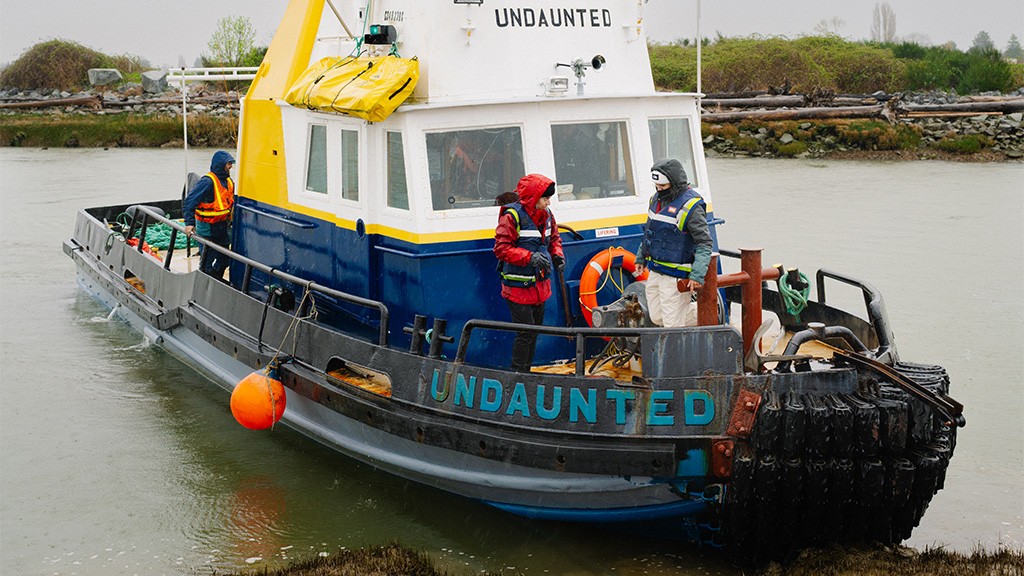
What's immediately apparent about Ocean Legacy's model is its scope. Material arrives from three streams simultaneously: a network of seven Ocean Plastic Depots built alongside landfill sites so communities have a natural drop-off point; directly from the fishing and aquaculture industry, whose end-of-life gear would otherwise have few options beyond the landfill; and the organization's own cleanup crews, who go out on boats to recover debris directly.
"We get reported to from a wide variety of sources," says Josh McLean, director of product and business development at Ocean Legacy. "We have connections with BC Ferries, Western Canada Marine Response Corporation, and we've got our own geographic information system folks who are combing satellite images. We've got a whole reporting system online as well, so between all of those, you can get a good idea of where there's buildup and accumulation."
McLean notes that over a decade of operational experience has also given the team an intuitive map of the coastline, as certain areas consistently accumulate debris year after year. That knowledge has become an asset in itself, complementing the satellite data and reporting networks.
The hardest plastics to recycle
Fishing gear is about as far from a tidy, single-stream plastic as you can get. A single rope can contain more than one polymer type. Saltwater exposure, UV degradation, embedded sand, and chemical residues from fuel and antifouling coatings all complicate processing in different ways at different stages. These are precisely the characteristics that cause most recyclers to pass on marine plastic entirely.
"We've done a lot of training and education as far upstream as we can," says McLean. "We do specific training with the shoreline, ocean, and marine industrial cleanup groups, like how it needs to be prepared and sorted, and try to push that as far forward in the process as possible so that once it lands here at the recycling facility, it's 98 percent done."
McLean breaks incoming material into two broad categories: hard, rigid plastics — barrels, buoys, buckets — and fibrous materials like rope and netting. By volume, fibre dominates. The most common rope material is relatively consistent: polypropylene, usually in a recognizable teal or turquoise colour. Ocean Legacy has processed millions of pounds of it. But rope can also contain woven strands of different polymers, and those blended materials can cause problems downstream.
When it comes to material identification, the facility has a near-infrared scanner for ambiguous cases, but McLean says they also mix technology with old-school methods.
"With buoys, we'll bounce them off the concrete, and if it's a lower-pitched thud, it's more likely to be polyethylene," he says. "And if it's kind of a higher-pitched ting, it's more likely to be acrylonitrile butadiene styrene (ABS)."
Buoys present a particular challenge since their spherical shape and thick walls actively resist processing equipment.
"It's the toughest to work with them in a lot of ways because the shape means teeth on a grinder are not going to want to catch and actually chew it up," says McLean. "It's hard to tell just by looking at them from the outside how thick they're actually going to be, so sometimes you start trying to claw into them, and it's an inch and a half thick of rock-hard ABS. That'll dull the blades on the grinders pretty quickly."
The team has found creative workarounds like repurposing intact buoys as planters and art installations, with the ABS fraction largely getting diverted to upcycling rather than mechanical recycling. The buoys that do get recycled go through the grinder and ultimately become pellets.
From ocean to extruder
The journey from incoming waste to finished pellet involves several distinct stages, each with its own processing challenges. Materials like rope and netting first go to a specialized shredder designed for fibrous material, capable of handling mooring lines up to five inches thick and whole sections of net. The output is a coarse, straw-like material roughly one to six inches in length.
Shredded fibre is extremely light and fluffy — too low-density to feed efficiently into an extruder — so it goes through a densifier, which applies heat and compression to produce a compact, workable feedstock.
"Densifying it is a necessary middle step," McLean explains. "It allows the extruders to get higher throughput."
Hard plastics follow a different path: they're shredded, then put through a wash line — a large float-sink tank combined with a friction wash — followed by a dryer. The float-sink stage does double duty, both cleaning the material and helping separate plastics by density. Everything then feeds into the extruder, which runs the melt through a stainless steel mesh filter to catch any remaining contaminants or metals before the material is pelletized.
The facility currently produces finished pellets, regrind, and densified crumble, with the latter offerings going to downstream partners who do their own extrusion — a flexible model that keeps material moving efficiently through the supply chain while pelletizing capacity continues to scale.
Legacy Plastic
Once pelletized, the end product is Legacy Plastic, Ocean Legacy's branded recycled plastic resin, which falls into three grades — used marine gear, shoreline plastic, and ocean-recovered material — and is sold in bulk to manufacturers for use in finished goods.
A well-established application is Legacy Plastic Lumber, which mirrors the standard dimensions of conventional lumber, as well as fence posts and parking curbs, distributed through CORE Landscape Products on Vancouver Island and beyond.
On the industrial side, Legacy Plastic also underpins a growing network of manufacturer partnerships working toward a closed-loop circular economy. One of these is with Sæplast Americas, which manufactures the insulated fish totes found throughout the commercial fishing industry.
Ocean Legacy collects end-of-life totes from industry partners, processes them into Legacy Plastic pellets, and ships those pellets to Sæplast's facility in Saint John, New Brunswick, where they go back into production as new totes. The same product is effectively remade from its own recovered material.
"It's like voluntary EPR, basically," says McLean. "If we could do that with every original manufacturer in this space, that would be the dream. We've got a couple of million pounds of rope just in this yard. If we can recycle that and get it made back into rope, that's true circularity, right? And that's how we view it: giving companies the opportunity to take part in the circular economy and to redesign their products for improved end-of-life management."
Education, policy, infrastructure, and cleanup
Ocean Legacy's approach to the broader problem of marine plastics is captured in a four-pillar framework the organization calls EPIC: Education, Policy, Infrastructure, and Cleanup.
Together, the four pillars are designed to address plastic pollution at every stage, preventing it at the source, removing what has already accumulated, and building the systems needed to keep recovered material out of landfill and in circulation.
Education equips people with the knowledge to act. Policy shapes the systems that govern how plastic is managed. Infrastructure builds the physical and technological capacity to process what's recovered. And Cleanup does the immediate, hands-on work of getting plastic off shorelines and out of ecosystems.
One of the underlying questions driving it all, McLean says, is how to make people who don't live near the ocean care about what happens to it. It's a harder problem than it might seem.
"With ocean plastics, no country specifically wants to take ownership of it. When it's on a shoreline, it's a little more cut and dried," says McLean. "But a lot of the stuff that's washing up on coastlines is coming from the wild west that is the Pacific gyres — any of the ocean gyres. So how do we prevent that from getting out there in the first place?"
The absence of clear ownership over plastic pollution makes it a uniquely difficult problem to solve. What Ocean Legacy has understood and built its entire model around is that the most durable solution is utility. Whether it's a fish tote made from last season's recovered gear or a fence post that was a fishing net not long ago, these products demonstrate that the material has value, that the loop can be closed, and that recovered ocean plastic has a place in the supply chain.
For communities, the most immediate and visible benefit is simply cleaner shores. But McLean argues that where the material ends up matters too.
"They've got somewhere to take it that doesn't feel like an anti-climax," he says. "If you go and spend a weekend with your neighbours and your kids, and you go out and you clean up your beach, and then all you do with that is just take it to the landfill, it doesn't really feel like a huge win. It's just moving a problem from one place to another. The more of it that you can actually get recycled and put back into the circular economy, the better."
This article originally appeared in the May/June 2026 issue of Recycling Product News.