
Five actionable insights on flexible plastic recycling challenges
The Alliance to End Plastic Waste identified critical areas to simplify flexible plastic recycling systems across Europe and North America
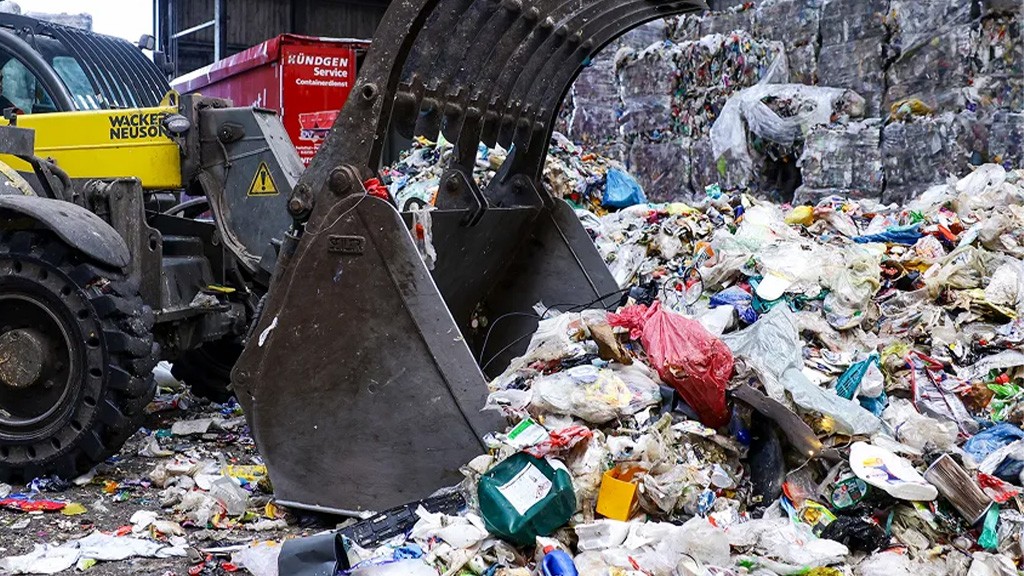
The Alliance to End Plastic Waste's report on "The Challenges and Solutions for Flexible Plastic Packaging Waste" offers actionable insights on how to solve the flexible plastic waste challenge in Europe and North America.
The report identifies five critical circularity enablers for flexible plastic:
- Improving collection and sorting to obtain homogenous high-quality recycling feedstock, achievable through segregated waste collection and granular secondary sorting that deploys advanced detection technologies such as digital watermarking and AI-based recognition.
- Enabling end-market demand for recycled material to drive systems viability and justify investment throughout the value chain. This can be facilitated through policy mechanisms such as Extended Producer Responsibility (EPR) schemes and mandatory Post-Consumer Recycled (PCR) content targets.
- De-risking investment to attract the capital necessary for infrastructure upgrades, through policy levers such as corporation tax relief, labour and energy subsidies, and concessional loans.
- Establishing design-for-recyclability guidelines to harmonise material choices and reduce complexity and barriers to recycling.
- Eco-modulated EPR fees to accelerate the adoption of simpler packaging design by rewarding packaging that is both recyclable and cost-efficient to process.
The Alliance drives systemic change for flexible plastic
As it implements its Strategy 2030, the Alliance is focused on collaborating with governments, development finance institutions, and other co-funders to launch large-scale integrated programmes in clearly defined geographies or thematic areas. Its "Flexibles Thematic Program" in Europe and North America seeks to improve the circularity of flexible films.
The Alliance's Flexibles Program adopts a three-part approach:
- Market mapping and system design that quantifies end-market opportunities and quality requirements.
- Showcasing demonstration projects to build confidence in systems solutions — key to subsequent scaling and geographic expansion.
- Enabling replication by mobilising brands, recyclers, and governments to create and proliferate effective systems solutions across geographies.
In addition to the Flexibles Program, the Alliance is also developing Country-Specific Programs in Brazil, Indonesia, India, South Africa, and in states of the Gulf Cooperation Council. Country Programs are intended to help countries move up the plastic recycling maturity curve in line with national priorities.
Jacob Duer, president and CEO at the Alliance said, "Delivering materials circularity for flexible plastics is complex but achievable. Solutions to improve the end-of-life management of plastic products already exist. Combined with industry action and regulatory momentum, there is a real opportunity to improve the rate and quality of flexible films recycling in an accelerated timeframe."
"The Alliance to End Plastic Waste will focus on demonstrating solutions that deliver systems change. Driving this will require coordinated action across the system, including identifying clear end-market opportunities for recyclates. In turn, this will make a viable business case for the investment necessary to evolve infrastructure for collection, sorting, and recycling."