
6 benefits of baler redundancy for high-volume recycling operations
Maintain productivity during baler maintenance, equipment downtime, and sudden increases in material volume
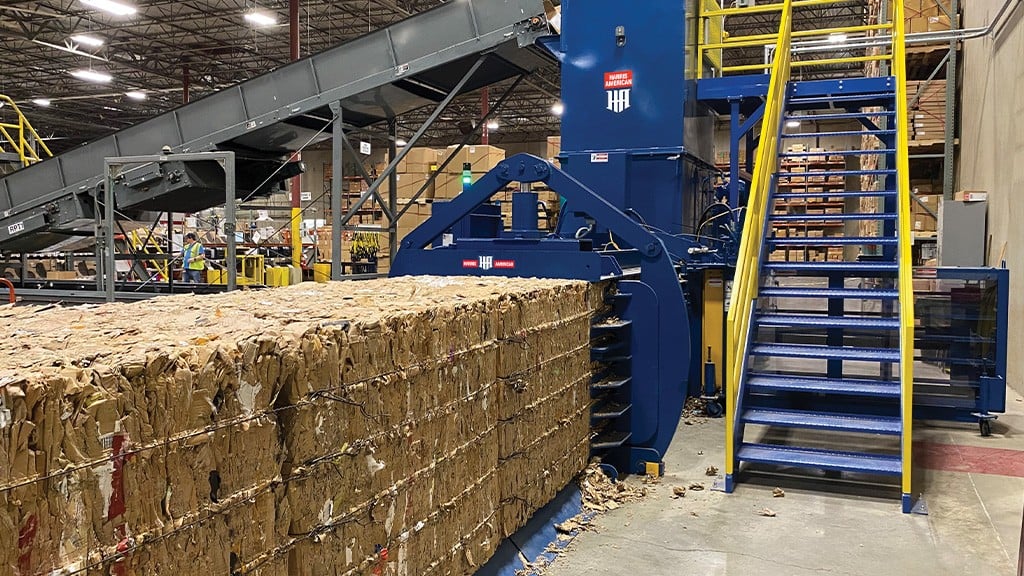
In a busy MRF, an unexpected baler outage can be chaotic, with lines backing up, trucks waiting, and crews hustling to keep things moving. Storage limitations heighten that pressure, since many MRFs don't have the bunker space to hold material while repairs are made.
Extended downtime can also force operators to divert material to other facilities, which adds transportation costs and introduces a more serious threat: suppliers permanently sending material elsewhere.
Redundant baler capacity is a strategic tool that helps maintain steady throughput, manage operational risks, and unlock efficiencies that a single line can rarely achieve. With backup machines in place, plants can handle maintenance, unexpected issues, or surges in material without sacrificing productivity.
I caught up with D.J. VanDeusen, president of Harris American Company, to discuss why baler redundancy has become an essential part of MRF optimization, rather than a luxury.
1. Protection against shutdowns
The most obvious benefit of baler redundancy is insurance against downtime. When a facility relies on a single baler line, any extended outage can bring production to a standstill.
"Depending on the storage space available, material may need to be diverted to an alternate location, which is a costly option and opens up the risk of the supplier electing to bring the material to another processor," says VanDeusen.
Once trucks are redirected, even temporarily, suppliers may choose to stay with another processor. Redundant baler capacity helps facilities avoid that scenario altogether by allowing production to continue while repairs are made, keeping material on site and moving through the system.
2. Fewer headaches from material changeovers
Single-baler facilities that handle multiple grades can feel the impact of changeovers more than they realize. "When the baler is in operation in facilities where multiple grades or types of materials are processed, there are inefficiencies associated with the material switch-over times," says VanDeusen.
Each change requires operators to pause production, clear material, and reset the system — interruptions that ripple upstream. Over the course of a shift, that lost time can eat into overall throughput. Redundant balers help smooth out those disruptions.
3. Simplified maintenance and parts management
"Having two identical machines can provide a tremendous amount of value," says VanDeusen. "Operators know the machine well; one set of maintenance parts can serve both machines, and the downtime can be handled by the other machine."
This standardization reduces response time during repairs and allows technicians to develop deeper expertise with the equipment.
4. Stronger preventive maintenance programs
Redundancy makes preventive maintenance easier to execute. "Being able to run a true preventive maintenance program is more palatable to the operations team because they don't have to stop doing what they're doing," VanDeusen says. That approach greatly reduces the likelihood of downtime.
5. Flexibility across materials and bale sizes
From a redundancy perspective, two-ram balers often provide the greatest value. Their ability to handle a wide range of materials and bale sizes makes them well-suited to redundancy-focused layouts and allows operators to adapt quickly when conditions change. This versatility strengthens redundancy by ensuring either baler can step in without limiting material options.
6. A clearer view of true operating costs
When it comes to baler redundancy, many operators struggle to justify the upfront capital investment required for more than one baler. VanDeusen says this is often driven by an incomplete view of downtime costs.
"The true cost of being down is sometimes hard to quantify. The lost revenue of production is only a piece of this equation," he says. "The inefficiencies of running a multi-grade facility with one baler, the cost of unexpected redirection of tons, and the possible loss of supply if tons have to be redirected all must be considered in the baler purchase decision."
Planning for baler redundancy
For baler redundancy to be effective, infeed conveyors must be designed to feed either baler with the full volume of material. Without that flexibility, redundancy exists on paper but not in practice.
"The design of the MRF needs to ensure that infeed conveyors to each machine can handle all of the material available to allow for maximum redundancy protection," says VanDeusen. "Having multiple balers, but each targeted for specific grades or types of material, limits the redundancy effect of having more than one baler."
When the decision to add redundancy is driven by high volumes of the same material, using two identical balers can be highly beneficial. Operators are already familiar with the equipment, a single set of maintenance parts works for both machines, and any downtime — whether planned or unexpected — can be managed by running the other unit.
For MRFs focused on resilience and long-term optimization, baler redundancy offers control: control over uptime, control over material flow, and control over customer relationships. That control can be the difference between reacting to problems and staying ahead of them.
This article originally appeared in the January/February 2026 edition of Recycling Product News.