
Pilot program confronts construction's plastic problem
Light House demonstrates the viability of a circular economy for plastic construction waste
As Metro Vancouver braces for the closure of its landfill within the next seven years and rising tipping fees put pressure on contractors, a new pilot program from Light House is drawing attention to one of construction's most overlooked waste streams: plastic.
Light House, a Vancouver-based non-profit focused on circular and regenerative practices in the built environment, launched its Construction Plastics Initiative (CPI) to tackle this growing issue head-on. "The Construction Plastics Initiative was a recognition that . . . almost no attention has been paid to plastic waste generated by the construction sector," says Gil Yaron, managing director of circular innovation at Light House. "We wanted to investigate the scope of plastics coming from construction and demonstrate the potential for converting plastic from a waste into a resource."
The construction sector's hidden plastic problem
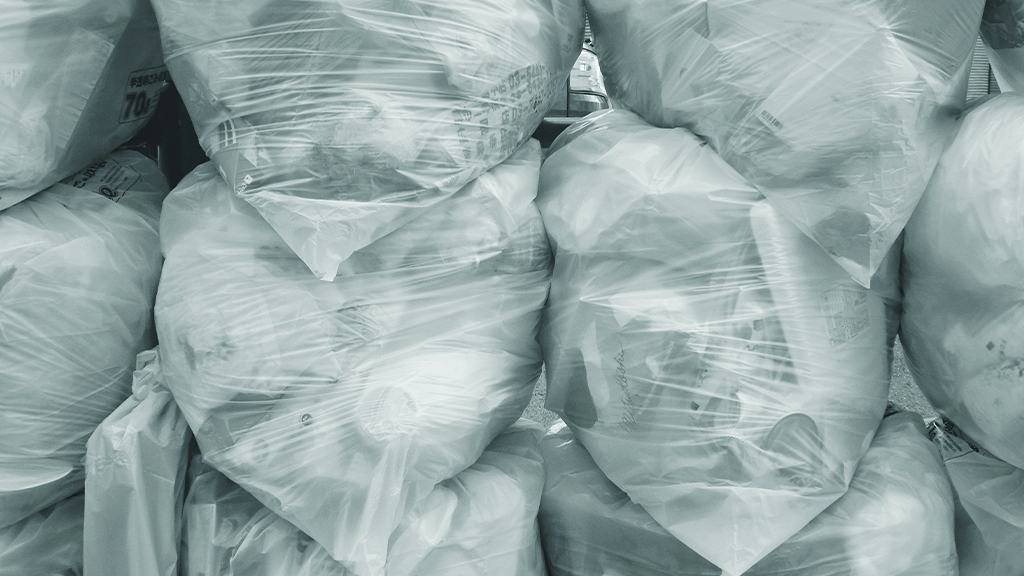
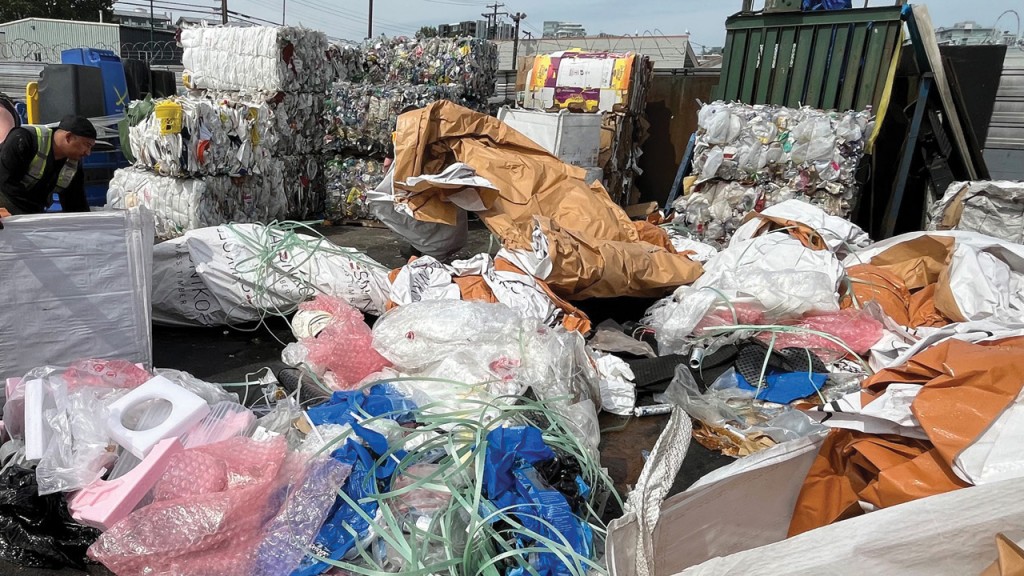
While construction waste is widely acknowledged as a significant contributor to landfills, accounting for roughly 40 percent of landfill volume in Metro Vancouver alone, plastics have largely been overlooked in favour of higher-profile materials, such as concrete and steel. Much of this plastic waste comes in the form of protective packaging: plastic film, wrappings, and tarps used to transport new materials to site.
"Up to this point, there's been virtually no awareness about plastics in the construction sector," explains Yaron. "Certainly no awareness of the magnitude of the amount being generated." Without intervention, that plastic either ends up buried on-site or sent directly to landfill.
Closing the loop on the job site
The CPI is testing a closed-loop system to capture and reuse construction plastic. For this pilot project, Light House will engage with ten high-profile Metro Vancouver projects, including the PNE Amphitheatre (Freedom Mobile Arch) with EllisDon and the Steveston Community Centre and Library with Scott Construction. Participating sites are required to separate all plastics at the source into dedicated bins.
From there, the material is collected and processed into plastic pellets. These pellets are then purchased by Plascon Plastics and used as feedstock for InfinaNet, a proprietary concrete void system from Infina Technologies that displaces 30 percent of concrete in slab floors.
"Suddenly this plastic, which everyone thinks is a waste product, has value," says Yaron. "We are . . . reducing the amount of virgin material that's required. We are eliminating waste from the construction sector. And we are putting it back into the system. Circular economics in action."
Making it easy to do the right thing
Recognizing that construction timelines are tight and change can be disruptive, Light House designed CPI to minimize interference. A site monitor works directly with the contractor's lead supervisor, and Light House coordinates bin pickup and downstream logistics.
"We provide a turnkey service . . . it's really easy," says Yaron. "Aside from the extra room for the bin, there shouldn't be much disturbance to the site's day-to-day operations."
Yet the benefits extend well beyond waste diversion. The program also generates valuable data. By tracking the type and quantity of plastics collected, CPI aims to spotlight what has so far remained invisible. This data will inform contractors, producers, and policymakers, especially as Canada's construction sector prepares for the reporting requirements of the federal plastics registry in 2026.
"I think the federal plastics registry is going to make the invisible visible," says Yaron. "Most of the industry is blind to it. It's something that the industry just doesn't want to deal with." Light House strives to ensure that the CPI will represent the most comprehensive effort in Canada to date to understand the scope and impact of plastic waste on construction sites.
Scaling circularity and raising the bar
By demonstrating that plastics can be separated, processed, and repurposed without disrupting job site operations, CPI is building a case for industry-wide change by showing that circularity is achievable on real-world construction job sites. And while the volume of waste currently captured by the program is small, the infrastructure and the market already exist to scale.
"This is the beginning," says Yaron. "We have the capacity to manage most plastics coming off the sites on this project. Once we establish the viability of this, and if policy follows that requires the sorting of all plastics, there is capacity. Other plastic processors can handle this material."
He also noted that the construction sector could eventually benefit financially. As with other post-consumer materials, such as PET bottles, plastic waste from construction may one day have a market value high enough to generate revenue. For now, CPI operates on a cost-neutral basis.
"At this point, [contractors] are doing it because they see the problem, they want to help, and it [doesn't cost] them," says Yaron. "At scale, they could actually be making some money."
From downstream to upstream
While CPI is focused on end-of-life plastic, it's already raising bigger questions about the materials entering job sites in the first place. Yaron hopes the program's findings will encourage contractors to pressure suppliers into reducing or rethinking plastic packaging. He says the next phase of the conversation is clear: it's time to look upstream.
"That is the upstream generation of plastic in the first place . . . Once we show the world the crap that's coming out of the tail end, then we say, okay, this is where it's coming from," he says. "Let's get the big construction companies to have conversations with their suppliers."
Ultimately, it's a call for extended producer responsibility in the construction supply chain. It's a call for a system where manufacturers design out excess packaging and also take ownership of the waste they create.
It is also estimated that 10 to 15 percent of all materials brought on site are wasted. "Contractors also need to embrace new technologies that allow them to plan better to reduce the amount of waste resulting from over purchasing materials and construction errors that generate plastic waste unnecessarily."
"Suppliers should be taking back their materials," adds Yaron. "Just like return programs for pallets or packaging in other industries, we need to rethink what responsibility looks like in construction."
Rethinking the role of buildings
For Yaron and the Light House team, circularity is just one piece of a broader vision for the built environment.
"Our mission is to build smarter by reducing materials used in construction and eliminating waste in the built environment," he says. "And to develop buildings that support the health and well-being of their occupants."
That means changing how buildings are designed, what materials go into them, how they're used, and what happens when they reach the end of their lifespan.
"We need to start viewing waste as a resource," Yaron says. "It's not just about building a structure. It's about how this structure interacts with our environment."
From site separation bins to reclaimed plastic pellets, the Construction Plastics Initiative is showing that circular construction isn't just a theory; it's a practical, scalable, and increasingly necessary evolution of the way we build.