
What does it take to be Recycler of the Year?
Richard S. Burns & Co. combines transparency, TOMMYcarts, and RCI certification to stay ahead in C&D recycling
Richard S. Burns & Co. built its business on doing things the right way long before LEED points, zero-waste targets, or third-party certifications became standard in construction and demolition (C&D) recycling.
Since the 1960s, the Philadelphia-based company has grown from a one-man cleanout and hauling operation into a full-scale C&D recycling facility capable of processing up to 1,500 tons of material every day. The company also offers a dumpster service supported by its own fleet of trucks for efficient pickups and deliveries.
Earlier this year, the Construction & Demolition Recycling Association (CDRA) named Richard S. Burns & Co. Recycler of the Year, recognizing leadership in material diversion, innovation, and industry progress. But what does it really take to earn that title?
1. Advancing business operations that result in increased recycling percentages
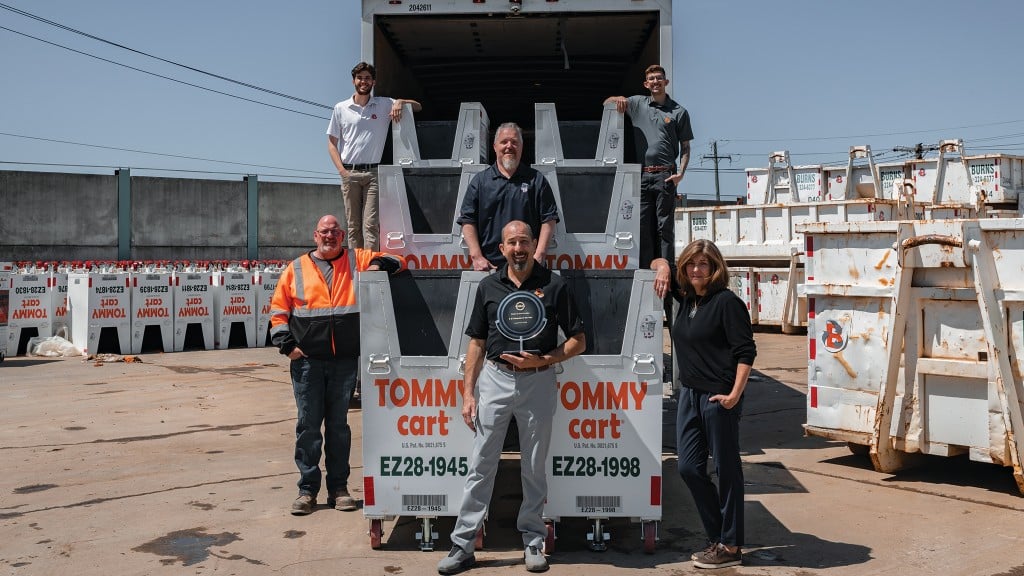
One of Richard S. Burns & Co.'s standout innovations is the company's TOMMYcart system, a barcoded cart-based collection method that allows for precise tracking, clean collection, and enhanced diversion analytics.
Here's how it works:
-
The company delivers barcoded TOMMYcarts to construction or demolition sites to collect commingled recyclable materials.
-
Commingled materials are placed directly into the carts by workers on site. Full carts are collected and transported to the recycling facility in standard 26-foot box trucks. A set of 21 TOMMYcarts can replace a traditional 30-yard dumpster.
-
Upon arrival, the barcode on each cart is scanned to identify the job site, linking each commingled load to its origin for job-specific reporting.
-
A Richard S. Burns & Co. employee hand sorts the contents into scaled bins for specific recyclable materials like wood, metal, or drywall.
-
The weight of each recovered material is recorded and linked back to the original ticket using the cart's barcode data.
Transparency is a core tenet of Richard S. Burns & Co., especially when it comes to diversion rates. The company achieves up to 90 percent diversion on its TOMMYcart line for new construction projects by using a sorting method that challenges today's industry norms.
While most facilities have shifted toward automation, Richard S. Burns & Co. has doubled down on manual sorting. After trying conveyor systems in the 1990s, they found that as they pushed more material through, recovery rates dropped and contamination rose — so they returned to hand sorting.
"You're destroying the material, and then you're trying to get clean material. The analogy is kind of like you're making beef stew and then trying to get a sirloin at the end. It's just not going to work," says owner Allen Burns. "Our cardboard got so dirty we could barely sell it. We almost had to pay to get rid of it. And our plasterboard just turned to dust."
The process proved inefficient. Contamination stayed high, and materials were often handled more than once, adding unnecessary cost and complexity.
"After a long enough period of time — and I'm a slow learner, so maybe 20 years — we said, hey, rather than buying all this equipment, just sort it on the ground," says Burns. "We did so much better."
That decision led to the development of a manual ground-sorting system using "Sortie Carts" — bins reminiscent of giant wheelbarrows, which are moved directly to the appropriate piles for processing. Burns says this approach has resulted in a contamination rate as low as four percent.
2. Developing novel methods of marketing and conducting business
The TOMMYcart line at the Richard S. Burns & Co. facility recently earned Recycling Certification Institute (RCI) certification, making it the first company in Pennsylvania — and one of the first in the U.S. — to do so. RCI certification is becoming increasingly important for recyclers working on LEED projects, especially under the newest v5 standard.
To earn a credit under LEED v5, a project must use a recycling facility certified by a third party. RCI provides independent verification of diversion rates through strict reporting protocols, transparent data tracking, and on-site evaluations.
Promoting the TOMMYcart system has involved more than launching a new product — it has meant shifting a mindset. "It's a cultural change for customers. Going from dumpsters to carts, it's a whole different concept," says Burns. "It took us probably about a year to get some of our customers educated and trained on how the carts work versus dumpsters. It's a little bit more involved."
Burns views RCI certification as a way to distinguish the company in the market, using it both to build credibility and as a key selling point. Being RCI certified gives them an edge, supporting diversion claims and appealing to customers seeking an extra point on LEED projects.
Burns isn't shy about sharing his perspective on current C&D recycling reporting. In his view, much of the system still relies heavily on trust rather than independent verification. He notes that some recyclers have shifted responsibility to customers for separating materials instead of building more robust sorting systems.
"If you're going to teach your customer how to separate the stuff, what does he need you for? He can just go to the cardboard guy or the iron guy directly. You're supposed to bring that expertise to the table," says Burns.
Burns is working to prove that high recovery rates and traceability can be achieved without outsourcing the job, and sees TOMMYcart's RCI certification as the first step toward wider standardization in C&D recovery. By digitizing and barcoding more of the facility's operations, he plans to certify additional processes, like the Sortie Carts, and eventually the entire facility.
Rather than building a national footprint alone, the company is looking to partner with like-minded recyclers who want to adopt the system. TOMMYcarts have recently been deployed at Rockwood Sustainable Solutions (TN), Michael Brothers Hauling (PA), Economy Disposal Service (IL), and Recon Services (TX), with interest from other major U.S. markets. Burns hopes this will push the industry away from visual reporting and toward more verifiable diversion tracking, redefining what responsible recovery looks like in C&D recycling.
4. Creating innovative practices in employer-employee relations
This focus on accountability and quality also extends to how the company manages its workforce. "We have a hundred people here, and we treat everybody like family. We've got guys that have been here 35 to 38, or maybe even more, years," says Burns. "There's not much attrition here. When people come aboard and they're good, and if they don't get fired, very rarely do we get people who want to leave."
Many employees have worked at the company for decades, moving up from entry-level sorting roles into skilled trades like welding, mechanics, and construction through in-house training and trade school support. This investment translates into a low-turnover, high-trust environment where employees are empowered to take ownership of their roles.
The manual sort model creates hands-on roles that require skill and accountability, making employees a key part of the company's success. With more eyes on the material, there's greater engagement across the board, and employees are directly involved in maintaining both quality and safety.
"We don't micromanage people, and we're not standing over people. You don't have a quota, you don't have to pick so much per hour or anything like that," says Burns. "We understand guys have bad days. Some days they do better than they did the day before. Sometimes they're having a bad week. As long as everything gets done, we're pretty good with it."
5. Protecting the environment
That practical mindset guides how Richard S. Burns & Co. tackles environmental responsibility, focusing on solutions that are effective and sustainable without added complexity. Rather than investing in heavy infrastructure, the company emphasizes simple, durable systems that last.
Many of their TOMMYcarts and other equipment have been in use for over a decade without needing replacement. Built for longevity, the carts reduce waste, conserve materials, and lower the environmental costs associated with manufacturing new equipment.
The facility also operates with a lean fleet of box trucks instead of specialized or oversized vehicles, keeping transportation emissions and fuel use low. Heavy machinery like loaders and excavators is used sparingly.
The TOMMYcart system itself is also designed with emissions in mind: while roll-off containers require large, fuel-intensive trucks, TOMMYcarts are hauled using standard box trucks. This smaller equipment footprint continues inside the facility, where material flow is managed with minimal machinery and greater human oversight.
6. Ensuring safer operations
Design also plays a major role in keeping workers safe. Safety is built into the daily workflow, starting with manual ground sorting. This method allows employees to work at a steady pace, with full visibility and hands-on control over the materials they're handling. Paired with a company-wide focus on consistency rather than quotas, this approach has helped Richard S. Burns & Co. maintain a low workers' comp rate of around one.
That same attention to safety extends to the equipment itself. TOMMYcarts are built with sealed steel to prevent leaks and spills, reflective tape for improved visibility, and floor stops to keep carts stable during loading and unloading. It's designed with daily use in mind, balancing durability with safety to create a system that protects both people and materials.
7. Setting new standards
The company is continuing to develop its processes with the goal of achieving full-facility RCI certification and expanding tracking to its Sortie Carts to match the TOMMYcart system. Richard S. Burns & Co.'s approach combines practical innovation and long-term focus, aiming to scale its systems while maintaining accountability.
The recognition of Recycler of the Year goes beyond a title: it confirms that leadership in recycling can be achieved without sacrificing transparency or care. It's about creating effective systems, sharing results openly, and encouraging higher standards across the industry.
Company info

2501 Chatham Road, Suite 5947
Springfield, IL
US, 62704
Website:
cdrecycling.org
Phone number:
866.758.4721