
ReMA 2025 spotlights policy, technology, and collaboration
How ReMA 2025 addressed the pressures shaping tomorrow’s material economy
ReMA 2025, held this year at the San Diego Convention Center, delivered a dynamic, future-focused convention that underscored the critical role of recycling and manufacturing in a rapidly changing world. Held against a backdrop of policy shifts, technological disruption, and soaring material demand, the event convened industry players, thought leaders, innovators, and advocates to explore what's next for metals, materials, and sustainability. For the more than 7,000 people who attended, it was a week of bold ideas, practical solutions, and meaningful connections. For those who missed it, this recap offers a snapshot of key moments — from big-picture advocacy updates and emerging market trends to groundbreaking tools, technologies, and best practices shaping the future of recycling.
Opening session sets the tone for ReMA 2025
ReMA 2025 launched with an energetic opening session that framed the convention as a call to action for recycling and manufacturing leaders. Chair Amy Cohen spotlighted ReMA's growing clout, noting partnerships with Ford, Toyota, and Samsung, and celebrating the organization's evolution from ISRI into a nationally recognized sustainability voice. Chair Colin Kelly detailed policy wins and advocacy efforts, including legal action against the EPA's PFAS rule and expanded congressional engagement. A standout safety message came from Brian Mack, who recounted surviving a mining accident and championed innovation in injury prevention. The session closed with keynote speaker Jesse Cole, founder of the Savannah Bananas, urging attendees to embrace creativity, boldness, and customer experience to lead in today's marketplace.
Storytelling in the recycling industry
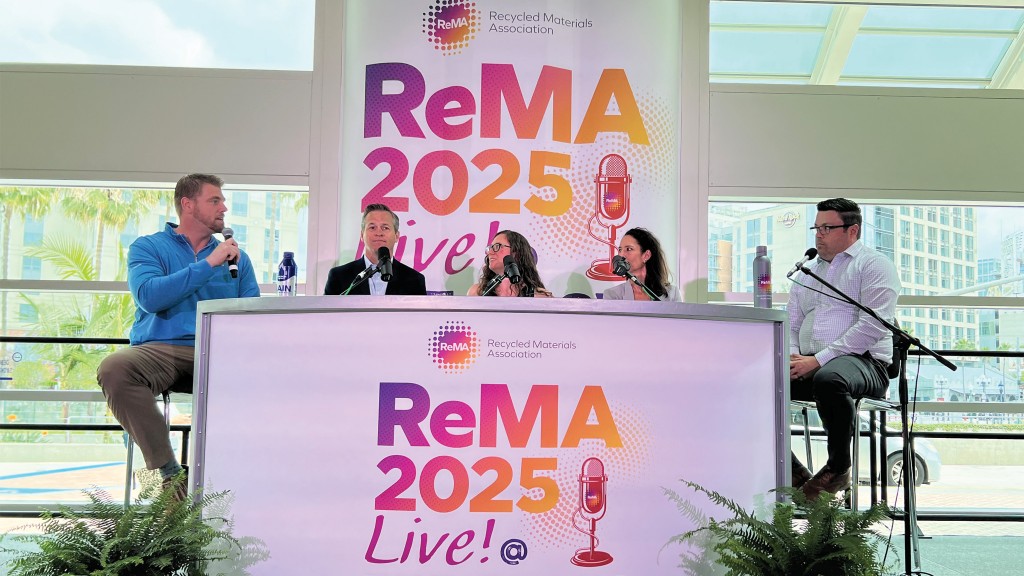
A live podcast-style panel at ReMA 2025 made the case for using storytelling to elevate recycling's image and connect with broad audiences. Panellists included former news anchor John Knicely, children's author Jessica "Scuba Jess" Alexanderson, Novelis VP Beatriz Landa, and Jeff Weld, VP of communications at Casella Waste Systems. They discussed how authentic, data-backed storytelling can counter greenwashing, educate the public, and turn employees into industry ambassadors. From youth advocacy to brand messaging, panellists shared strategies for making recycling more relatable and memorable. Attendees left with actionable tips for building trust and improving engagement through human-centred communication.
Spotlight on paper
This session provided a timely update on the state of paper recycling, including changes to how recycling rates are measured. Terry Webber, VP of the American Forest & Paper Association, explained a move from use-based to supply-based rate calculations to better reflect trade realities. Jeff Ryalls, VP of recycled fibres with International Forest Products, noted that mill conversions and China's import ban have kept more fibre in the U.S. system. Leonard Zeid, president of Midland Davis, introduced ReMA's Fiber Recycling Readiness Tool to assess packaging compatibility with current recycling infrastructure. The session also addressed design challenges posed by the switch from plastic to paper packaging, particularly coatings and formats. Panellists called for continued collaboration to ensure evolving materials are compatible with recycling systems.
Spotlight on copper
Speakers for this panel included Edward Meir, president of Commodity Research Group, Adam Estelle, president and CEO of the Copper Development Association (CDA), and Inge Hofkins, COO of multimetal recycling at Aurubis. The discussion highlighted the complex role of copper in national infrastructure, energy systems, and defence. Copper demand is projected to double by 2035, driven by electrification, AI, data centers, EVs, and energy transitions. However, permitting bottlenecks and limited domestic refining capacity threaten supply. Panellists debated the merits of export restrictions on high-purity copper scrap, with CDA advocating for them to strengthen domestic supply and ReMA opposing them on principle. Trade policies, tariffs, and workforce gaps were discussed. Canada was identified as a key trading partner in North America's copper supply chain, with speakers cautioning that shifting tariff policies could disrupt cross-border flows and complicate long-term investment planning. The themes of federal support and improved public messaging were underlined as important areas of focus moving forward.
AI innovation in the recycling materials industry
A panel of tech leaders (Drake Hougo, COO at ReMatter, Raghav Mecheri, CEO at Visia, Julian Tauterer, COO at REDWAVE US, and Atilla Widnell, founder and managing director at Navigate Commodities) showcased practical uses of AI in scrap and recycling operations, moving beyond the hype to real-world integration. Panellists highlighted the value of AI applications in material detection, market monitoring, and hazard identification. Use cases included computer vision for sorting, satellite tracking of global smelters, and AI models for detecting batteries and contaminants at MRFs. The session emphasized the importance of customizing AI tools to site-specific needs, integration with quality data and operator feedback, and collaboration between recyclers and developers to ensure AI delivers measurable business value and improves safety and efficiency.
Spotlight on nickel and stainless steel
Panellists for this session included David Miller, president of Cronimet, Atilla Widnell, founder and managing director at Navigate Commodities, Brandon Fleisher, VP at Dominion Nickel Alloys, and moderator, Alberto Xodo from the London Metal Exchange. Discussions were focused on the North American stainless and nickel scrap markets, where stability and uncertainty coexist. U.S. demand remains steady, but Canadian markets tied to automotive manufacturing are more volatile. Panellists discussed trade policy friction, especially under the United States-Mexico-Canada Agreement (USMCA), and its cooling effect on scrap flows and investment. They also addressed how nickel oversupply, driven largely by increased production from Indonesia, contributes to falling prices and market instability, making it more difficult for scrap suppliers and stainless producers to maintain profitable pricing structures. This session highlighted the need for better data, policy clarity, and the ability to pivot quickly to navigate a rapidly changing stainless market.
Spotlight on aluminum
Industry leaders from Novelis, Ford, and CW Metals introduced Vesper, a new specification designed to separate and upcycle the wrought content in Twitch aluminum scrap. With major investments in domestic aluminum recycling, Vesper was presented as a pathway to meet low-carbon material demand while keeping recyclers in the loop. Ford shared its approach to closed-loop recycling for the F-150, and Novelis explained how segregating cast and wrought alloys prevents downcycling and supports alloy-specific reuse. Panellists emphasized that recycler participation is essential and that investments in sorting tech are key. An in-depth audience Q&A that explored challenges facing secondary smelters, the implications of increasing alloy complexity, and how definitions of recycled content are shifting in response to market conditions closed out the session.
Best practices in shredding
Industry veterans Adam Weitsman (owner and CEO at Upstate Shredding) and Jorge Simoes (national shredder operational analyst at SA Recycling) shared practical insights and hard-learned lessons from their extensive experience managing shredder operations across the U.S. From fatalities caused by distracted workers to explosions from hidden gas tanks, speakers made a compelling case for strict safety protocols and leadership-led culture change. Topics included lockout/tagout practices, designated walkways, and PPE enforcement. The panel also covered shredder productivity strategies such as full-box shredding and automated feed systems. Maintenance, critical spares, and hiring strategies were discussed, with Weitsman highlighting success in recruiting athletes for their discipline and teamwork. Environmental concerns, inbound inspections, and fire mitigation, especially with lithium batteries, rounded out a session that emphasized vigilance, communication, and data-informed decisions.