
End-of-life truck recycling
The process for recycling Volvo trucks is a model of sustainability
These days, a truck straight off the factory assembly line may not be quite as new as it seems. When it comes to Volvo Trucks, one-third of a newly manufactured vehicle’s total weight consists of recycled metals. The company says their production system embraces the recycling of old trucks, whereby old becomes new in a sustainable process.
At the Volvo Truck Center just outside Göteborg, Sweden, they take in about 30 to 40 trucks per year. At present, just over 90 percent of a scrapped Volvo truck is recycled, down to their last nuts and bolts. When a Volvo FH model is scrapped, for example, more than nine tonnes of various materials are recovered for recycling.
“The biggest advantage of this approach, from both environmental and personal perspectives, is that the materials live on,” says sales representative Mikael Olofsson, as he surveys their workshop and a truck that is about to be stripped down to its smallest components.
A newly arrived end-of-life truck will continue to be useful. Its best parts will be sold on the used vehicle market. All materials removed from the truck that cannot be sold will be put into containers marked separately for iron, aluminium, brass, copper, plastic, combustibles and so on. All parts that are too worn out will be sent away for melting or incineration, to be re-used in the form of new products or for district heating. Nothing goes to landfill. According to Volvo Trucks, they work hard to reduce the company’s environmental footprint, and have applied a carefully thought-out recycling strategy since the mid-1990s.
“We have to consider the environment, our resources and future generations,” says Volvo Trucks’ environmental affairs director Lars Mårtensson. “What is more, there are sound financial reasons for the customer to recycle the truck. We try to aid that process as much as possible, for instance by providing detailed instructions with each truck on how it is to be recycled.”
Every Volvo truck, the company says, is designed and built at the factory to take account of what will happen on the day the truck is withdrawn from service.
“We tailor the technology needed for subsequent dismantling and recycling into the design and production of new trucks,” explains Mårtenssson. “For example, we use plastic rather than metal clips to attach wires and hoses, since metal clips take far longer to remove.”
The materials used are also carefully selected. “The challenge is to balance usage demands against recycling properties. For some purposes, plastics that can be melted down are more suitable than plastics that are incinerated, while for other purposes the opposite applies.”
In terms of weight, roughly 50 percent of the wrought iron used in a new truck comes from recycled metal, while 97 percent of the cast iron is recycled metal. Since it takes less energy to manufacture products from recycled material than from new raw materials, Volvo says the environmental gains are considerable. Moreover, recycling also has financial advantages. If, for instance, there is a shortage of certain metals and prices rise, recycling becomes even more important.
The dismantling workshop
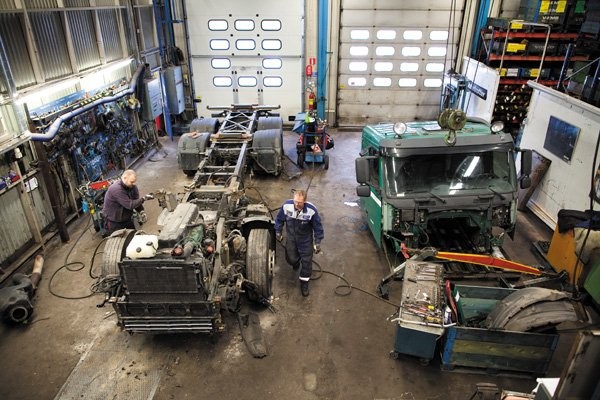
At the Volvo Truck Center in Sweden, a newly arrived Volvo FH 460 Euro 3 is carefully inspected by employees Kenneth Olsson and Jimmy Gustavsson in the dismantling workshop. The truck has covered close to one million kilometres and its active days are now over.
“We’re primarily looking for oil leakage, but we also look for other easily identifiable faults [such as a damaged panel],” explains Olsson.
All dents and rusty panels are marked with a large yellow arrow and the truck’s ID number before the dismantled parts are placed in a container that is also marked with the vehicle’s ID number. Every single part that can be sold must be traceable back to the exact truck model, year and production series.
Simply speaking, the trucks are dismantled from the front to the rear. To take the FH 460 apart, Olsson and Gustavsson have to struggle with the bolts because rust is holding them securely together. The bolts usually need to be heated with a welding torch to get them to work loose. The noise is sometimes deafening.
It takes the team six to seven days to dismantle this truck and clean all the parts that are to be sold.
The cab of this particular Volvo FH is judged to be in good condition. It will be cleaned up and resold. Cabs older than ten years, however, are seldom saved. Instead, they are melted down to make new metal components. Everything on and around the cab is first removed. Olsson attaches a hose to the small refrigerant reservoir and transfers the gas to a cylinder that is carefully weighed to verify that the reservoir has not leaked.
“Draining off the refrigerant is perhaps the most important part of the whole dismantling operation, because it is so environmentally hazardous,” explains Olsson.
The toxic-green glycol and engine oil drain off into two containers placed below the vehicle. All environmentally hazardous fluids are poured into sealed tanks that are put in the yard outside and will later be sent for destruction.
After the cab has been lifted off using a roof-mounted traversing crane, all its interior fittings are removed. Seats, steering wheel, wall and roof panelling as well as all electronic components are removed and sold individually, if they are in good enough condition. The rest is recycled.
When the cab is done, it is time for the gearbox to be removed, followed by the truck’s 12-litre engine. “We often send gearboxes and rear axles for renovation, but engines are often regarded as too expensive to rebuild. Instead, we clean them thoroughly,” says Olsson.
Calculating the results
According to Volvo Trucks’ Environmental Product Declaration calculator, a recycled truck reduces carbon dioxide emissions by just over four tonnes. This is because of the now widely accepted fact that it takes less energy to manufacture new products from recycled materials than from entirely new raw materials.
If a Euro 3 truck were replaced by a Euro 5 truck that consumes almost eight percent less fuel, particulate emissions would also be cut by 80 percent. Moreover, the more modern truck would release 86 tonnes less carbon dioxide during its lifetime than its older counterpart.
This corresponds to more than 20 return air trips between Stockholm, Sweden and Bangkok. A trip of this kind is calculated to produce emissions corresponding to four tonnes of carbon dioxide equivalent. This measurement takes account of the fact that different greenhouse gases have different impacts, and specifies how much carbon dioxide can be emitted to produce the same climate impact as all the other greenhouse gases put together, during the course of a given journey.
The Volvo Trucks Environmental Product Declaration calculator can be found at Volvotrucks.com. Volvo Trucks offers a full range of medium to heavy duty trucks worldwide, with a global network of 3,000 service points in more than 140 countries.